
Podagrion
Spinola, 1811
Podagrion is a of small in the Torymidae that exclusively parasitize (). measure 2–3 mm and possess distinctive hind legs that mimic their mantis , along with elongated ovipositors for penetrating oothecae. The genus exhibits a near- distribution with strongest representation in Afrotropical, Neotropical, and Australasian regions. Podagrion demonstrates complex reproductive adaptations including multivoltine , phoretic oviposition , and frequent sib-mating facilitated by limited .

Pronunciation
How to pronounce Podagrion: /pɔˈdaɡriɔn/
These audio files are automatically generated. While they are not always 100% accurate, they are a good starting point.
Identification
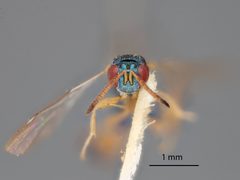
Distinguished from other Torymidae by the combination of: enlarged claw-like hind mimicking mantis legs; elongated ovipositor in females nearly equal to body length; dorsoventrally flattened ; and exclusive association with . The micropilose region on the antennal clava is a diagnostic -rich structure for tactile assessment. Similar in Podagrionini and Mantiphagia share phylogenetic affinity but lack the full suite of morphological adaptations for mantid ootheca .
Images
Habitat
Associated with in varied environments where mantids occur; no specific limitations beyond presence. Females can parasitize oothecae in both newly laid (soft, tacky matrix) and fully hardened (protective foam-like) states.
Distribution
Near- distribution with most documented in Afrotropical, Neotropical, and Australasian regions. P. mantis ranges throughout the Americas. Documented occurrence in Arizona (USA), Bihar and Nagaland (India), New South Wales and Queensland (Australia).
Seasonality
Multivoltine with ≥3 per year and 35-day lifecycle; synchronized with through ( larvae emerging with spring mantid hatching) and oversummering (final-generation larvae delaying development until fall host oviposition).
Diet
Larvae consume developing embryos within , leaving only empty . do not feed on tissue; specific adult feeding habits unreported.
Host Associations
- Stagmomantis carolina - primary most frequently associated
- Stagmomantis limbata - recorded of
- Tenodera angustipennis - recorded of
Life Cycle
Haplodiploid : unfertilized develop into haploid males, fertilized eggs into females. Females deposit eggs externally on individual embryos within oothecal . Larvae consume embryos completely, orienting with ends toward attachment surface (opposite to mantid orientation). Development includes embryonic stage with centrolecithal, anhydropic eggs and superficial cleavage; larval ectoparasitism; within ootheca. Multivoltine with ≥3 /year (35-day cycle) versus mantid hosts. and oversummering stages synchronize with host availability.
Behavior
Males emerge 1–5 days before females and exhibit territorial defense of using enlarged hind legs to dislodge rivals. Courtship involves: palpating ootheca with to detect emerging females; rhythmically tapping quiescent females to stimulate exit; wing-fanning displays with abdominal lifting to produce audible vibrations; mounting with antennal scissor motions over female . Females assess oothecal suitability through rhythmic tapping using micropilose antennal region. Oviposition via mechanical penetration of hardened cases with serrated ovipositor, phoretic transport on female mantids to access fresh oothecae, or recurrent of natal ootheca. Limited promotes frequent sib-mating.
Ecological Role
Significant mortality agent in ; cumulative impact estimated >30% mortality across . Negative correlation between parasitoid rates and successful mantid . of mantid through .
Human Relevance
No direct economic importance reported; potential value in of though not actively utilized.
Similar Taxa
- MantiphagiaShares closest phylogenetic affinity and of , but distinguished by morphological differences in hind leg structure and antennal features.
- Other Torymidae generaMost Torymidae parasitize gall-forming insects or seeds rather than ; lack the specialized hind leg mimicry and extreme ovipositor elongation.
More Details
Chromosomal adaptations
Low genetic rates and reduced numbers (maximum observed 2n=10) may buffer against deleterious effects of regular inbreeding.
Phylogenetic origin
2018 phylogenetic analysis supports monophyletic origin in Palearctic region with ancestral specialization on , followed by to other regions.
Emergence constraints
Each consumes one embryo, limiting to ≤ original count; shared emergence holes complicate efforts. Reported emergence ranges from <10 to >100 adults per depending on oothecal size, host , and multiparasitism frequency.