
Tenodera angustipennis
Saussure, 1869
Narrow-winged Mantis, Japanese Mantis, Korean Mantis
Tenodera angustipennis is a medium-to-large mantis native to East Asia, now established as a non-native species in the eastern United States. First recorded in Maryland in 1921, it has spread to multiple mid-Atlantic and northeastern states. The species exhibits sexual , with males demonstrating mate choice based on female hunger status to avoid . Females produce elongate containing over 100 that overwinter and hatch in spring.
Pronunciation
How to pronounce Tenodera angustipennis: //ˌtɛnəˈdɛrə ˌæŋɡjʊstɪˈpɛnɪs//
These audio files are automatically generated. While they are not always 100% accurate, they are a good starting point.
Identification
Distinguished from the sympatric Tenodera sinensis (Chinese mantis) by its more elongate pronotum, shorter and narrower tegmina, and transparent hind wings with brown patterned streaks rather than fully patterned brown hind wings. When placed side by side, T. angustipennis appears noticeably more slender and less stocky. are elongate (40–60 mm long, ~14 mm diameter) and may be confused with those of Stagmomantis carolina, but hatch approximately 1–2 weeks later than T. sinensis oothecae.
Images
Appearance
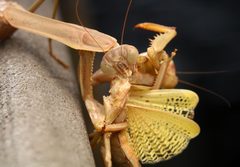
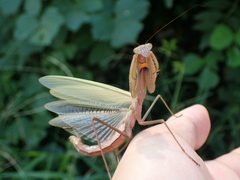
are 65–85 mm in length, with females slightly larger than males. Body coloration is variable, typically brown or green. The pronotum is proportionately more elongate than in Tenodera sinensis. Tegmina and wings are shorter and narrower than those of T. sinensis. Hind wings are transparent with a brown, patterned streak on each wing, unlike T. sinensis which has completely patterned brown hind wings. Overall body form is more slender and less stocky than the Chinese mantis.
Habitat
In its native range, found in grasslands around rice fields and similar open . are deposited on twigs of shrubs, stems of tall herbs, tree trunks, and fence posts—particularly in field margins. In the introduced North American range, occupies similar open and semi-open habitats including gardens, meadows, and agricultural field margins.
Distribution
Native to East Asia: China, Korean Peninsula, Japan (Honshu, Shikoku, Kyushu, Tsushima Island, Okinawa Island), Taiwan, Vietnam, Java, India, Hawaii, and Ulleung-do and Jejudo islands. Introduced and established in the eastern United States: Delaware, Maryland, New Jersey, New York, North Carolina, Ohio, Pennsylvania, and Virginia. First detected in Aberdeen, Maryland in 1921, with published record in 1933.
Seasonality
with in late summer. Adults occur for approximately two months with overlapping sexes. overwinter and hatch in spring when warm weather returns and small insect prey become available.
Diet
consuming a variety of insects and other arthropods. Laboratory studies indicate acceptance of crickets (Gryllus bimaculatus). Specific natural prey composition not documented.
Life Cycle
occurs as within . Each ootheca contains over 100 eggs. Nymphs emerge in spring and develop through multiple instars. emerge in late summer. Juveniles collected in the field in late July to late August in Japan. Adults live approximately 50 days post- under laboratory conditions.
Behavior
Males exhibit mate choice based on female body condition, preferentially approaching well-fed females and avoiding recently starved females that pose higher risk. Males display abdominal bending during female encounters; this behavior is less intensive toward hungry females. Males escape sooner from hungry females, supporting cannibalism avoidance as the driver of male mate choice. Females in poor nutritional condition more frequently locomote toward males. Sexual cannibalism commonly occurs, with cannibalized males often able to complete copulation. Sit-and-wait strategy typical of mantids.
Ecological Role
in terrestrial . Potential agent of pests in its introduced range, though specific impacts not quantified.
Human Relevance
have been used in traditional Oriental and Chinese medicine (as "Mantidis Ootheca") for enhancing male since ancient times. Scientific studies have demonstrated therapeutic effects of ootheca extracts on radiation-induced gonadal in mammals. Occasionally introduced inadvertently on nursery stock and ornamental plants. Non-native in North America result from historical introductions, likely via on imported plants.
Similar Taxa
- Tenodera sinensisOverlapping distribution in North America; distinguished by stockier build, shorter pronotum, longer tegmina, and fully patterned brown hind wings versus transparent hind wings with brown streaks in T. angustipennis
- Stagmomantis carolina sometimes mistaken for those of T. angustipennis; T. angustipennis oothecae are larger (40–60 mm vs. smaller in S. carolina) and hatch later
More Details
Etymology
"Tenodera" derives from Greek meaning "slender neck"; "angustipennis" from Latin meaning "narrow wing"
Male Mate Choice Research
Experimental studies demonstrate that male T. angustipennis distinguish between well-fed and starved females, with behavioral responses indicating active avoidance of risk rather than simple preference for
Female Mating Frequency
Genetic paternity analysis of wild in western Japan revealed females mate with 2–6 males on average before oviposition
Sources and further reading
- BugGuide
- Wikipedia
- GBIF taxonomy match
- iNaturalist taxon
- NCBI Taxonomy
- Catalogue of Life
- Decorations on the Christmas tree: Egg cases of the European mantis, Mantis religiosa, Chinese mantis, Tenodera sinensis, and Carolina mantis, Stagmomantis carolina — Bug of the Week
- Surviving winter, Part III: Egg cases of the Praying mantis, Mantis religiosa, Chinese mantis, Tenodera sinensis, and Carolina mantis, Stagmomantis carolina — Bug of the Week
- Decorations on the Christmas tree: Egg cases of the European mantis, Mantis religiosa, Chinese mantis, Tenodera sinensis, and Carolina mantis, Stagmomantis carolina — Bug of the Week
- Death of a stink bug, Part 1: A curious reunion between the Brown Marmorated Stink Bug, Haylomorpha halys, and the Chinese Praying Mantis, Tenodera sinensis — Bug of the Week
- From the Bug of the Week Mailbag: Non-native mantids, the European mantis, Mantis religiosa, and Chinese mantis, Tenodera sinensis, enjoying North American cuisine — Bug of the Week
- To eat a stink bug, part 1 - A curious reunion, Brown marmorated stink bug, Halyomorpha halys , and Chinese praying mantis, Tenodera sinensis
- Reproductive phenology and female mating frequency of the praying mantid Tenodera angustipennis in western Japan
- Male mate choice in a sexually cannibalistic species: male escapes from hungry females in the praying mantid Tenodera angustipennis
- Transcriptome analysis demonstrating the therapeutic effect of Tenodera angustipennis (Mantidis Ootheca) extracts on radiation‐induced gonadal toxicity in mouse testis