
Amorbia
Clemens, 1860
leafroller moths
Species Guides
7- Amorbia concavana
- Amorbia cuneanum(Western Avocado Leafroller Moth)
- Amorbia emigratella(Mexican leaf-roller)
- Amorbia humerosana(white-lined leafroller)
- Amorbia knudsoni
- Amorbia synneurana
- Amorbia vero
Amorbia is a New World of tortricid moths containing approximately 29 distributed from Brazil through Central America, the Caribbean, Mexico, and into the United States and Canada. Larvae of at least some species are known leafrollers that feed on plants including blackberry (Rubus). The genus has been subject to systematic revision, with eight informal species groups proposed based on morphological characters. Several species are of economic concern as pests of Rubus crops in Mexico.
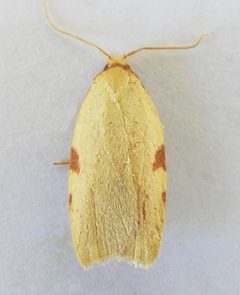
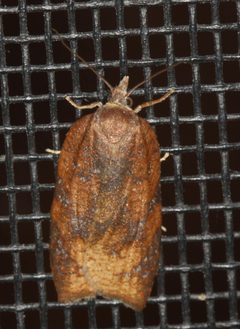
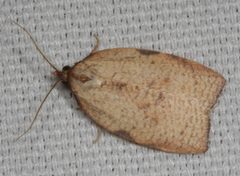
Pronunciation
How to pronounce Amorbia: /æˈmɔr.bi.ə/
These audio files are automatically generated. While they are not always 100% accurate, they are a good starting point.
Identification
The can be distinguished from other Sparganothini by genitalic characters described in the systematic revision. A key to based on male features is available. Species-level identification requires examination of male and female genitalia; the eight informal species groups (Curitiba, Productana, Humerosana, Chiapas, Colubrana, Exsectana, Rectangularis, Decerptana) are defined by shared character states.
Images
Habitat
Greatest occurs at middle elevations (500-1500 m) in Central and South America. Larvae inhabit rolled leaves of plants. In Mexico, Amorbia sp. has been documented in commercial blackberry plantations in Michoacán.
Distribution
Ranges from Brazil through Central America, the Caribbean, Mexico, the southeastern and western United States, and northeastern and southwestern Canada. Specific locality records include: Rica (Puntarenas, Guanacaste), Guatemala (Quetzaltenango), Mexico (Veracruz, Nuevo León, Chiapas, Michoacán, Tamaulipas), Brazil (Paraná, Santa Catarina), Dominica, and Texas, USA.
Diet
Herbivorous. Larvae feed on leaves of plants; specific host plants documented for 12 where stages are known. Rubus sp. (blackberry/zarzamora) is a confirmed host for at least some species.
Host Associations
- Rubus sp. - larval plantblackberry/zarzamora; confirmed for at least Amorbia sp. in Michoacán, Mexico
Life Cycle
Complete with , larva, pupa, and stages. Larval stage is the feeding and leaf-rolling stage. Under laboratory conditions (22 ± 2°C, 60 ± 5% RH, 16:8 h ), egg-larva development has been observed to take approximately 14 days for at least one .
Behavior
Larvae exhibit leaf-rolling , constructing shelters by rolling or folding leaves of plants. This behavior gives rise to the 'enrollador de las hojas' (leafroller) used in Mexican agricultural contexts.
Ecological Role
Human Relevance
Some are agricultural pests of blackberry (Rubus) plantations in Mexico, where they are known as 'enrolladores de hojas.' Natural by has been studied as a management strategy. The Mexican leaf-roller, Amorbia emigratella, is specifically noted as a pest species.
Similar Taxa
- ArgyrotaeniaAlso contains leafroller associated with Rubus in the same regions; distinguished by genitalic characters and systematic placement
- SparganothisMember of same tribe Sparganothini; distinguished by morphological characters and genitalic features detailed in systematic revisions
More Details
Species groups
Eight informal groups were proposed in the 2007 revision: Curitiba (2 spp.), Productana (4 spp.), Humerosana (3 spp.), Chiapas (2 spp.), Colubrana (8 spp.), Exsectana (1 sp.), Rectangularis (3 spp.), and Decerptana (6 spp.). Five species were excluded from Amorbia and assigned to incertae sedis: 'Amorbia' depicta, 'Amorbia' elaeopetra, 'Amorbia' leptophracta, 'Amorbia' rectilineana, and 'Amorbia' teratana.
Taxonomic history
Amorbia revolutana was raised from synonymy, and three new synonymies were proposed in the 2007 revision: A. synneurana with A. cuneana; A. aequiflexa with A. productana; and A. spylocriptis with A. revolutana.
Sources and further reading
- BugGuide
- Wikipedia
- GBIF taxonomy match
- iNaturalist taxon
- NCBI Taxonomy
- Catalogue of Life
- Phylogenetic relationships, systematics, and biology of the species of Amorbia Clemens (Lepidoptera: Tortricidae: Sparganothini)
- Parasitoides asociados a los enrolladores de hojas de zarzamora Argyrotaenia montezumae Walsingham y Amorbia sp. (Lepidoptera: Tortricidae), en Michoacán, México
- PARÁMETROS BIOLÓGICOS DE APANTELES NR. ARISTOTELIAE (VIERECK) (HYMENOPTERA: BRACONIDAE), PARASITOIDE DEL ENROLLADOR DE LAS HOJAS, AMORBIA SP. (LEPIDOPTERA: TORTRICIDAE)