
Bactra
Stephens, 1834
nutsedge borers
Species Guides
6- Bactra furfurana(mottled marble)
- Bactra lancealana(Black-blotched Bactra Moth)
- Bactra maiorina
- Bactra priapeia
- Bactra sinistra
- Bactra verutana(javelin moth)
Bactra is a of small tortricid moths (Lepidoptera: Tortricidae: Olethreutinae) comprising primarily associated with sedges and nutsedges (Cyperus species). Several species have been investigated as agents for weedy nutsedges, particularly purple nutsedge (Cyperus rotundus). Some species have expanded their range to agricultural crops, with Bactra bactrana documented as a pest of sweet pepper in Greece. The genus occurs across temperate and tropical regions including Europe, North America, and Southeast Asia.

Pronunciation
How to pronounce Bactra: /ˈbæk.trə/
These audio files are automatically generated. While they are not always 100% accurate, they are a good starting point.
Identification
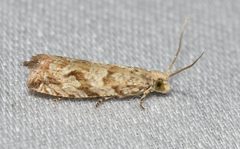
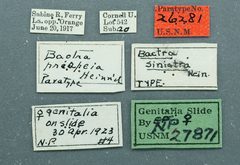
-level identification within Bactra requires examination of genitalia . Male and female genitalia characteristics provide diagnostic features for distinguishing closely related species. External morphology of is generally nondescript with gray-brown to silver-gray coloration.
Images
Habitat
Associated with moist where sedges and nutsedges occur. Includes sedge fields, wetlands, and agricultural areas infested with Cyperus .
Distribution
Widespread across temperate and tropical regions. Documented from Nordic countries (Denmark, Norway, Sweden), North America (including Vermont, USA), and Southeast Asia (Vietnam, Thailand).
Diet
Larvae feed internally on stems of sedges and nutsedges (Cyperus ). Bactra bactrana has been observed feeding on sweet pepper (Capsicum annuum) fruit, representing a documented range expansion.
Host Associations
- Cyperus rotundus - purple nutsedge, primary for biocontrol
- Cyperus species - weedy nutsedges, general association for
- Capsicum annuum - sweet pepper, documented for B. bactrana in Greece
Life Cycle
Complete with , larva, pupa, and stages. Bactra venosana: eggs oval, white turning pale yellow, approximately 1 mm; larvae pass through 5 instars, newly hatched dark yellow; pupae pale green turning dark brown at maturity; total approximately 36 days under laboratory conditions.
Behavior
Larvae are stem borers, feeding internally within plant stems. are laid scattered on host plant surfaces. Feeding damage causes stems to soften, discolor from green to yellow, and eventually wilt and die.
Ecological Role
Several serve as agents for weedy nutsedges. Bactra verutana has been evaluated for augmentative release programs targeting purple nutsedge in agricultural systems.
Human Relevance
Dual significance: beneficial as biocontrol agents for agricultural weeds (nutsedges), and potentially harmful as crop pests when range expands. Bactra bactrana caused significant yield losses in sweet pepper greenhouses in Crete, Greece. Chemical control is complicated by the boring larval habit.
Similar Taxa
- Other Tortricidae generaExternal of small gray-brown tortricids is nondescript; genitalia examination required for definitive identification to and .
More Details
Biocontrol applications
Bactra have been considered for releases against sage and nutsedge weeds. The discovery of B. bactrana as a sweet pepper pest raises concerns about non-target effects and range stability in biocontrol programs.
Taxonomic challenges
The requires careful morphological examination, particularly of genitalia, for accurate identification. This has implications for pest management and biocontrol agent selection.
Sources and further reading
- BugGuide
- GBIF taxonomy match
- NCBI Taxonomy
- Catalogue of Life
- Description of Bactra suedana sp. n. and notes on the Nordic species of Bactra Stephens (Lepidoptera: Tortricidae)
- Agents for biological control of purple nutsedge, Cyperus rotundus L. : the genus Bactra Stephens (Lepidoptera : Tortricidae : Olethreutinae) as a major source, with emphasis on the biology and potential use of Bactra verutana Zeller /
- Larval Biology of Bactra verutana, an Indigenous Biological Control Agent of the Weedy Nutsedges1,3,4
- Is Bactra bactrana (Kennel, 1901) a novel pest of sweet peppers?
- Morphology, biology, and damage behaviors of nutsedge borer (Bactra venosana Zeller) in Tra Vinh Province, Vietnam