
Bactra lancealana
(Hübner, [1796-1799])
Black-blotched Bactra Moth
Bactra lancealana is a small tortricid with a wingspan of 11–20 mm, distributed across Europe. are active from May to October. Larvae feed primarily on rushes in the Juncus and Scirpus. The is morphologically similar to Bactra furfurana, requiring careful examination for identification.
Pronunciation
How to pronounce Bactra lancealana: /ˈbæk.trə ˌlæn.siˈæ.lə.nə/
These audio files are automatically generated. While they are not always 100% accurate, they are a good starting point.
Identification
Similar to Bactra furfurana; separation requires examination of genitalia or detailed wing pattern analysis. The dark streak from base to apex, when present, is a useful character but is often obsolete. Costal strigulation and the position of discal markings help distinguish it from .
Images
Appearance
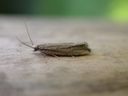
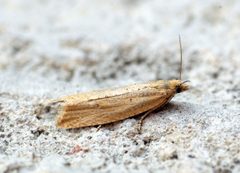
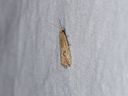
: forewings pale ochreous to ochreous-brownish with strigulated (finely streaked) with darker ochreous or dark fuscous; discal spot at 1/3 and angular mark beyond middle dark fuscous, often obsolete, sometimes forming a more or less complete dark streak from base to apex; central fascia sometimes indicated on costa. Hindwings grey. Wingspan 11–20 mm. Larva: greenish or whitish-flesh-coloured with black and black plate of segment 2.
Habitat
Moist supporting rush ; associated with wetlands, marshes, and damp grasslands where plants (Juncus and Scirpus) occur.
Distribution
Europe; recorded from Belgium, the Netherlands, Sweden (Skåne, Öland), Denmark, and the Azores (Flores, São Miguel, Terceira).
Seasonality
fly from May to October; the season is based on records from Belgium and the Netherlands and may vary elsewhere in the range.
Diet
Larvae feed on rushes, specifically Juncus and Scirpus .
Host Associations
- Juncus - larval plantvarious
- Scirpus - larval plantvarious
Life Cycle
Complete with , larva, pupa, and stages. Larval stage associated with rush stems. Specific details beyond adult period are not documented in available sources.
Ecological Role
Larval herbivore on wetland rushes; contributes to nutrient cycling in marsh . Specific ecological interactions are not documented.
Similar Taxa
- Bactra furfuranaExtremely similar external ; reliable separation requires genitalia examination or detailed wing pattern comparison
- Bactra suedanaOccurs in similar moist in northern Europe; distinguished by genitalia and subtle wing pattern differences
- Bactra robustanaNordic with overlapping distribution; distinguished by genitalia and