
Bactra furfurana
(Haworth, 1811)
mottled marble
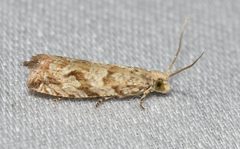
Bactra furfurana is a small tortricid with a wingspan of 13–19 mm, found across the Nearctic and Palearctic realms. fly in June and July in damp marshy . The larvae are stem-borers in rushes, feeding internally on Schoenoplectus lacustris and Juncus conglomeratus. The closely resembles Bactra lancealana but can be distinguished by subtle wing shape and pattern differences.
Pronunciation
How to pronounce Bactra furfurana: //ˈbæk.trə ˌfɜːr.fjʊˈræ.nə//
These audio files are automatically generated. While they are not always 100% accurate, they are a good starting point.
Identification
are very similar to Bactra lancealana. Distinguished by forewings that are slightly narrower with a straighter , and by more indistinct darker markings. Examination of genitalia may be required for definitive identification. Larvae can be identified by their presence inside hollowed rush stems.
Images
Habitat
Damp marshy regions with abundant rushes.
Distribution
Nearctic and Palearctic realms. Recorded from Belgium (Flemish and Walloon regions, Antwerp province), Sweden (Skåne, Öland), Denmark, and across northern Europe.
Seasonality
fly in June and July.
Diet
Larvae feed within stems of rushes, specifically Schoenoplectus lacustris and Juncus conglomeratus, hollowing out the stem. diet not documented.
Host Associations
- Schoenoplectus lacustris - larval larvae bore into stems
- Juncus conglomeratus - larval larvae bore into stems
Life Cycle
Larval stage occurs within rush stems where feeding hollows out the stem. presumably occurs within the larval tunnel or in surrounding vegetation, though details are not documented. emerge in early summer.
Behavior
Larvae are internal stem-borers, feeding concealed within rush stems. are active in early summer.
Ecological Role
As a stem-borer in rushes, the contributes to nutrient cycling in wetland and may influence rush locally.
Human Relevance
No significant economic or medical importance. Occasionally encountered by wetland ecologists and enthusiasts.
Similar Taxa
- Bactra lancealana nearly identical in appearance; distinguished by broader forewings with more curved and generally more distinct markings in B. lancealana
- Bactra suedanaFound in similar moist in northern Europe; distinguished by genitalia and subtle external differences
More Details
Taxonomic history
Originally described as Tortrix furfurana by Adrian Hardy Haworth in 1811. Transferred to Bactra by subsequent authors.
Wetland indicator
Presence of this indicates healthy rush-dominated wetland .