
Bactra verutana
Zeller, 1875
javelin moth
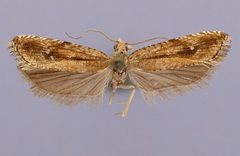
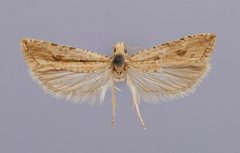
Bactra verutana, commonly known as the javelin , is a small tortricid moth with a wingspan of 11–17 mm. It has a broad distribution spanning North America, the Caribbean, Central and South America, and parts of Africa. The is notable as an agent for weedy nutsedges (Cyperus species), particularly purple nutsedge (C. rotundus) and yellow nutsedge (C. esculentus). Larval feeding damages leaves, fascicles, basal bulbs, tubers, and inflorescences of plants, reducing both vegetative and .
Pronunciation
How to pronounce Bactra verutana: /ˈbæktrə vəˈruːtænə/
These audio files are automatically generated. While they are not always 100% accurate, they are a good starting point.
Identification
Distinguishable from other Bactra by genitalia examination; external alone insufficient for reliable identification. Small size (11–17 mm wingspan) and association with Cyperus, Scirpus, or Juncus plants may aid field recognition.
Images
Appearance
Small with wingspan of 11–17 mm. Specific coloration and pattern details not documented in available sources.
Habitat
Prairies, aspen parkland, foothills, and mixed wood areas. Associated with plant occurrence in both natural and agricultural settings.
Distribution
North America: Florida, Texas, Mississippi, North Carolina, Indiana, Missouri, Ontario, Alberta, Quebec, Labrador, Vermont, Saskatchewan. Caribbean: Cuba, Puerto Rico. Central and South America: Mexico, Panama, Paraguay. Africa: Mozambique, South Africa.
Diet
Larvae feed on leaves, fascicles, and basal bulbs of Cyperus esculentus, Cyperus rotundus, and other Cyperus , as well as Scirpus and Juncus species.
Host Associations
- Cyperus rotundus - larval Purple nutsedge; highly suitable with 90% larval survival to maturity
- Cyperus esculentus - larval Yellow nutsedge; less suitable with 65% larval survival to maturity
- Cyperus - larval -level association with nutsedge
- Scirpus - larval Bulrush
- Juncus - larval Rush
Life Cycle
Complete with , larval, pupal, and stages. Larvae develop on plants with survival rates varying by host : 90% survival to maturity on purple nutsedge versus 65% on yellow nutsedge. Oviposition occurs on both host species. Specific details of site and adult longevity not documented.
Behavior
females oviposit on plants; both purple and yellow nutsedge are equally acceptable for oviposition. Larval feeding causes significant damage to host plant tubers and inflorescences. At high plant densities, larval feeding reduces tuber dry weight by 93% in purple nutsedge and 80% in yellow nutsedge, and reduces tuber numbers by 77% and 62% respectively. Inflorescence production is greatly reduced in both host .
Ecological Role
agent of nutsedge weeds. Larval feeding reduces vegetative through tuber damage and through inflorescence damage. Potential for in agricultural systems.
Human Relevance
Investigated and used as a agent for purple nutsedge (Cyperus rotundus) and yellow nutsedge (C. esculentus), which are major agricultural weeds. Greenhouse studies demonstrate effectiveness in reducing weed tuber production and seed set. No documented negative impacts on non-target plants or human activities.
Similar Taxa
- Other Bactra species Bactra contains multiple that are external morphologically similar; reliable identification requires genitalia dissection and examination.
More Details
Biological Control Efficacy
Purple nutsedge is significantly more suitable as a than yellow nutsedge, with higher larval survival and greater feeding damage at equivalent larval densities. However, both would be approximately equally affected by of B. verutana due to compensatory effects: yellow nutsedge's greater reliance on seed makes inflorescence damage particularly impactful.
Sources and further reading
- BugGuide
- Wikipedia
- GBIF taxonomy match
- iNaturalist taxon
- NCBI Taxonomy
- Catalogue of Life
- Larval Biology of Bactra verutana, an Indigenous Biological Control Agent of the Weedy Nutsedges1,3,4
- Agents for biological control of purple nutsedge, Cyperus rotundus L. : the genus Bactra Stephens (Lepidoptera : Tortricidae : Olethreutinae) as a major source, with emphasis on the biology and potential use of Bactra verutana Zeller /
- Comparative Biocontrol of Purple Nutsedge (Cyperus rotundus)and Yellow Nutsedge (C. esculentus)withBactra verutanaunder Greenhouse Conditions