
Cydia nigricana
(Fabricius, 1794)
Pea Moth
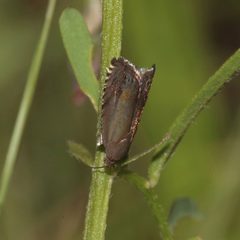
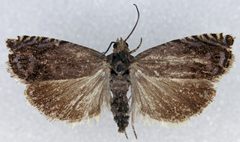
Cydia nigricana, commonly known as the pea , is a small tortricid moth native to Europe and introduced to North America. The is a significant agricultural pest whose larvae develop inside pea pods, feeding on developing seeds. emerge from cocoons in early summer and are monitored using traps for . The species exhibits strong male response to synthetic , with peak activity occurring in late afternoon and evening hours.
Pronunciation
How to pronounce Cydia nigricana: /ˈsɪdiə nɪɡrɪˈkɑːnə/
These audio files are automatically generated. While they are not always 100% accurate, they are a good starting point.
Identification
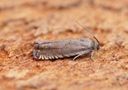
Distinguished from similar Cydia by the herringbone pattern of white and yellow spots on the wing edges. The relatively long compared to body size is a notable feature. traps baited with (E,E)-8,10-dodecadienyl acetate are used for species-specific monitoring. Larval presence is detected by damage to pea pods, which may develop yellow coloration and ripen prematurely.
Images
Habitat
Agricultural fields cultivated with pea crops (Pisum sativum). In Europe, found in a range of agricultural settings from conventional to organic farming systems. Larval is restricted to developing pea pods.
Distribution
Native to Europe, including Austria, Belgium, Britain, Bulgaria, Czechoslovakia, Denmark, Finland, France, Germany, Hungary, Ireland, Italy, Netherlands, Norway, Poland, Portugal, Romania, Spain, Sweden, and Switzerland. Also recorded in Japan and Russia. Introduced to North America, where it is established in Canada (Maritime Provinces, British Columbia, Ontario) and the United States. First recorded in Canada in 1893.
Seasonality
from sites begins in early June and continues through summer. Peak activity occurs between 16:00-18:00 hours, with maximum activity around 17:04. In Finland and Germany, flight activity has been recorded from June through July. Larval development occurs from late June to August. Field threshold temperature for adult take-off is 18°C.
Diet
Larvae feed exclusively on developing seeds within pea pods (Pisum sativum). Each larva typically consumes 1-2 peas per pod. plants also include vetch, clover, and lentils, though peas are the primary cultivated host.
Host Associations
- Pisum sativum - primary Garden peas and field peas; larvae feed inside developing pods
- Vicia - Vetch
- Trifolium - Clover
- Lens culinaris - Lentils
Life Cycle
Overwinters as mature larva in soil cocoon. occurs in spring, with emerging from cocoons buried just below the soil surface beginning in early June. Adults feed on pea flowers before mating. Females lay 1-3 on undersides of leaves, petioles, stems, and flowers. Eggs hatch in 7-10 days (or 1-3 weeks depending on temperature). Larvae undergo brief wandering stage (approximately 1 day) before entering pea pods. Larval development lasts 18-30 days, with up to 5 instars. Mature larvae exit pods in August and descend to soil to spin cocoons incorporating soil particles.
Behavior
Males exhibit strong positive anemotactic response to female , flying upwind toward sources. Close-range orientation involves sustained anemotactic even when flying down concentration gradients. activity is temperature-dependent with minimal activity below 12°C and threshold for take-off at 18°C. are capable of dispersing several kilometers by low flight above vegetation in winds up to 10 km/h. Males are not captured in suction traps above 0.4 m height, indicating low-altitude flight behavior.
Ecological Role
Agricultural pest of pea crops. In native European range, are partially regulated by natural including three that can achieve up to 60% . In introduced North American range, absence of these parasitoids has led to population and severe crop damage. Serves as for larval parasitoid Glypta haesitator.
Human Relevance
Significant economic pest of pea production. In Canada, crop losses of 10-50% are common, with exceeding 75% damage. In Ontario, caused abandonment of mid-season pea . Management relies on monitoring systems to time applications, with recommended 10-15 day delay after sustained trap catches to target hatch. Alternative control methods include insect netting, early-maturing cultivars, and cultivation of mange-tout types where pods are harvested before pea development. The Royal Horticultural Society discourages use due to harm to beneficial .
Similar Taxa
- Cydia pomonellaBoth are Cydia with similar and pest status, but C. pomonella attacks apples and pears rather than legumes, and has distinct wing patterning without the herringbone spot arrangement.
- Cydia latiferreanaFilbertworm moth is congeneric but associated with hazelnut and oak acorns; lacks the distinctive wing edge pattern of C. nigricana and has different association.
More Details
Pheromone monitoring
Triangular-shaped traps with 'Bird-Tanglefoot' adhesive and (E,E)-8,10-dodecadienyl acetate lures are most effective for monitoring. Optimal trap height is three-quarters of crop height. Multiple trap lines reduce variability in catch data compared to single traps.
Population dynamics
Local abundance increases linearly with pea-cropping area in the previous year within 4 km . Risk assessment models indicate that minimum distances of 500 m between current and previous-year pea fields significantly reduce immigration and in early-flowering crops.
Sources and further reading
- BugGuide
- Wikipedia
- GBIF taxonomy match
- iNaturalist taxon
- NCBI Taxonomy
- Catalogue of Life
- Blacklighting at the Bohart: They Saw the Light | Bug Squad
- What Will You See at Bohart Museum Open House | Bug Squad
- Like a Moth to a Flame: Moth Night at Bohart Museum of Entomology | Bug Squad
- Oh, What a (Moth) Night! | Bug Squad
- Line Trapping: A Promising Method for More Accurate Pest Monitoring
- Odorant Receptor Gene in Codling Moth Also Affects Egg Production
- Cydia nigricana . [Distribution map].
- The behavioural basis of a pheromone monitoring system for pea moth, Cydia nigricana
- A Study of the natural Control of the Pea Moth, Cydia nigricana, Steph.
- Expansion of pea cropping increases the risk of pea moth (Cydia nigricana; Lep., Tortricidae) infestation
- Modelling of post-diapause development and spring emergence of Cydia nigricana (Lepidoptera: Tortricidae)
- Short‐term variations in catches of the pea moth, Cydia nigricana, in interacting pheromone traps
- Design and elevation of sex‐attractant traps for pea moth, Cydia nigricana (Steph.) and the effect of plume shape on catches
- Sources of volatiles mediating host location behaviour of Glypta haesitator, a larval parasitoid of Cydia nigricana
- Close‐range behaviour of male pea moths, Cydia nigricana, responding to sex pheromone re‐released via the substrate
- Risk assessment of pea moth Cydia nigricana infestation in organic green peas based on spatio‐temporal distribution and phenology of the host plant