
Tischeria
Zeller, 1839
Species Guides
2- Tischeria ceanothi
- Tischeria quercitella(Oak Blotch Miner Moth)
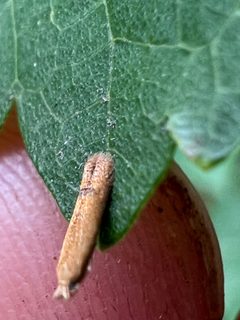
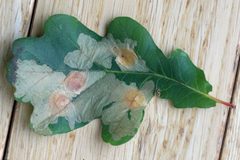
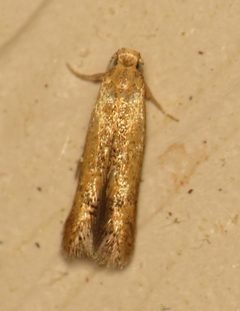
Tischeria is a of micromoths in the Tischeriidae, established by Zeller in 1839. The genus was long considered to include Coptotriche, which is now recognized as distinct. are leaf-mining whose larvae create blotch mines in plant foliage. The genus has undergone recent taxonomic revision, with some species transferred to the new genus Manitischeria.
Pronunciation
How to pronounce Tischeria: /tɪˈʃɛr.i.ə/
These audio files are automatically generated. While they are not always 100% accurate, they are a good starting point.
Identification
Tischeria are small distinguished from the related Coptotriche by genitalic characters and mine . Male genitalia with spiny appendages of the juxta have been used as diagnostic features in some . are typically small with relatively simple wing venation characteristic of Tischeriidae.
Images
Habitat
occur in supporting their plants, including oak forests, urban plantings of ornamental trees, and native shrub . Specific habitat associations depend on host plant distribution.
Distribution
Recorded from Europe, Asia (including Iran, China, and Southeast Asia), and North America. Distribution records include Denmark, Norway, and Sweden; additional records from Germany, Finland, Iran, and China. Some have been introduced to new regions with cultivated plants.
Seasonality
timing varies by and latitude. Tischeria ekebladella adults emerge in June in Northern Germany. Tischeria immaculata adults appear in early May. Tischeria caucasica shows with a second in November–December in Iran.
Diet
Larvae are leaf miners feeding on plant leaf tissue. Documented host associations include Quercus (oak), Ceanothus, and Ulmus (elm). Specific host ranges vary by ; some appear restricted to single host while others may be more within particular plant .
Host Associations
- Quercus - larval plantMultiple including Q. robur, Q. infectoria, Q. libani, Q. castaneifolia, Q. macranthera
- Ceanothus griseus - larval plantIncludes Ceanothus thyrsiflorus var. griseus
- Ulmus pumila - larval plant of T. ulmella
Life Cycle
Larvae form blotch mines in leaves, with typically expelled through a constructed opening. Larvae of some hibernate in silken, cocoon-like within the mine. occurs within the mine; emerge through crescent-shaped or other constructed exit holes. Some species are .
Behavior
are weak fliers with to activity. Tischeria immaculata adults fly primarily between 1750–2400 hours. Adults are readily dispersed by gentle winds and captured in traps set below 30 cm. Females preferentially oviposit on unmined leaves.
Ecological Role
Leaf-mining larvae function as herbivores on plants. Larvae serve as hosts for diverse complexes, including ichneumonid wasps (Diadegma, Scambus) and chalcidoid wasps (Eulophidae: Chrysocharis, Pnigalio, Cirrospilus). Some may reach pest status in ornamental or forest plantings.
Human Relevance
Some are minor pests of oak plantations and ornamental plantings. Tischeria immaculata has been subject to control trials using contact and . Leaf mines may reduce aesthetic value of ornamental plants.
Similar Taxa
- CoptotricheFormerly treated as synonym of Tischeria; now recognized as distinct based on morphological differences
- ManitischeriaNew established for formerly in Tischeria, primarily associated with Malvaceae, Rhamnaceae, and Betulaceae rather than Fagaceae and Rhamnaceae of core Tischeria
Sources and further reading
- BugGuide
- Wikipedia
- GBIF taxonomy match
- iNaturalist taxon
- NCBI Taxonomy
- Catalogue of Life
- Biologie und Parasitoidenkomplex der EichenminiermotteTischeria ekebladella(Bjerkander, 1795) (Lep., Tischeriidae) in Norddeutschland
- Tischeriidae (Lepidoptera) leafminers new to Iran, including Tischeria caucasica on Quercus: a sibling species of T. ekebladella or a case of clinal variation?
- THE LIFE HISTORY AND HABITS OF A CEANOTHUS LEAF MINER, TISCHERIA IMMACULATA (LEPIDOPTERA: TISCHERIIDAE)
- Diagnostics of Manitischeria gen. nov., an Old-World genus of leaf-mining Tischeriidae, composed of new species and species formerly in Tischeria Zeller
- Studies on host selection, flight behaviour and control of the Ceanothus leaf miner Tischeria immaculata (Braun) (Lep., Tischeriidae)
- Neither the devil nor the deep blue sea: larval mortality factors fail to explain the abundance and distribution of Tischeria ekebladella
- Discovery of Ulmaceae-feeding Tischeriidae (Lepidoptera, Tischerioidea), Tischeria ulmella sp. nov., and the first report of the Quercus-feeding T. naraensis Sato in China
- A new distribution record, first host plant record and DNA barcoding of the Neotropical micromoth Astrotischeriakarsholti Puplesis & Diškus (Lepidoptera, Tischeriidae).