
Tischeriidae
Spuler, 1910
Trumpet Leafminer Moths, Trumpet Moths
Genus Guides
3- Astrotischeria(trumpet leaf-miner moths)
- Coptotriche
- Tischeria
is a small of leaf-mining comprising the superfamily Tischerioidea, one of the oldest monotrysian lineages of Lepidoptera. are minute to small (wingspan 5–10 mm) with distinctive enlarged third antennal segments; males possess exceptionally long antennal sensillae trichodea. Larvae are specialized leaf miners that produce irregular blotch-like or slender sinuous mines within green leaf tissues, pupating inside the mine in a silken-lined nidus. The family has a global distribution excluding Australasia, with highest diversity in tropical and subtropical regions of the Americas, Africa, and Asia.
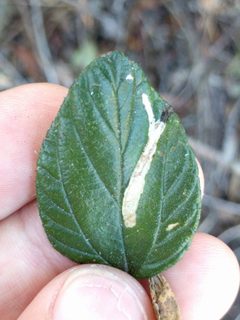
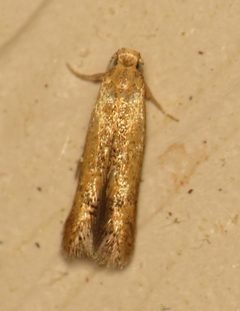
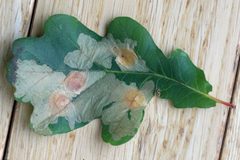
Pronunciation
How to pronounce Tischeriidae: /tɪˌʃɛɹiˈaɪdiˌaɪ/
These audio files are automatically generated. While they are not always 100% accurate, they are a good starting point.
Identification
Enlarged third antennal segment and exceptionally long male antennal sensillae trichodea are diagnostic -level characters. Leaf mines are fully transparent without , with oval trap door for frass ejection and crescentic exit hole. Male genitalia with highly modified valva structure (three-lobed in Astrotischeria trilobata group) useful for identification. Distinguished from other leaf-mining Lepidoptera families by combination of monotrysian , antennal structure, and mine .
Images
Habitat
Diverse environments from lowland tropical forests to high elevation montane regions; recorded up to 3,600 m elevation (highest for ). Occupies tropical moist forests, dry forests, and areas with plant availability. Associated with wild and cultivated plants across varied elevations.
Distribution
Global distribution excluding Australasia. Present in North America, Central America, Caribbean, South America (Andes, Amazon Basin, Atlantic forests), Africa (including Madagascar), Asia (China, India, Southeast Asia), and Europe. Neotropics show highest .
Seasonality
activity varies by region and elevation. In Peru, larvae mine in October with adults present late October–November; in Uruguay, adults recorded in February. Temperate such as Tischeria immaculata active from early May with peak 1750–2400 h.
Diet
Larvae are specialized leaf miners feeding on green leaf tissues of living plants. Monophagous or oligophagous with strong plant specificity.
Host Associations
- Asteraceae - primary for Astrotischeria and Paratischeria
- Malvaceae - including Sida, Wissadula excelsior, Helicteres viscida
- Fabaceae - Dalbergia assamica; first worldwide record for
- Sapindaceae - Allophyllus edulis; first worldwide record for
- Rhamnaceae - Manitischeria associations
- Betulaceae - Manitischeria associations
- Ceanothus griseus - plantRhamnaceae; Tischeria immaculata
- Ambrosia cumanensis - plantAsteraceae; Astrotischeria karsholti
- Baccharis spicata - plantAsteraceae; Astrotischeria atlantica
- Montanoa hibiscifolia - plantAsteraceae; Paratischeria mesoamericana
- Elephantopus mollis - plantAsteraceae; Paratischeria guarani
- Rubus - plantRosaceae; Emmetia heinemanni
Life Cycle
translucent, approximately 0.12 × 0.08 mm, laid on leaves. Larvae hatch minute, delay feeding 24 hours, then mine through all instars producing transparent blotch or serpentine mines. ejected through oval trap door. occurs within mine in round silken-lined nidus. emerges through crescentic exit hole at mine end. Developmental rate temperature-dependent; optimal rearing at 21°C and 70% relative humidity.
Behavior
Specialized leaf-mining with larvae feeding internally in leaf mesophyll. or ; Tischeria immaculata flies predominantly 1750–2400 h. Mating and oviposition commence immediately upon adult . Oviposition via protruding slender ovipositor with lobes covered in peg-like setae. Adults attracted to light.
Ecological Role
Leaf miners of wild and cultivated plants; contribute to herbivore diversity and leaf litter processing. Serve as indicators for biodiversity monitoring and rapid assessment of critical biodiversity plots in tropical America. Prey for (eulophids such as Pnigalio flavipes), spiders, and birds.
Human Relevance
Used as express tool for monitoring biodiversity and rapid assessment of conservation priority areas in tropical America. Some associated with cultivated plants; Tischeria immaculata occasionally in Ceanothus plantings. Rearing methods developed for taxonomic study.
Similar Taxa
- GracillariidaeAlso leaf-mining Lepidoptera but distinguished by ditrysian , different antennal structure, and typically serpentine mines with visible
- NepticulidaeMinute leaf-mining with different wing venation, reduced antennal structure, and typically linear mines
- PhyllocnistidaeLeaf-mining producing epidermal mines with highly reduced larvae; different and
Sources and further reading
- BugGuide
- GBIF taxonomy match
- iNaturalist taxon
- NCBI Taxonomy
- Catalogue of Life
- First report on Paratischeria from Asia (Lepidoptera: Tischeriidae)
- Exotic-looking Neotropical Tischeriidae (Lepidoptera) and their host plants
- The first record of Tischeriidae (Insecta: Lepidoptera) from Madagascar, with description of Coptotriche alavelona sp. n. and an updated distributional checklist of Afrotropical Tischeriidae
- Dishkeya, a recently described endemic Tischeriidae genus, now discovered in Colombia
- Figures 142-144 from: Stonis JR, Diškus A, Remeikis A, Solis MA, Katinas L (2020) Exotic-looking Neotropical Tischeriidae (Lepidoptera) and their host plants. ZooKeys 970: 117-158. https://doi.org/10.3897/zookeys.970.54801
- Figures 138-141 from: Stonis JR, Diškus A, Remeikis A, Solis MA, Katinas L (2020) Exotic-looking Neotropical Tischeriidae (Lepidoptera) and their host plants. ZooKeys 970: 117-158. https://doi.org/10.3897/zookeys.970.54801
- Discovery of leaf-mining Tischeriidae (Lepidoptera) in Colombia and their distribution in the Neotropics
- Four Tischeriidae species in Colombia, including a new Astrotischeria species: is it not too little for a megadiverse country?
- Astrotischeria neotropicana sp. nov.—a leaf-miner on Sida, Malvaceae, currently with the broadest distribution range in the Neotropics (Lepidoptera, Tischeriidae)
- A new distribution record, first host plant record and DNA barcoding of the Neotropical micromoth Astrotischeria karsholti Puplesis & Diškus (Lepidoptera, Tischeriidae)
- THE LIFE HISTORY AND HABITS OF A CEANOTHUS LEAF MINER, TISCHERIA IMMACULATA (LEPIDOPTERA: TISCHERIIDAE)
- Data on the parasitoid complexes of Metallus pumilus (Hymenoptera: Tenthredinidae) and Emmetia heinemanni (Lepidoptera: Tischeriidae) mining leaves of Rubus sp.
- How high can trumpet moths occur: documentation of mountainous leaf-mining Tischeriidae, featuring a species from record-high elevations
- American Asteraceae-feeding Astrotischeria species with a highly modified, three-lobed valva in the male genitalia (Lepidoptera, Tischeriidae)
- Diagnostics of Manitischeria gen. nov., an Old-World genus of leaf-mining Tischeriidae, composed of new species and species formerly in Tischeria Zeller