
Tischeria quercitella
Clemens, 1863
Oak Blotch Miner Moth
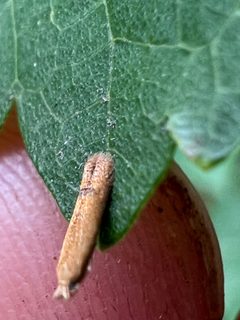
Tischeria quercitella is a leaf-mining in the Tischeriidae. Its larvae create distinctive blotch mines on the leaves of oaks (Quercus) and chestnuts (Castanea). The is documented across eastern North America, with records from Ontario south to Virginia and west to Missouri and Illinois.
Pronunciation
How to pronounce Tischeria quercitella: /tɪˈʃɛriə kwɜːrkɪˈtɛlə/
These audio files are automatically generated. While they are not always 100% accurate, they are a good starting point.
Identification
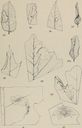
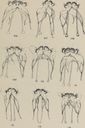
Distinguished from other Tischeria by association with oaks and chestnuts combined with the blotch-shaped (rather than linear) mine. Tischeria ekebladella creates similar blotch mines but primarily on Fagaceae other than Quercus/Castanea; microscopic examination of genitalia may be required for definitive identification. The silvery forewing fascia helps separate from many Nepticulidae.
Images
Habitat
Deciduous forests and woodlands containing oak or chestnut. Found in urban parks and suburban areas where trees are present. Larvae occur specifically on the leaves of host trees.
Distribution
Eastern North America: Ontario (Canada); United States: District of Columbia, Illinois, Kentucky, Massachusetts, Missouri, New Jersey, Ohio, Pennsylvania, and Virginia. Range corresponds to distribution of primary plants.
Seasonality
fly from May through August, with peak activity in June and July. Larval mines visible from late spring through summer. Multiple per year suspected but not confirmed.
Diet
Larvae feed as leaf miners within leaves of Castanea dentata (American chestnut), Castanea sativa (sweet chestnut), Castanea crenata (Japanese chestnut), Castanea ozarkensis (Ozark chinquapin), Quercus alba (white oak), Quercus ilicifolia (bear oak), Quercus prinus (chestnut oak), and Quercus velutina (black oak). Feeding creates blotch mines—irregular, expanded areas of consumed leaf tissue visible from both leaf surfaces. feeding habits unknown.
Host Associations
- Castanea dentata - larval American chestnut
- Castanea sativa - larval Sweet chestnut
- Castanea crenata - larval Japanese chestnut
- Castanea ozarkensis - larval Ozark chinquapin
- Quercus alba - larval White oak
- Quercus ilicifolia - larval Bear oak
- Quercus prinus - larval Chestnut oak
- Quercus velutina - larval Black oak
Life Cycle
laid on leaf surface. Larva burrows into leaf, creating an initial linear mine that expands into a characteristic blotch. Full-grown larva pupates within the mine, often in a slight depression on the underside of the leaf. emerge to mate and oviposit. Number of per year uncertain; likely or multivoltine in southern part of range.
Behavior
Larvae are endophagous leaf miners, feeding entirely within leaf mesophyll. They typically mine from the upper leaf surface, with the blotch mine often appearing paler or translucent against the surrounding green tissue. Larvae may move between leaves if a mine is exhausted. are or , often resting on leaves.
Ecological Role
As a , larvae contribute to nutrient cycling by accelerating leaf and increasing detritus input to forest floors. They serve as prey for and possibly insectivorous birds. Heavy may cause localized leaf damage but rarely tree-level impacts.
Human Relevance
Minor forestry pest; leaf mining damage is primarily cosmetic and does not threaten tree health. Occasionally noted in urban settings on ornamental oaks and chestnuts. Used as an for oak-chestnut forest in ecological studies.
Similar Taxa
- Tischeria ekebladellaCreates similar blotch mines but primarily on Fagus (beech) and other Fagaceae; requires genitalia examination for definitive separation.
- Nepticulidae (various)Many create linear or serpentine mines on oaks; distinguished by mine shape and wing pattern (Nepticulidae typically lack distinct silvery fascia).
- Phyllonorycter spp.Create blotch mines on oaks but typically on lower leaf surface with mine tenting; are larger with different wing patterns.
More Details
Mine Morphology
The blotch mine typically begins as a short linear track that abruptly expands into an irregular, somewhat circular blotch 5-15 mm across. is concentrated in one corner of the mine. The mine is visible from both leaf surfaces, with the upper surface often appearing slightly raised.
Conservation Note
Association with Castanea dentata (American chestnut) is historically significant; decline of this due to chestnut blight has likely reduced suitable in parts of the range, though other Castanea and Quercus maintain .