
Pyrausta
Schrank, 1802
Mint Moths
Species Guides
57- Pyrausta acrionalis(mint-loving pyrausta moth)
- Pyrausta andrei
- Pyrausta antisocialis
- Pyrausta arizonicalis
- Pyrausta atropurpuralis
- Pyrausta augustalis
- Pyrausta aurea
- Pyrausta bicoloralis(bicolored pyrausta moth)
- Pyrausta borealis(Northern Pyrausta Moth)
Pyrausta is a speciose of crambid commonly known as mint moths. Larvae of various feed on diverse plants including mints (Mentha), monardas, Prunella vulgaris, and other herbaceous plants. Several species are significant agricultural or horticultural pests, notably Pyrausta nubilalis (European corn borer), a major pest of maize with a nearly worldwide distribution. The genus exhibits considerable variation in host specialization, with some species restricted to single host genera while others are .
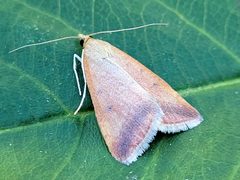
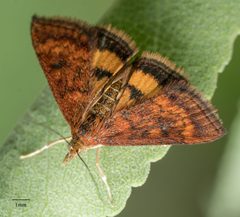
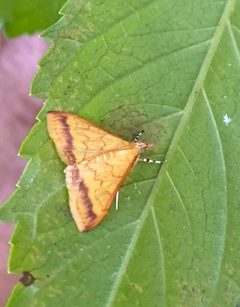
Pronunciation
How to pronounce Pyrausta: /pɪˈraʊstə/
These audio files are automatically generated. While they are not always 100% accurate, they are a good starting point.
Identification
Pyrausta are small to medium-sized crambid , typically with wingspans under 30 mm. Many species display metallic or purplish coloration, earning like "purple and gold." As members of the snout moth Crambidae, adults possess elongated labial palps projecting forward from the . Species-level identification requires examination of genitalia or detailed wing pattern analysis; larvae are creamy-colored and concealed within plant tissues, making field identification challenging.
Images
Habitat
Associated with herbaceous vegetation, particularly in meadows, gardens, agricultural fields, and disturbed where plants occur. Larval habitat is determined by host plant distribution, with many found in moist areas supporting mint plants.
Distribution
Worldwide distribution with greatest diversity in temperate regions. Pyrausta nubilalis occurs across Europe, Asia, North America, and parts of Africa and the Pacific. Individual show more restricted ranges; for example, Pyrausta purpuralis is documented from the British Isles and mainland Europe.
Seasonality
Activity patterns vary by and latitude. Pyrausta signatalis (raspberry pyrausta) is active from late May through summer, with multiple per year. of most temperate species fly during summer months.
Diet
Herbivorous. Larvae feed internally or externally on herbaceous plants. Documented associations include: Mentha arvensis and Thymus spp. for Pyrausta purpuralis; Prunella vulgaris as a primary host for P. purpuralis in the British Isles; Monarda for P. signatalis; maize, hops, hemp, and diverse plants for P. nubilalis; lotus plants for P. penitalis; Perilla for P. phoenicealis.
Host Associations
- Mentha arvensis - larval foodplantPyrausta purpuralis
- Thymus spp. - larval foodplantPyrausta purpuralis
- Prunella vulgaris - larval foodplantPyrausta purpuralis, possibly primary in British Isles
- Monarda - larval foodplantPyrausta signatalis
- Zea mays - larval foodplantPyrausta nubilalis (maize, major pest)
- Humulus lupulus - larval foodplantPyrausta nubilalis (hops)
- Cannabis sativa - larval foodplantPyrausta nubilalis (hemp)
- Nelumbo - larval foodplantPyrausta penitalis (lotus borer)
- Perilla frutescens - larval foodplantPyrausta phoenicealis (perilla leaf )
Life Cycle
Complete with , larva, pupa, and stages. Pyrausta signatalis has multiple per year with eggs laid in flower buds. Larvae develop concealed within plant tissues—flower buds, stems, or leaves depending on . occurs in silk-lined chambers within plant debris or soil.
Behavior
Larvae are concealed feeders, hiding within flower buds, leaf axils, or boring into stems. Pyrausta signatalis larvae produce silk and pellets visible in damaged flower . are or fliers; many have been observed visiting flowers for nectar.
Ecological Role
Herbivores that can significantly reduce flowering in plants. Pyrausta signatalis damage to Monarda reduces nectar availability for including hummingbirds, butterflies, and bees. Larvae serve as prey for . Some are major agricultural pests affecting crop yields.
Human Relevance
Mixed economic impact. Pyrausta nubilalis (European corn borer) is a destructive pest of maize, causing billions of dollars in damage annually. Pyrausta signatalis is a nuisance pest in gardens, damaging ornamental Monarda plantings. Several are subjects of genomic and mitochondrial sequencing studies. The name "Pyrausta" originates from a mythological fire-dwelling insect described by Pliny, though this has no biological connection to the .
Similar Taxa
- OstriniaPyrausta nubilalis has been reclassified as Ostrinia nubilalis; historically congeneric and morphologically similar
- EthmiaEthmia pyrausta shares the specific epithet but belongs to Depressariidae, not Crambidae; unrelated despite similar name
- Other CrambidaeMany crambid share elongated labial palps and concealed larval feeding habits; genitalia examination required for definitive identification
Misconceptions
The name derives from a mythological insect described by Pliny the Elder as a four-legged creature living in fire—this has no biological validity and does not describe any actual . Janssens's identification of the mythical pyrausta with Melanophila acuminata is speculative and unrelated to the moth genus Pyrausta.
More Details
Etymology
The name derives from Greek pyraustēs (fire-dweller), referencing the mythological creature described by Pliny the Elder, not from any biological trait of the .
Taxonomic note
The is speciose with many ; precise species boundaries and phylogenetic relationships remain active research areas. Several economically important species have been moved to other genera (e.g., Ostrinia) based on molecular data.
Sources and further reading
- BugGuide
- Wikipedia
- GBIF taxonomy match
- iNaturalist taxon
- NCBI Taxonomy
- Catalogue of Life
- Return of the monarda marauder: Raspberry pyrausta, Pyrausta signatalis — Bug of the Week
- Monarda marauder: Raspberry pyrausta, Pyrausta signatalis — Bug of the Week
- Pyrausta nubilalis . [Distribution map].
- Biology of the lotus borer (Pyrausta penitalis grote) /
- On the biology of Pyrausta purpuralis (Linnaeus, 1758) and its comparison with Pyrausta ostrinalis (Hübner, 1793) and Pyrausta aurata (Scopoli, 1763) (Lepidoptera: Pyralidae)
- Figure 10 from: Nupponen K, Ahola M, Nieminen M, Juerivete U (2015) Biology and distribution of the declining moth Ethmia pyrausta (Pallas, 1771), with description of the larva (Gelechioidea, Depressariidae, Ethmiinae). Nota Lepidopterologica 38(1): 47-58. https://doi.org/10.3897/nl.38.9034
- Figure 1 from: Nupponen K, Ahola M, Nieminen M, Juerivete U (2015) Biology and distribution of the declining moth Ethmia pyrausta (Pallas, 1771), with description of the larva (Gelechioidea, Depressariidae, Ethmiinae). Nota Lepidopterologica 38(1): 47-58. https://doi.org/10.3897/nl.38.9034
- Figure 9 from: Nupponen K, Ahola M, Nieminen M, Juerivete U (2015) Biology and distribution of the declining moth Ethmia pyrausta (Pallas, 1771), with description of the larva (Gelechioidea, Depressariidae, Ethmiinae). Nota Lepidopterologica 38(1): 47-58. https://doi.org/10.3897/nl.38.9034
- Figure 3 from: Nupponen K, Ahola M, Nieminen M, Juerivete U (2015) Biology and distribution of the declining moth Ethmia pyrausta (Pallas, 1771), with description of the larva (Gelechioidea, Depressariidae, Ethmiinae). Nota Lepidopterologica 38(1): 47-58. https://doi.org/10.3897/nl.38.9034
- Figure 4 from: Nupponen K, Ahola M, Nieminen M, Juerivete U (2015) Biology and distribution of the declining moth Ethmia pyrausta (Pallas, 1771), with description of the larva (Gelechioidea, Depressariidae, Ethmiinae). Nota Lepidopterologica 38(1): 47-58. https://doi.org/10.3897/nl.38.9034
- Figure 2 from: Nupponen K, Ahola M, Nieminen M, Juerivete U (2015) Biology and distribution of the declining moth Ethmia pyrausta (Pallas, 1771), with description of the larva (Gelechioidea, Depressariidae, Ethmiinae). Nota Lepidopterologica 38(1): 47-58. https://doi.org/10.3897/nl.38.9034
- Life History of Pyrausta Ainsliei Heinr. at Ames, Iowa, During The Season of 1920
- The genome sequence of the Common Purple & Gold, Pyrausta purpuralis Linnaeus, 1758 (Lepidoptera: Crambidae).
- The genome sequence of the Straw-barred Pearl moth, Pyrausta despicata Scopoli, 1763.
- Complete mitochondrial genomes of the Perilla leaf moth, Pyrausta phoenicealis (Hübner, 1818) (Lepidoptera: Crambidae).