
Melanophila acuminata
(DeGeer, 1774)
black fire beetle, fire bug
Melanophila acuminata is a metallic wood-boring beetle in the Buprestidae, renowned for its exceptional ability to detect and locate forest fires from considerable distances. possess specialized infrared radiation sensors on the that detect heat, enabling them to swarm to freshly burned conifer trees for . The has a broad Holarctic distribution and exhibits strong capabilities, with adults documented flying more than 50 miles to reach fire sites. Larvae develop in the phloem of fire-damaged conifers, taking several years to mature before emerging through D-shaped exit holes.
Pronunciation
How to pronounce Melanophila acuminata: /mɛˌlænoʊˈfaɪlə əˌkjuːmɪˈneɪtə/
These audio files are automatically generated. While they are not always 100% accurate, they are a good starting point.
Identification
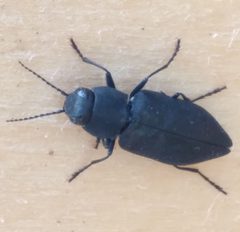
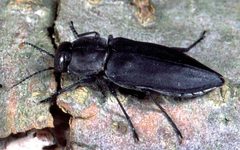
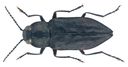
Distinguished from other Melanophila by the pointed elytral apices (acuminate shape, hence the specific epithet). Males can be separated from females by the presence of small teeth on the middle legs and a deep cut. The combination of all-black metallic coloration, pointed , and association with burned conifer is diagnostic. Similar species in the Melanophila may have rounded or differently shaped elytral apices.
Images
Habitat
Specialized for post-fire environments; swarm to recently burned conifer forests. Larvae develop in the bark and phloem of fire-damaged coniferous trees, particularly pines (Pinus), firs (Abies), and other conifers. Also attracted to other heat and smoke sources including smelter plants, refineries, and sawmills. In Europe, are more sporadic due to fire suppression and commercial forestry practices.
Distribution
Holarctic distribution spanning North America, Europe and Northern Asia (excluding China), Central America, the Caribbean (likely introduced), and Southern Asia. The most geographically widespread in the Melanophila. In the Nearctic region, occur across forested areas and swarm to fires. European risk of extirpation due to changes.
Seasonality
are active primarily from May to September, with peak activity during the fire season. In the western United States, abundance is highest at fires that ignite in mid-season rather than early or late season. Adults may continue to visit burned timber for up to one year after fire events.
Diet
Larvae feed on phloem and inner bark of fire-damaged coniferous trees. consume sap and fluids from burned trees, utilizing specialized mouthparts adapted for liquid feeding. Alternative food sources include decaying organic matter in fire-affected areas such as fungi and microorganisms.
Host Associations
- Pinus - larval primary in burned forests
- Abies - larval fir used as
- Coniferales - larval general conifer association
Life Cycle
Females oviposit in bark of freshly burned conifers, sometimes while trees are still smoldering. First instar larvae feed within the bark and overwinter in this stage. Subsequent instars burrow deeper into plant tissue, developing over several years. occurs in spring. emerge through D-shaped exit holes and may continue to visit burned timber for extended periods.
Behavior
Exhibits pyrophilous (fire-loving) : swarm in large numbers to forest fires and other heat sources, attracted by infrared radiation and smoke. Possesses paired infrared sensory pits on the containing fluid that expands upon heat detection, triggering response. Adults are strong fliers with documented exceeding 50 miles. Known to alight on humans and occasionally bite when attracted to smoke sources. Forms on burned trees, likely mediated by . Females exhibit parental care: guarding and clusters, and depositing nutrient-rich secretions to support larval growth.
Ecological Role
Primary decomposer of fire-killed conifers, accelerating wood breakdown and nutrient cycling in post-fire . Larvae serve as critical food resource for fire-associated birds, particularly the Black-backed Woodpecker (Picoides arcticus). Contributes to reduction of fuel loads in burned forests. Microbiome associations facilitate detoxification and digestion in nutrient-poor, toxin-rich burned environments.
Human Relevance
Considered a nuisance pest by wildland firefighters due to swarming and tendency to crawl into protective clothing and bite. Attracted to industrial heat sources and smoke, causing occasional at sawmills, smelters, and refineries. Historical reports document swarming to cigarette smoke at large outdoor gatherings. Has potential to damage timber and wooden structures, though primarily restricted to fire-damaged or heat-stressed wood. Subject of scientific interest due to exceptional infrared detection capabilities.
Similar Taxa
- Melanophila consputaAlso attracted to fire and smoke; distinguished by different elytral shape and geographic distribution
- Phaenops speciesRelated jewel beetles in conifers; lack infrared sensors and fire-seeking
- Other BuprestidaeMany are metallic wood-borers but lack specialized fire-detection adaptations and pyrophilous
Misconceptions
Historical claims that infrared sensors function for long-distance fire detection (up to 100 km) are unsupported by physical calculations and exceed distances predicted by the inverse square law of radiation. The sensors more likely function for close-range reproductive activities at fire sites rather than distance perception. The has been suggested as the 'pyrotocon' of Pliny's Natural History, though this connection remains speculative.
More Details
Infrared Sensor Function
The paired thoracic infrared sensors contain fluid-filled that expand when heated, triggering neural response. Research indicates these evolved primarily for reproductive activities at fire sites—locating suitable oviposition substrates and avoiding hazardous flaming conditions—rather than for long-distance fire detection.
Physiological Adaptations
Exhibits reduced wing load and higher -muscle mass compared to non-pyrophilous relatives, representing a trade-off between ability and reproductive output (fewer and ). Cuticular pigmentation aids by minimizing heat dissipation.
Historical Note
E. Gorton Linsley documented swarming to cigarette smoke at UC Berkeley football games in 1943, with beetles biting spectators. This observation highlighted the ' sensitivity to smoke and heat from non-fire sources.
Sources and further reading
- BugGuide
- Wikipedia
- GBIF taxonomy match
- iNaturalist taxon
- NCBI Taxonomy
- Catalogue of Life
- Meet the 'Extreme Insects' Aug. 19 at Bohart Museum of Entomology Open House | Bug Squad
- These Insects Thrive in the Extreme! | Bug Squad
- First internet image of Phaenops piniedulis | Beetles In The Bush
- Rise of the Grasshoppers: New Analysis Redraws Evolutionary Tree for Acrididae Family
- When Forest Fires Flare, Woodboring Beetles Rush In
- Desmiphora hirticollis: Crypsis or Mimicry? | Beetles In The Bush
- Description de la larve du Melanophila acuminata DeGeer et de quelques caractères distinctifs du Melanophila fulvoguttata (Harris) (Coleoptera: Buprestidae)
- Reproductive Role of Infrared Radiation Sensors ofMelanophila acuminata(Coleoptera: Buprestidae) at Forest Fires