
Phaenops
Dejean, 1833
Species Guides
8- Phaenops abies
- Phaenops aeneola
- Phaenops californica(California Flat-Headed Borer)
- Phaenops drummondi(flatheaded fir borer)
- Phaenops fulvoguttata(Hemlock Borer)
- Phaenops gentilis
- Phaenops lecontei
- Phaenops piniedulis
Phaenops is a of jewel beetles (Buprestidae) in the tribe Melanophilini. in this genus are primarily associated with coniferous trees, especially pines (Pinus spp.), and are closely related to the fire beetles of genus Melanophila. Unlike Melanophila, Phaenops lack the heat-sensing pores on the and do not exhibit fire-seeking . The genus occurs across North America, with species documented from the southwestern United States to the Pacific Northwest and into Canada.
Pronunciation
How to pronounce Phaenops: //ˈfaɪn.ɒps//
These audio files are automatically generated. While they are not always 100% accurate, they are a good starting point.
Identification
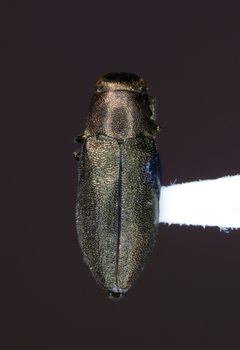
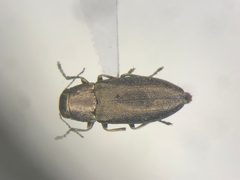
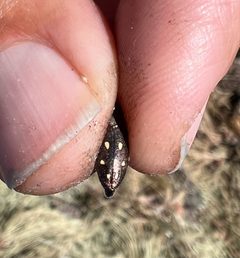
Phaenops can be distinguished from the closely related Melanophila by the absence of large heat-sensing pores on the . Some , such as Phaenops piniedulis, are characterized by large yellow maculations covering more than 50% of the elytral surface. Species are generally small to medium-sized jewel beetles with metallic coloration typical of the .
Images
Habitat
Forested areas dominated by coniferous trees, particularly pine . Documented associations include ponderosa pine (Pinus ponderosa), pinyon pine (Pinus edulis), Jeffrey pine (Pinus jeffreyi), single-leaf pinyon (Pinus monophylla), and California foothills pine (Pinus sabiniana).
Distribution
North America. Documented from the southwestern United States (Arizona, California, Colorado, Nevada, New Mexico, Oregon, Texas, Utah) northward to Canada (records from Denmark, Norway, and Sweden in GBIF likely represent data errors or introduced specimens). Specific state records include Oregon, with historical records from Vermont.
Host Associations
- Pinus ponderosa - larval First larval record for Phaenops vandykei
- Pinus edulis - larval Original association for Phaenops piniedulis
- Pinus sabiniana - larval Reared from this
- Pinus jeffreyi - larval Reared from this
- Pinus monophylla - larval Reared from this
Life Cycle
Larvae develop within the wood of living or recently dead conifer . Specific details on developmental stages and duration are not well documented.
Behavior
have been observed on freshly cut pine logs and dead branches. Unlike the related Melanophila, Phaenops do not exhibit attraction to fire or smoldering wood.
Ecological Role
Wood-boring larvae contribute to nutrient cycling in coniferous forest . serve as prey for predatory , including Cerceris completa and Cerceris fumipennis.
Human Relevance
Some are associated with commercially important pine species. The is of interest to collectors due to the rarity of certain species, such as Phaenops piniedulis, which is infrequently encountered.
Similar Taxa
- MelanophilaClosely related in the same tribe; distinguished by the presence of large heat-sensing pores on the and fire-seeking in Melanophila, both absent in Phaenops
More Details
Predation and parasitism
Phaenops vandykei has been documented as prey for the crabronid Cerceris completa and as a for the sarcophagid fly Senotainia trilineata.
Nomenclatural history
The has undergone taxonomic revision, with previously placed in Melanophila transferred to Phaenops. The aberration Melanophila drummondi ab. nicolayi was synonymized under Phaenops drummondi following changes to the International Code of Zoological regarding infrasubspecific names.
Species diversity
North American include Phaenops carolina, P. caseyi, P. drummondi, P. gentilis, P. obenbergeri, P. piniedulis, and P. vandykei, among others.
Sources and further reading
- BugGuide
- Wikipedia
- GBIF taxonomy match
- iNaturalist taxon
- NCBI Taxonomy
- Catalogue of Life
- First internet image of Phaenops piniedulis | Beetles In The Bush
- Some recent publications | Beetles In The Bush
- Bug Eric: Beetle Bonanza
- Wasp, Geographic Data Improve Surveillance for Emerald Ash Borer
- North America’s second-rarest pine | Beetles In The Bush
- Let’s make a deal! | Beetles In The Bush
- Nomenclatural history of Melanophila drummondi ab. nicolayi Obenberger, 1944 (Coleoptera: Buprestidae), a change of authorship and synonymy under Phaenops drummondi (Kirby 1837), and a new distribution record and summary of larval hosts for the species
- Phaenops vandykei(Obenberger, 1944) (Coleoptera: Buprestidae): Its First Larval Host Record, First Record of Parasitism bySenotainia trilineataWulp, 1890 (Diptera: Sarcophagidae), New State Record for Oregon, and First Prey Record forCerceris completaBanks, 1919 (Hymenoptera: Crabronidae)