
Phaenops aeneola
(Melsheimer, 1845)
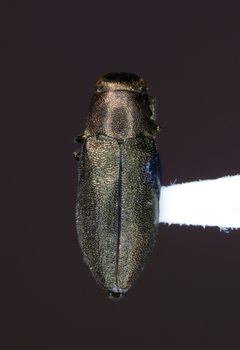
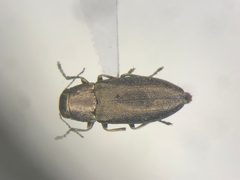
Phaenops aeneola is a of metallic wood-boring beetle in the Buprestidae. It is found in North America, with records from Canada including New Brunswick, Ontario, Prince Edward Island, and Québec. The species is rarely collected, with only a handful of specimens documented from Missouri.
Pronunciation
How to pronounce Phaenops aeneola: //ˈfiː.nɒps iː.neɪˈoʊ.lə//
These audio files are automatically generated. While they are not always 100% accurate, they are a good starting point.
Identification
The Phaenops belongs to the Buprestidae, whose members are characterized by their metallic coloration and streamlined, often bullet-shaped bodies. Phaenops aeneola can be distinguished from similar buprestids by its specific coloration and morphological features, though detailed diagnostic characters are not well documented in available sources.
Images
Distribution
North America. Canadian records include New Brunswick, Ontario, Prince Edward Island, and Québec. In the United States, it has been documented in Missouri, where it is considered extremely rare.
Host Associations
- Pinus - larval Members of the Phaenops are associated with coniferous trees, particularly pines (Pinus spp.), where larvae develop under bark.
Ecological Role
As a wood-boring , Phaenops aeneola contributes to the decomposition of dead and dying pine trees, facilitating nutrient cycling in forest .
Similar Taxa
- Other Phaenops speciesSimilar metallic appearance and conifer-associated ; distinguished by subtle differences in coloration, size, and genitalia.
- Other BuprestidaeShare metallic coloration and wood-boring habits; Phaenops is distinguished by its association with conifers rather than hardwoods.
More Details
Rarity and Collection
The is exceptionally rare in Missouri, with only two known specimens collected from the same location at Stegall Mountain Natural Area—one collected many years prior and a second in 2022 from an ethanol-only baited trap. This suggests the species may be more readily attracted to ethanol-only baits than ethanol/red wine mixtures, unlike many other cerambycids and buprestids.