
Melanophila
Eschscholtz, 1829
fire beetles
Species Guides
5- Melanophila acuminata(black fire beetle)
- Melanophila atropurpurea
- Melanophila consputa(Charcoal Beetle)
- Melanophila notata
- Melanophila occidentalis
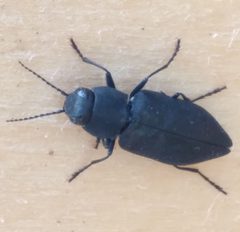
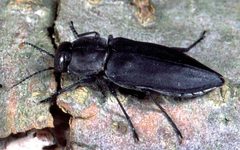
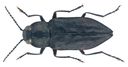
Melanophila is a of buprestid beetles known as fire beetles, distinguished by extraordinary sensitivity to infrared radiation. They possess specialized heat-sensing organs located near their legs that detect infrared radiation from forest fires. This sensory drives their of seeking out fires to mate and oviposit in freshly burned wood. The genus contains approximately 16 described distributed across North America and Eurasia.
Pronunciation
How to pronounce Melanophila: /mɛˌlænoʊˈfaɪlə/
These audio files are automatically generated. While they are not always 100% accurate, they are a good starting point.
Identification
Members of Melanophila can be distinguished from related buprestid by the presence of specialized infrared-sensing pit organs on the . These sensory structures, located near the legs, are unique among beetles and are not found in similar genera such as Phaenops. Melanophila lack the large yellow elytral maculations that characterize some related jewel beetles. The genus is further distinguished by its documented attraction to smoke and heat from smoldering trees.
Images
Habitat
Forested areas subject to wildfire disturbance; specifically attracted to recently burned or smoldering coniferous forests. are found at active fire sites, including forest fires, burning refuse dumps, refineries, and smelter plants. Larvae develop in fire-scarred or freshly burned coniferous wood, particularly pines.
Distribution
North America (including western United States and Canada) and Eurasia (records from Denmark, Norway, Sweden). Specific distribution varies by ; M. acuminata has the widest distribution across these regions.
Seasonality
activity peaks during late summer and fall, coinciding with the dry season and peak fire activity. In California, adults have been observed flying in August and September. Activity is directly tied to fire events rather than calendar season.
Host Associations
- Pinus edulis (pinyon pine) - larval for some
- Pinus jeffreyi (Jeffrey pine) - larval for some
- Pinus sabiniana (California foothills pine) - larval for some
- Pinus monophylla (single-leaf pinyon) - larval for some
- Ponderosa pine - larval for M. californica in northeastern California
Life Cycle
Larvae are wood-borers that develop in fire-damaged or recently burned coniferous trees. In some , larval may spend several years in an incipient stage within living trees before entering a fast-growing, voracious feeding stage triggered by host tree decline. occurs within the wood. is associated with fire events.
Behavior
exhibit strong attraction to infrared radiation and smoke from fires, often flying more than 50 miles to reach fire sites. At fires, they swarm in large numbers, mate, and oviposit on heated, exposed tree roots and burnt trunks. They have been observed crawling inside protective clothing of firefighters and biting exposed skin. The infrared sensors function primarily to enable reproductive activities at fires rather than for long-distance fire detection. Adults are strong, rapid fliers with exceptional capacity.
Ecological Role
Larvae contribute to decomposition of fire-killed coniferous wood and nutrient recycling in post-fire . They serve as a critical food resource for fire- birds, particularly the Black-backed Woodpecker (Picoides arcticus), which forages extensively on woodboring larvae in recently burned forests.
Human Relevance
Considered a nuisance to wildland firefighters due to swarming and biting. Historical records document large at human-produced smoke sources, including cigarette smoke at stadium events. Some may contribute to economic losses in commercial pine stands through larval damage.
Similar Taxa
- PhaenopsRelated buprestid that also breeds in coniferous wood but lacks the infrared-sensing pits on the and does not exhibit fire-seeking . Phaenops typically have large yellow elytral maculations covering more than 50% of the surface, which Melanophila lacks.
- AnthaxiaRelated buprestid in the same but without specialized heat-sensing organs or documented fire attraction.
More Details
Infrared Sensing Mechanism
The possesses one of the most sensitive biological infrared detection systems known. The pit organs near the legs contain specialized that detect infrared radiation, enabling beetles to locate fires. Research suggests these sensors evolved for reproductive enhancement at fires rather than for long-distance fire detection, with effective perception distances likely much shorter than previously claimed estimates of up to 100 km.
Historical Synonymy
The M. fulvoguttata (Harris) has been treated as distinct from M. acuminata in some literature, with larval characters described as distinctive between the two.
Sources and further reading
- BugGuide
- Wikipedia
- GBIF taxonomy match
- iNaturalist taxon
- NCBI Taxonomy
- Catalogue of Life
- Meet the 'Extreme Insects' Aug. 19 at Bohart Museum of Entomology Open House | Bug Squad
- These Insects Thrive in the Extreme! | Bug Squad
- UC Davis Seminars: Two USDA Forest Entomologists to Zero in on Bark Beetles | Bug Squad
- First internet image of Phaenops piniedulis | Beetles In The Bush
- When Forest Fires Flare, Woodboring Beetles Rush In
- A rare opportunity to do fall insect collecting in western North America | Beetles In The Bush
- Description de la larve du Melanophila acuminata DeGeer et de quelques caractères distinctifs du Melanophila fulvoguttata (Harris) (Coleoptera: Buprestidae)
- New state and adult host records for species of Anthaxia DeGeer and Melanophila Eschscholtz (Coleoptera: Buprestidae) in the Western United States
- Reproductive Role of Infrared Radiation Sensors ofMelanophila acuminata(Coleoptera: Buprestidae) at Forest Fires
- THE CALIFORNIA FLATHEADED BORER (MELANOPHILA CALIFORNICA VAN DYKE) IN PONDEROSA PINE STANDS OF NORTHEASTERN CALIFORNIA