
Pyrausta phoenicealis
Hübner, 1818
perilla leaf moth, Phoenician pyrausta moth
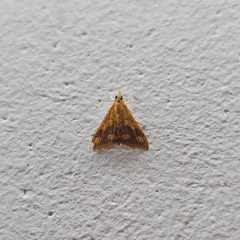
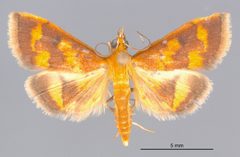
Pyrausta phoenicealis is a crambid with a nearly distribution across the Americas, Africa, Australia, and Asia. It is a documented agricultural pest, particularly in South Korea where it damages Perilla (shiso) crops. Larvae feed on plants in the mint (Lamiaceae) and related Asteraceae, binding leaves with silk to form protective shelters. The is frequently confused with Pyrausta panopealis due to morphological similarity, but genetic analysis reveals approximately 4.62% COI divergence between them.

Pronunciation
How to pronounce Pyrausta phoenicealis: /pɪˈraʊstə foʊˌnɪsiˈælɪs/
These audio files are automatically generated. While they are not always 100% accurate, they are a good starting point.
Identification
Morphologically similar to Pyrausta panopealis; genetic analysis of COI sequences shows ~4.62% divergence between these . are small crambid with characteristic snout-like elongated mouthparts. Larvae are creamy colored with body spots becoming more prominent and color turning red-violet as they develop. Early instars lack distinct body markings.
Images
Habitat
Agricultural and natural settings where plants occur; larvae inhabit young shoots of host plants, binding leaves together to form tent-like shelters.
Distribution
Pantropical and nearly : recorded from the Americas, Africa, Australia, Asia (including Korea, China, and Japan). GBIF records confirm presence in United Arab Emirates, Democratic Republic of the Congo (Equateur, Katanga, North Kivu provinces), and Ghana.
Diet
Larvae are herbivores feeding on Lamiaceae (mint ) and Asteraceae. Documented include Perilla (shiso), Dicerandra frutescens (fruit mint), Hyptis capitata (knobweed), Hyptis pectina, various Coleus , rosemary, and sweet basil.
Host Associations
- Perilla - primary major pest in South Korea; leaves and young shoots damaged
- Dicerandra frutescens - fruit mint
- Hyptis capitata - knobweed
- Hyptis pectina -
- Coleus - various
- Rosmarinus officinalis - rosemary
- Ocimum basilicum - sweet basil
Life Cycle
Early instar larvae lack distinct body markings; as larvae develop, body spots become more prominent and body color turns red-violet. Larvae live in groups on young shoots. Severe can result in larvae breaking stems, making plant harvesting difficult. Multiple per year have been observed in related Pyrausta .
Behavior
Larvae bind leaves together with silk to form tent-like shelters for protection while feeding. In severe , larvae break plant stems. are active fliers and have been observed visiting flowers.
Ecological Role
herbivore; major agricultural pest for Perilla leaf production in South Korea. Larval feeding can destroy flower buds and reduce nectar availability for in ornamental plantings. Serves as prey for including birds and predatory .
Human Relevance
Significant agricultural pest of Perilla (shiso) and culinary herbs including basil and rosemary. In ornamental settings, larval feeding in Monarda flower buds can destroy floral displays and reduce resources for . Management through mechanical removal of caterpillars or application of Bacillus thuringiensis kurtstaki (Btk) or spinosad is effective; spinosad use requires caution due to to bees.
Similar Taxa
- Pyrausta panopealisMorphologically very similar; distinguished by ~4.62% COI sequence divergence and subtle morphological differences
- Pyrausta signatalisRelated crambid with similar feeding on Monarda; raspberry pyrausta is a distinct species with different preferences and coloration
Sources and further reading
- BugGuide
- Wikipedia
- GBIF taxonomy match
- iNaturalist taxon
- NCBI Taxonomy
- Catalogue of Life
- Return of the monarda marauder: Raspberry pyrausta, Pyrausta signatalis — Bug of the Week
- Monarda marauder: Raspberry pyrausta, Pyrausta signatalis — Bug of the Week
- Complete mitochondrial genomes of the Perilla leaf moth, Pyrausta phoenicealis (Hübner, 1818) (Lepidoptera: Crambidae).