
Pyrausta signatalis
Walker, 1866
Raspberry Pyrausta Moth
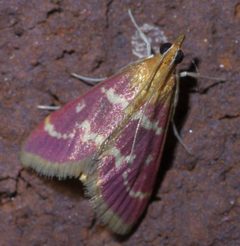
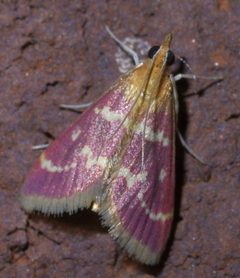
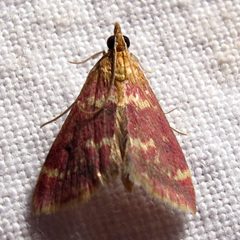
Pyrausta signatalis, commonly known as the raspberry pyrausta , is a small crambid moth native to North America. The was first described by Francis Walker in 1866. are noted for their attractive coloration, while larvae are significant pests of Monarda species ( balms), feeding destructively within developing flower buds and foliage. The moth has multiple per year and is particularly problematic in gardens where these popular ornamental and -supporting plants are grown.
Pronunciation
How to pronounce Pyrausta signatalis: /pɪˈraʊstə sɪɡˈneɪtəlɪs/
These audio files are automatically generated. While they are not always 100% accurate, they are a good starting point.
Identification
can be recognized by their small size, crambid characteristics (elongated labial palps forming a 'snout'), and distinctive raspberry-pink coloration. Larvae are identified by their presence within Monarda flower buds, creamy coloration, and association with chewed florets, holes in leaves, silk webbing, and small black pellets. The is distinguished from other Pyrausta species by association with Monarda and specific coloration patterns.
Images
Habitat
Aspen parkland, grasslands, and flower beds or gardens where Monarda (spotted beebalm, scarlet beebalm, wild bergamot) are present. The species is closely associated with its plants and is found wherever these occur in suitable climate zones.
Distribution
North America, recorded from British Columbia to Ontario in Canada, and south to North Carolina, South Carolina, Texas, and Arizona in the United States. Additional records from Alberta, Manitoba, Saskatchewan (Canada), and Vermont (USA).
Seasonality
are active in late spring and early summer, with multiple per year. Larval activity peaks in late May and early June when Monarda flower buds are developing. Later generations continue through summer as long as plants are flowering.
Diet
Larvae feed exclusively on Monarda , including Monarda fistulosa (wild bergamot), spotted beebalm, and scarlet beebalm. They consume developing flower buds, florets, sepals, and supporting leaves. feeding habits are not documented.
Host Associations
- Monarda fistulosa - larval food plantWild bergamot; primary
- Monarda didyma - larval food plantScarlet beebalm
- Monarda punctata - larval food plantSpotted beebalm
Life Cycle
are laid in buds of leaves and flowers. Larvae hatch and feed within developing flower , producing silk and . Multiple occur per year, with later generations continuing to infest successive flower crops. details are not documented in available sources.
Behavior
Larvae are concealed feeders, hiding within flower bud axils and among florets. They produce silk webbing within flower . are active fliers and can be observed flitting around plants. The exhibits a 'marauding' pattern of damage, with just one or a few caterpillars sufficient to ruin a flower bud's display.
Ecological Role
Herbivore that reduces floral resources for , , and dependent on Monarda nectar and pollen. The creates a garden management dilemma: uncontrolled eliminate flowers and their ecological benefits, while intervention is required to preserve these resources for beneficial insects.
Human Relevance
Significant pest of ornamental Monarda in gardens and landscapes. Manual control through crushing caterpillars is effective for small plantings. Organic (Bacillus thuringiensis kurstaki, spinosad) are options for larger plantings, with caution required to avoid harm to —spinosad is highly toxic to bees and should not be used when flowers are in bloom or near blooming plants.
Similar Taxa
- Other Pyrausta speciesSimilar size, wing shape, and crambid characteristics; distinguished by coloration patterns and plant associations
- Other crambid mothsShare elongated labial palps ('snout'); many are grass or stem borers rather than flower feeders
More Details
Management
Mechanical destruction by crushing caterpillars is foolproof for small patches. For larger plantings, Btk (Bacillus thuringiensis kurstaki) or spinosad are OMRI-listed options. Avoid Btk on milkweeds if monarch caterpillars are present. Avoid spinosad when bees are active.
Taxonomic Note
Originally described as Rhodaria signatalis by Walker in 1866, now placed in Pyrausta. Some sources give 1865 as the date.
Sources and further reading
- BugGuide
- Wikipedia
- GBIF taxonomy match
- iNaturalist taxon
- NCBI Taxonomy
- Catalogue of Life
- Bug Eric: Blodgett Peak Bioblitz Report
- Archive — Bug of the Week
- Return of the monarda marauder: Raspberry pyrausta, Pyrausta signatalis — Bug of the Week
- Monarda marauder: Raspberry pyrausta, Pyrausta signatalis — Bug of the Week