
Loxostege commixtalis
Walker, 1866
alfalfa webworm
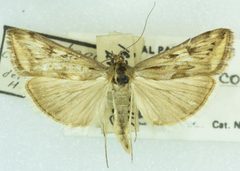
Loxostege commixtalis, commonly known as the alfalfa webworm, is a crambid described by Francis Walker in 1866. The species has a transcontinental distribution spanning the Palearctic and Nearctic regions. In North America, it ranges from the Atlantic provinces to the Yukon, while in Europe it occurs in Fennoscandia, Estonia, and northern Russia. Recent records document its first occurrence in the Eastern Palearctic (South-Eastern Transbaikalia and Amur Uplands). The species is a documented for the Bracon vulgaris. Its larvae feed on succulent plants including alfalfa and sugar beet.
Pronunciation
How to pronounce Loxostege commixtalis: /lɒkˈsɒstɛdʒɪ kəˈmɪkstəlɪs/
These audio files are automatically generated. While they are not always 100% accurate, they are a good starting point.
Identification
May be distinguished from the related and similar Loxostege sticticalis (sugar-beet webworm) by subtle morphological differences; specific diagnostic characters require expert examination. The two overlap broadly in distribution and share similar larval plants.
Images
Habitat
Specific preferences are not documented. Based on larval plants, likely associated with agricultural fields, meadows, and other open habitats where alfalfa, sugar beet, and other succulent herbaceous plants grow.
Distribution
Palearctic: Fennoscandia, Estonia, northern Russia, South-Eastern Transbaikalia, and Amur Uplands mountains (first Asian records). Nearctic: North America from Nova Scotia and Newfoundland and Labrador west to Yukon. Absent from most of continental Europe south of Fennoscandia.
Seasonality
are active from May to July in Europe and from June to July in North America. Larval stage timing is not specified in available sources.
Diet
Larvae feed on various succulent plants, specifically documented on alfalfa (Medicago sativa) and sugar beet (Beta vulgaris). feeding habits are not documented.
Host Associations
- Bracon vulgaris - Documented for this braconid ; recorded by Hoerner (1933)
Life Cycle
Complete with , larval, pupal, and stages. Specific details on egg deposition site, location, or number of per year are not documented in available sources.
Behavior
Larvae are web-forming, constructing silken shelters on plants. Specific such as activity patterns, mating, or oviposition are not documented.
Ecological Role
Herbivore feeding on herbaceous plants; serves as for including Bracon vulgaris. Specific role in or processes beyond these associations is not documented.
Human Relevance
Considered a potential agricultural pest due to larval feeding on alfalfa and sugar beet. Specific economic impact assessments are not available in provided sources.
Similar Taxa
- Loxostege sticticalisSimilar appearance, overlapping distribution, and shared larval plants (sugar beet); requires expert examination to distinguish
- Other Loxostege species contains multiple with similar and ; identification often requires dissection or molecular methods
More Details
Taxonomic Note
The was originally described by Walker in 1866 (some sources cite 1865). The basionym is Scopula commixtalis. It is classified in the Pyraustinae of the Crambidae.
Parasitoid Host Record
The is one of only two documented for Bracon vulgaris in North America, the other being L. sticticalis. This specific host association was recorded by Hoerner (1933) and cited in subsequent studies.
Zoogeographic Significance
First records from the Eastern Palearctic (South-Eastern Transbaikalia and Amur Uplands) were published in 2011, representing a significant range extension from the previously known European and North American distributions.
Sources and further reading
- BugGuide
- Wikipedia
- GBIF taxonomy match
- iNaturalist taxon
- NCBI Taxonomy
- Catalogue of Life
- Bug Eric: Wasp Wednesday: Euodynerus annulatus
- Bug Eric: August 2012
- DATA ON THE DISTRIBUTION OF MEADOW MOTH LOXOSTEGE (MARGARITIA) COMMIXTALIS (LEPIDOPTERA: PYRALOIDEA, PYRAUSTIDAE) IN EASTERN PALAEARCTIC
- The Biology of the Parasites of Loxostege sticticalis, L., in North America—Bracon vulgaris (Cress.) (Braconidae, Agathinae)