
Scopula
Schrank, 1802
Species Guides
23- Scopula aemulata(Imitator Wave)
- Scopula ancellata(angled wave moth)
- Scopula apparitaria
- Scopula benitaria
- Scopula cacuminaria(Frosted Tan Wave)
- Scopula compensata(small frosted wave)
- Scopula frigidaria(Frigid Wave)
- Scopula fuscata
- Scopula inductata(Soft-lined Wave)
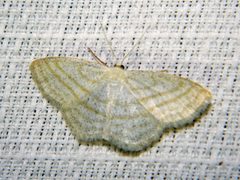
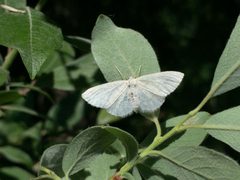
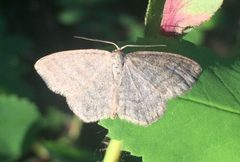
Scopula is a large of geometrid moths comprising approximately 705 distributed globally. The genus was established by Franz von Paula Schrank in 1802 and belongs to the Sterrhinae. Species within Scopula exhibit considerable diversity in wing pattern and coloration, though many share the characteristic 'wave' or 'lace' patterning that gives rise to like 'wave moths' and 'lace borders'. The genus includes both widespread Holarctic species and numerous regional endemics, with new species continuing to be described from underexplored regions such as Ascension Island and Yunnan, China.
Pronunciation
How to pronounce Scopula: //ˈskɒpjʊlə//
These audio files are automatically generated. While they are not always 100% accurate, they are a good starting point.
Identification
Scopula are distinguished from related geometrid primarily by genitalic characters, particularly structures of the male valvae and the degree of curvature of the female ductus bursae. External features such as wing pattern can be highly variable and sometimes misleading; many species require dissection for definitive identification. The genus is most readily separated from superficially similar genera like Idaea by genitalic and details of wing venation. Species-level identification often relies on subtle differences in wing pattern elements, particularly the shape and course of transverse lines, presence or absence of discal spots, and details of terminal markings. Some species groups (e.g., S. cajanderi group, S. dubernardi group) show reduced genitalic differentiation, requiring careful examination of quantitative genitalic measurements and external features.
Images
Habitat
range widely depending on , including grasslands, meadows, woodland edges, scrublands, coastal dunes, alpine meadows, and disturbed agricultural areas. Many species favor open or semi-open habitats with abundant herbaceous vegetation. Some species are associated with specific substrates such as sand dunes, gypsum soils, or rocky outcrops. Elevation ranges from sea level to montane zones.
Distribution
Global distribution with highest diversity in the Palearctic and Oriental regions. Significant representation in the Nearctic, Afrotropical, and Australasian regions. Specific documented distributions include: Europe (widespread), North Africa, Asia Minor through Central Asia to China and Japan, Southeast Asia, North America (including disjunct Holarctic ), South America (Ascension Island ), Australia, and New Zealand. Some species show highly restricted ranges while others are broadly distributed across continents.
Seasonality
periods vary considerably by and latitude. Many temperate species are with adults active in late spring to summer (May–August). Some species show partial or complete second , particularly in southern parts of their range, with flight extending into September or later. Tropical and subtropical species may have extended or continuous flight periods. Specific examples: S. subpunctaria shows during both scotophase and photophase but primarily activity; S. orientalis recorded flying in September in Romania, representing the latest seasonal record for the Balkans and suggesting partial second generation.
Life Cycle
Complete with , larval, pupal, and stages. Larvae are the familiar 'inchworms' or 'loopers' characteristic of Geometridae, possessing only two or three pairs of at the end and moving with a looping gait. Larval instars: typically five instars documented (e.g., S. rubraria), though this may vary by . Larval duration: approximately 28 days in S. rubraria under laboratory conditions. Pupal duration: approximately 11–12 days in S. rubraria. Total : approximately 49 days in S. rubraria under favorable conditions. stage varies; some species overwinter as larvae, others as pupae. Larval development of S. ascensionis and other species may include specific associations (details not fully documented in available sources).
Behavior
are primarily , with most activity restricted to scotophase (dark period). Calling (female release) and mating occur during nocturnal hours. In S. subpunctaria, virgin females begin calling 2.5–3 hours into scotophase, peaking at 7.5 hours; mating peaks from 6–8 hours of scotophase. Adults typically engage in sexual activity one day after . Males may mate multiple times (twice documented in S. subpunctaria), females typically once. Oviposition occurs during scotophase; females may lay from first day after mating until eighth day, peaking at second day. Adults are attracted to light and can be collected at ultraviolet and mercury vapor light traps. Some show flower-visiting behavior as adults, though this appears less common than in some related geometrid .
Ecological Role
Larvae function as herbivores, feeding on diverse herbaceous plants and occasionally woody . Some species have become agricultural pests, particularly on forage crops such as plantain (Plantago spp.)—S. rubraria documented as significant defoliator of plantain in New Zealand. Larvae serve as prey for diverse natural enemies including (Ichneumonoidea, Chalcidoidea documented as /parasitoids of Scopula spp.). may contribute to pollination through incidental pollen transfer during flower visitation. The serves as a food source for insectivorous birds, bats, and other vertebrates.
Human Relevance
Some are minor agricultural pests, particularly on forage crops and pasture plants. S. rubraria has caused significant defoliation of plantain (Plantago lanceolata) in New Zealand, prompting research into and management. The potential for -based control methods has been investigated for S. subpunctaria, given its well-documented calling and mating . The is well-represented in biodiversity monitoring and citizen science programs (e.g., iNaturalist), with Scopula marginepunctata notably recorded as the 1,000th species documented at a rewilding site in France. No species are known to pose direct threats to human health or structures.
Similar Taxa
- IdaeaSuperficially similar small geometrid moths with comparable wing patterns and ; distinguished by genitalic and wing venation details. Scopula typically has more rounded wing apices and distinct genitalic structures of Sterrhinae.
- LoxaspilatesSome Scopula (e.g., S. anfractata) resemble Loxaspilates in forewing shape with acute apices and concave transverse lines; distinguished by genitalic characters and details of wing pattern.
- EpyaxaNew Zealand E. rosearia has been confused with S. rubraria as both are 'plantain ' causing similar damage; distinguished by larval and genitalia.
More Details
Taxonomic complexity
The Scopula presents significant taxonomic challenges due to high (705+ ), subtle morphological differences among species, and extensive geographic variation. Several species groups (cajanderi group, dubernardi group, umbelaria group) require detailed examination of genitalic for accurate identification. Molecular data (COI barcoding) increasingly used to resolve species boundaries, as demonstrated in studies of S. orientalis and related .
Biogeographic patterns
Scopula shows interesting biogeographic patterns including disjunct Holarctic distributions (e.g., S. cajanderi), island (S. ascensionis on Ascension Island), and potential glacial refugia effects on structure. The Romanian record of S. orientalis reduced the apparent distributional gap between Balkan and Ukrainian populations, suggesting more continuous distributions than previously recognized.
Research significance
Scopula subpunctaria has become a model organism for studying geometrid reproductive , with detailed laboratory studies documenting patterns, calling , mating dynamics, and oviposition. This research has practical applications in developing -based monitoring and control strategies for pest .
Sources and further reading
- BugGuide
- Wikipedia
- iNaturalist taxon
- NCBI Taxonomy
- Catalogue of Life
- Discovering Citizen Science and ecosystem balance in France - Buglife Blog - Buglife
- Insecta | Beetles In The Bush | Page 6
- Geometridae | Beetles In The Bush
- A new Scopula from mid-Atlantic Ascension Island (Lepidoptera, Geometridae)
- Temporal pattern of adult emergence and sexual behavior of Scopula subpunctaria (Lepidoptera: Geometridae)
- First record of Scopula orientalis (Alphéraky, 1876) (Lepidoptera, Geometridae) in Romania, at the northern limit of the Balkans
- Scopula anfractata sp. n., a new geometrid moth from Yunnan, China (Lepidoptera: Geometridae, Sterrhinae)
- Revision of the Scopula dubernardi species group: how many species? (Lepidoptera: Geometridae, Sterrhinae)
- Larval development of the plantainfeeding moth <i>Scopula rubraria</i> (Doubleday) (Lepidoptera Geometridae)
- Two new Geometridae for the Maltese islands - Microloxia herbaria (Hübner, [1813]) and Scopula luridata (Zeller, 1847) (Lepidoptera: Geometridae)
- Revision of the Scopula cajanderi (Lepidoptera: Geometridae, Sterrhinae) species group with description of a new species
- Effects of Violet Light Radiation on Growth, Development and Reproduction of Scopula subpunctaria (Herrich-Schaeffer) at Different Instars
- Contribution to an understanding of the biology and larval morphology of two taxa in the genus Scopula Schrank, 1802, subgenus Glossotrophia Prout, 1913 (Lepidoptera: Geometridae)