
Scopula frigidaria
(Möschler, 1860)
Frigid Wave
Scopula frigidaria is a small geometrid distributed across regions of northern Eurasia and North America. have a wingspan of 21–23 mm and are active from late May through June. The exhibits a with larvae feeding exclusively on bilberry (Vaccinium myrtillus). Larvae overwinter in the larval stage, with development spanning from July through May of the following year. Two are recognized: the nominate form and S. f. schoyeni restricted to the Kola Peninsula and Fennoscandia.
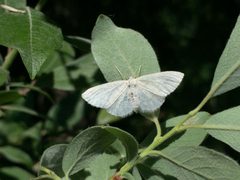
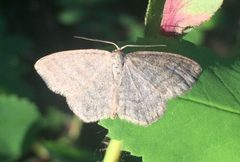
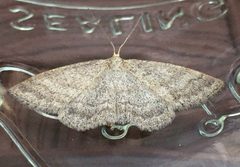
Pronunciation
How to pronounce Scopula frigidaria: //ˈskɒpjʊlə ˌfrɪdʒɪˈdɛəriə//
These audio files are automatically generated. While they are not always 100% accurate, they are a good starting point.
Identification
Distinguished from other Scopula by combination of small size, pale coloration with fine wavy lines, and distribution. Most similar to S. limboundata (large lace-border ) but smaller with finer, less contrasting wing pattern. S. marginepunctata (mullein wave) has more distinct dark dots along wing margins. Genitalia examination may be required for definitive identification from closely related Palearctic species. In North America, the species is the only Scopula regularly occurring in the boreal forest zone.
Images
Appearance
Small with wingspan of 21–23 mm. Forewings are typically pale with wavy transverse lines; coloration tends toward grayish-white to cream with darker markings. Wing pattern consists of fine, irregular lines creating a characteristic 'wave' appearance typical of the . Body is slender with relatively long, delicate legs. are . Overall appearance is cryptic against lichen-covered substrates.
Habitat
forest and subarctic woodland . Associated with coniferous and mixed forests where Vaccinium myrtillus occurs in the understory. Found in both lowland and montane settings, occurring southward in North America primarily in mountainous regions. Habitats include spruce-fir forest, pine woodlands, and subarctic scrub. In western North America, extends into subalpine and montane zones.
Distribution
Holarctic distribution spanning northern Eurasia and North America. In Eurasia: from Fennoscandia eastward across northern Russia to the Kamchatka Peninsula. In North America: across the forest region from Alaska through the Northwest Territories and Nunavut to Newfoundland; southward in mountains to southern Wisconsin, Alberta, and British Columbia. Disjunct southern occur in montane refugia.
Seasonality
are active from late May through June in a single . Larvae present from July through May of the following year, in the larval stage. occurs in late spring with adult timed to coincide with early summer conditions in .
Diet
Larvae feed exclusively on Vaccinium myrtillus (bilberry, whortleberry). No other plants have been documented. do not feed.
Host Associations
- Vaccinium myrtillus - larval plantsole documented ; larvae feed on foliage
Life Cycle
with extended larval development. laid in early summer; larvae feed through late summer then enter , as larvae. Feeding resumes in spring with occurring in late May. emerge shortly thereafter, with the entire adult period compressed into approximately one month. Overwintering stage is the larva.
Behavior
are and attracted to light. Larvae are typical geometrid 'inchworms' or 'loopers' with reduced , moving with characteristic looping gait. Larval feeding occurs primarily at night; during daytime larvae rest on plant foliage or stems. larvae likely seek shelter in leaf litter or soil at base of host plants.
Ecological Role
Larval herbivore in forest understory, contributing to nutrient cycling through consumption of Vaccinium myrtillus foliage. Serves as prey item for various insectivorous birds, small mammals, and predatory insects in boreal . Part of the diverse geometrid fauna characteristic of northern forest ecosystems.
Human Relevance
No significant economic importance. Occasionally encountered by naturalists and enthusiasts in regions. Not considered a pest of commercial blueberry or cranberry crops despite related plant. Scientific interest primarily from biogeographic and ecological perspectives given its transcontinental boreal distribution.
Similar Taxa
- Scopula limboundataSimilar size and wing pattern but larger (wingspan 25–28 mm) with more contrasting dark marginal band on forewing; occurs in deciduous woodlands of eastern North America rather than forest
- Scopula marginepunctataSimilar pale coloration but with distinct dark dots along wing margins; occurs in Europe and western Asia, not North America
- Scopula immutataPalearctic with similar distribution but slightly larger with more uniform wing coloration; genitalia examination required for separation
More Details
Subspecies
Two recognized: S. f. frigidaria (nominate form, widespread) and S. f. schoyeni (Schneider, 1883), restricted to Kola Peninsula and Fennoscandia. The latter differs subtly in wing pattern intensity.
Taxonomic history
Originally described as Acidalia frigidaria by Möschler in 1860, later transferred to Scopula. The epithet 'frigidaria' refers to its cold-climate (frigid) distribution.
Conservation status
Not evaluated by IUCN; presumed secure given extensive distribution, though southern montane may be vulnerable to climate change.