
Scopula inductata
(Guenée, 1857)
Soft-lined Wave, soft-lined wave moth
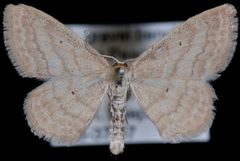
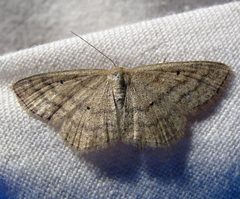
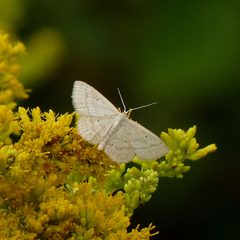
Scopula inductata, commonly known as the soft-lined wave, is a in the Geometridae described by Achille Guenée in 1857. It occurs across North America east of the Rocky Mountains, with active from July to September. The has a wingspan of 20–25 mm and exhibits the characteristic 'wave' pattern typical of its .
Pronunciation
How to pronounce Scopula inductata: //ˈskɒp.jʊ.lə ˌɪn.dʌkˈteɪ.tə//
These audio files are automatically generated. While they are not always 100% accurate, they are a good starting point.
Identification
The soft-lined wave can be distinguished from similar Scopula by the fine, delicate wavy lines on the forewings and its relatively small size. It is smaller than Scopula limboundata (large lace-border moth), which has more prominent lace-like wing margins. The species lacks the bold spotting or strong contrast seen in some other wave moths. Accurate identification often requires examination of genitalia or reference to regional faunal guides.
Images
Appearance
have a wingspan of 20–25 mm (0.79–0.98 in). The forewings display fine, wavy transverse lines with a soft, muted appearance that gives the its . Coloration is generally pale with subtle darker markings. The body is slender, typical of geometrid moths. Larvae are long, thin, and 'inchworm-like' with reduced , moving with the characteristic looping gait of the .
Habitat
Occurs in a variety of open and semi-open including prairies, meadows, forest edges, and disturbed areas. Found in both dry-mesic upland deciduous forests and more open grassland environments. The appears adaptable to human-modified landscapes.
Distribution
Found in North America east of the Rocky Mountains, from Newfoundland west to the coast of British Columbia, north to the Northwest Territories, and south to Alabama and Utah. Distribution records include Canadian provinces: Alberta, Manitoba, Saskatchewan; and US states including Vermont.
Seasonality
are on wing from July to September, with peak activity varying by latitude and local climate conditions.
Diet
Larvae feed on Aster, Trifolium, Taraxacum, Ambrosia, and Melilotus . do not feed.
Host Associations
- Aster - larval food plant
- Trifolium - larval food plant
- Taraxacum - larval food plant
- Ambrosia - larval food plant
- Melilotus - larval food plant
Life Cycle
Complete with four stages: , larva, pupa, and . Larvae are the active feeding stage, consuming herbaceous vegetation. occurs in soil or leaf litter. Adults emerge in mid to late summer. stage not explicitly documented in available sources.
Behavior
are and attracted to light. Larvae exhibit the characteristic 'inching' or 'looping' locomotion of geometrid caterpillars, using only their at the end to grip while extending the body forward.
Ecological Role
Larvae function as primary consumers, feeding on herbaceous plants. The serves as prey for various including birds, bats, and predatory insects. may contribute to pollination through incidental contact while resting on flowers.
Human Relevance
No significant economic impact. Occasionally encountered by naturalists and enthusiasts at light traps. Not considered a pest .
Similar Taxa
- Scopula limboundataLarger size with more prominent lace-like wing margins; both occur in similar and regions
- Other Scopula speciesMany wave moths share similar fine-lined wing patterns, requiring careful examination for accurate identification
More Details
Nomenclatural Note
The was originally described as Acidalia inductata by Guenée in 1857. Some sources cite the date as [1858], reflecting publication date variations.
iNaturalist Observations
As of the data source, the has 4,861 observations on iNaturalist, indicating it is relatively well-documented by citizen scientists.