
Pyraustini
Genus Guides
27- Achyra
- Anania
- Arenochroa
- Crocidophora
- Daulia
- Ecpyrrhorrhoe
- Epicorsia(Fiddlewood Leafroller)
- Fumibotys(mint root borer moth)
- Hahncappsia
Pyraustini is a large tribe of within the Crambidae, containing thousands of distributed worldwide. Members are commonly known as pyralid moths or snout moths, though this name applies broadly to related groups. The tribe is characterized by specific genitalic and wing venation features that distinguish it from other crambid tribes. Many species are associated with aquatic or semi-aquatic , with larvae often feeding on aquatic plants.
Pronunciation
How to pronounce Pyraustini: /ˌpɪrəˈaʊstɪnaɪ/
These audio files are automatically generated. While they are not always 100% accurate, they are a good starting point.
Identification
Separation from other crambid tribes relies on male genitalia examination, specifically the structure of the valvae and . The hindwing with M2 arising closer to M3 than to M1, and the presence of specific tibial spination patterns, aid identification. Externally, many Pyraustini resemble Pyralini but lack the strongly projecting second segment of the labial palps seen in that tribe. Molecular phylogenetic analysis increasingly supplements morphological identification.
Images
Appearance
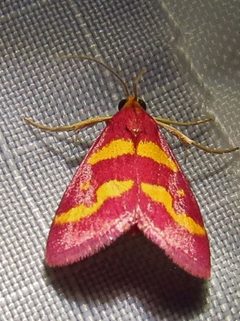
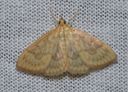
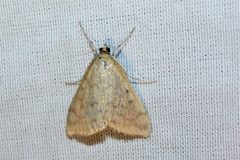
are small to medium-sized with wingspans generally ranging from 15-40 mm. Forewings are typically triangular with rounded apices, often displaying muted colors including browns, grays, and ochres with variable patterning. Hindwings are usually paler and more uniform. Labial palps are prominent and project forward, giving a 'snouted' appearance. Wing venation includes a characteristic arrangement of in the hindwing . Genitalic structures, particularly in males, show diagnostic features including specific arrangements of cornuti on the .
Habitat
span diverse environments including wetlands, marshes, ponds, streams, grasslands, forests, and agricultural areas. Many show strong affinity for freshwater aquatic systems. Larval habitats are frequently tied to plant locations, which may include emergent vegetation in shallow water or moist terrestrial soils.
Distribution
distribution with highest diversity in tropical and subtropical regions. Well-represented in North America, Europe, Asia, Africa, Australia, and South America. Specific range limits vary considerably among constituent and .
Seasonality
activity patterns vary by and latitude. Temperate species generally fly from late spring through autumn, with peak diversity in summer months. Tropical species may show year-round activity or wet-season peaks. Many species are with some activity.
Life Cycle
Complete with , larva, pupa, and stages. Larvae are often aquatic or semi-aquatic, feeding on , detritus, or living plant tissue. Some larvae construct silken cases or tunnels in plant stems or among roots. occurs in silken cocoons, frequently attached to vegetation or within larval tunnels. time varies from to multivoltine depending on and climate.
Behavior
are generally and attracted to light. Many are strong fliers. Larval includes stem-boring, leaf-mining, or external feeding on aquatic vegetation. Some species show gregarious larval habits.
Ecological Role
Larvae function as primary consumers in aquatic and wetland , processing plant material and serving as prey for aquatic , fish, and birds. may contribute to pollination though this role is poorly documented. Some are significant herbivores in managed wetlands and rice systems.
Human Relevance
Several are agricultural pests, notably in rice where larval stem-boring causes yield reduction. The water hyacinth moth (Niphograpta albiguttalis) has been introduced as a agent for water hyacinth. Some species serve as indicators of wetland health.
Similar Taxa
- PyraliniShares 'snout moth' and general body plan; distinguished by more strongly projecting labial palps and different genitalic structure.
- SchoenobiiniAlso contains aquatic crambid with similar larval habits; separated by wing venation and genitalic characters.
More Details
Taxonomic History
Pyraustini has undergone substantial revision with the advent of molecular . Many formerly placed here have been moved to other tribes, and the concept of Pyraustini has been narrowed to reflect monophyletic groupings. The tribe remains one of the most -rich in Crambidae.