
Daulia
Walker, 1859
Species Guides
2- Daulia arizonensis
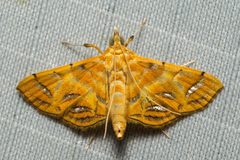
- Daulia magdalena(Glittering Magdalena Moth)
Daulia is a of in the Crambidae, Spilomelinae. The genus was established by Francis Walker in 1859. in this genus are distributed primarily in tropical and subtropical regions of the Old World, including parts of Africa, Asia, and Australia. The genus comprises relatively small to medium-sized moths with characteristic wing patterns typical of the Spilomelinae.
Pronunciation
How to pronounce Daulia: /ˈdaʊ.li.a/
These audio files are automatically generated. While they are not always 100% accurate, they are a good starting point.
Identification
Members of Daulia can be distinguished from related in Spilomelinae by wing pattern and genitalic , though specific diagnostic characters vary by . The genus is part of a complex of similar Spilomelinae genera that require careful examination of male genitalia and wing venation for accurate identification. Forewings often show distinct pattern elements including transverse lines and discal spots.
Images
Distribution
Tropical and subtropical regions of the Old World, including parts of sub-Saharan Africa, South and Southeast Asia, and northern and eastern Australia.
Similar Taxa
- SpilomelaSimilar wing patterns and body form in Spilomelinae; distinguished by genitalic characters and wing venation details.
- HymeniaOverlapping distribution and superficially similar appearance; requires examination of genitalia for separation.
- NausinoeRelated in Spilomelinae with similar size and habitus; differentiated by wing pattern details and male genitalia.
More Details
Taxonomic History
The Daulia was established by Francis Walker in 1859 in his 'Catalogue of the Lepidopterous Insects in the British Museum.' The type is Daulia afralis Walker, 1859. The genus has been variously treated in different classifications, with some authors synonymizing it with related genera, but it is currently recognized as valid within Spilomelinae.
Species Diversity
The contains approximately 10-15 described , though the exact number varies depending on taxonomic treatment. Several species were transferred to or from related genera in recent revisions. New species continue to be described from poorly collected regions, particularly in Southeast Asia and Africa.