
Hymenia
Hübner, 1825
Hawaiian beet webworm moth (for H. recurvalis)
Species Guides
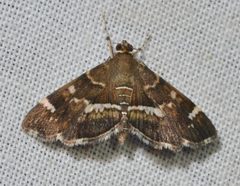
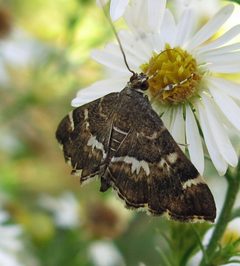
1- Hymenia perspectalis(spotted beet webworm moth)
Hymenia is a of crambid in the Spilomelinae, established by Hübner in 1825. The genus includes at least three described : Hymenia perspectalis (Hübner, 1796), Hymenia nigerrimalis (Hampson, 1900), and Hymenia lophoceralis (Hampson, 1912). The most extensively studied species is Hymenia recurvalis, commonly known as the Hawaiian beet webworm, which has become a significant agricultural pest of leafy vegetables and weeds across tropical and subtropical regions worldwide.
Pronunciation
How to pronounce Hymenia: /hɪˈmiː.ni.ə/
These audio files are automatically generated. While they are not always 100% accurate, they are a good starting point.
Images
Habitat
Agricultural environments, particularly vegetable systems and areas where plants occur. such as H. recurvalis thrive in arid and semi-arid regions as well as humid agroecological zones with favorable temperature and moisture conditions. Microhabitats characterized by fluctuating temperatures, abnormal precipitation patterns, and relative humidity conditions support rapid development.
Distribution
Documented from multiple continents including Africa (Nigeria), Asia (India, Japan), and North America (United States, specifically Vermont). Hymenia recurvalis shows expanding distribution in Nigerian agroecological zones including Sahel, Sudan Savanna, Northern Guinea Savanna, Southern Guinea Savanna, and Forest regions. In India, the occurs in arid and semi-arid regions of Rajasthan. Japanese records document around Nobeoka.
Seasonality
Hymenia recurvalis is present throughout the year in suitable climates, with peak activity from July to October in India. In Nigeria, risk is maximized during the post-rainy season, particularly in southern Guinea Savanna and Forest regions.
Diet
Larvae are herbivorous, feeding on leafy vegetable crops and weeds. Documented include Amaranthus cruentus (amaranth), Amaranthus viridis, Solanum macrocarpon (African aubergine), Trianthema monogyna, and Beta vulgaris (beet). Host associations span Amaranthaceae, Chenopodiaceae, and Aizoaceae.
Host Associations
- Amaranthus cruentus - leafy vegetable crop
- Amaranthus viridis - kharif weed, cholai
- Solanum macrocarpon - African aubergine
- Trianthema monogyna - kharif weed, patharchata
- Beta vulgaris - beet
- Amaranthaceae -
- Chenopodiaceae -
Life Cycle
Complete with , larva, pupa, and stages. Larval duration and specific developmental timing documented for H. recurvalis in laboratory and field studies, though precise stage durations not detailed in available sources.
Behavior
Larvae construct silk webs to bind leaves together, feeding from within the protected enclosure. This web-spinning gives H. recurvalis its "webworm." exhibit migratory behavior; documented around Nobeoka, Japan. driven by climate-responsive factors, with rapid occurring when temperature and humidity conditions are favorable.
Ecological Role
Agricultural pest causing defoliation and yield losses in vegetable systems. Serves as for in the Apanteles (Braconidae), which may provide services. increase costs of pest management interventions.
Human Relevance
Significant economic impact as a pest of leafy vegetable crops in tropical and subtropical agriculture. Documented yield losses in amaranth, African aubergine, and beet . Subject of climate-responsive forecasting research to improve strategies. Control efforts include using such as Apanteles .
Sources and further reading
- BugGuide
- Wikipedia
- GBIF taxonomy match
- iNaturalist taxon
- NCBI Taxonomy
- Catalogue of Life
- Hymenia perspectalis (Huber, 1796) possible new host plant
- Climate-Responsive Forecasting of Hymenia recurvalis Outbreaks in Nigerian Agroecological Zones
- HOST PREFERENCES OF THE HAWAIIAN BEET WEBWORM, HYMENIA RECURVALIS( FAB.) (LEPIDOPTERA: PYRALIDAE)
- Distribution of the migrating moths of the rice leaf roller, Cnaphalocrocis medinalis GUENEE and the Hawaiian beet webworm, Hymenia recurvalis FABRICIUS around Nobeoka.
- STUDIES ON SOME ECOLOGICAL AND BIOLOGICAL OBSERVATIONS OF THE PARASITOIDS, Apanteles SPP. (HYMENOPTERA: BRACONIDAE) ON THE HAWAIIAN BEET WEBWORM, Hymenia recurvalis FAB. (LEPIDOPTERA: PYRALIDAE) AT FAYOUM DISTRICT
- Some Observations on the Bionomics of Hymenia recurvalis F. (Lepid., Pyralidae) feeding on Trianthema monogyna and Amaranthus viridis in India
- Discovering the diversity of Acarosporaceae (Acarosporales, Lecanoromycetes) with carbonized epihymenial accretions in North America.