
Pontia
whites
Species Guides
4- Pontia beckerii(Becker's white)
- Pontia occidentalis(Western White)
- Pontia protodice(Checkered White)
- Pontia sisymbrii(Spring White)
Pontia is a of pierid butterflies in the Pieridae, commonly referred to as the "whites." These butterflies are distributed across the Holarctic region, with found in North America, Europe, and Asia, though they are relatively rare in central and eastern North America and Europe. Several species formerly classified in Pontia have been reassigned to the genus Sinopieris. The genus includes well-known species such as the Checkered White (Pontia protodice) and the Spring White (Pontia sisymbrii).
Pronunciation
How to pronounce Pontia: //ˈpɒn.ti.ə//
These audio files are automatically generated. While they are not always 100% accurate, they are a good starting point.
Identification
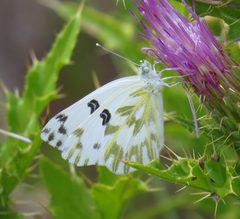
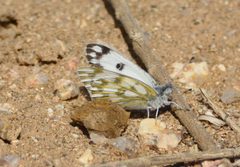
Pontia are distinguished from the related Pieris by wing pattern characteristics, particularly the presence of dark checkered or spotted markings on the wing undersides and often on the uppersides as well. The genus name Pontia is applied to butterflies with more extensive dark patterning compared to the mostly plain white wings of Pieris. Specific identification to species level requires examination of wing pattern details, geographic location, and seasonal occurrence. For example, the Checkered White (Pontia protodice) exhibits more extensive dark markings in females than males, and flies with a straighter, more direct path compared to the erratic flight of Pieris rapae.
Images
Habitat
Pontia inhabit open, sunny environments including grasslands, steppes, prairies, meadows, and disturbed areas. Many species are associated with arid and semi-arid regions, including sagebrush steppe and desert margins. The Spring White (Pontia sisymbrii) frequents foothills and higher elevations in western North America. The Checkered White is strongly associated with grassland and steppe , occurring in both natural and agricultural settings including irrigated alfalfa fields.
Distribution
The Pontia has a Holarctic distribution, occurring across North America, Europe, and Asia. In North America, are most diverse in the western United States and adjacent Canada, with some species ranging into the Great Basin, Rocky Mountains, and southwestern deserts. The genus is rare in central and eastern North America. Several species extend into the Afrotropics. East Asian species have been reassigned to Sinopieris.
Seasonality
of most Pontia are active in spring and early summer. The Spring White (Pontia sisymbrii) appears among the first butterflies of the season in western North America, often flying from late February through June. The Checkered White may be seen from spring through fall depending on location, with potential in some areas. At higher elevations, some species have a single annually, while lower elevations may support two generations.
Diet
feed on nectar from a variety of flowers including mustards, composites, and legumes. Caterpillars feed on plants in the Brassicaceae (mustards and relatives), with specific plants including hedge mustards (Sisymbrium), tansy-mustard (Descurainia), rock-cresses (Arabis), peppergrasses (Lepidium), tumble mustard (Sisymbrium altissimum), and Hirschfeldia incana.
Life Cycle
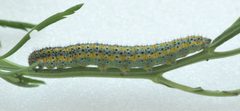
Females deposit single on plant stems and foliage. Eggs are orange and laid conspicuously near the top of the plant. Caterpillars hatch in approximately one week and progress through five instars. Older caterpillars are striped lengthwise in yellow and greenish-gray with black speckles. The chrysalis is mottled brown or black with a texture. Unlike most pierids, the Spring White pupa lacks a silk girdle and attaches only at the tail end. Some have one annually at higher elevations, two at lower elevations.
Behavior
Males of some exhibit "" , flying along ridgelines and buttes to intercept females flying up from below. are wary and startle easily, making them difficult to approach for observation. The Checkered White tends to fly in a straighter, more direct line compared to the erratic of related whites. Females may exhibit rejection postures when approached by males, including raising the .
Ecological Role
As herbivores in the larval stage, Pontia caterpillars contribute to nutrient cycling and plant dynamics in grassland and steppe . butterflies serve as . The is part of the diverse pierid fauna that characterizes open across the Holarctic.
Human Relevance
Some Pontia , particularly the Checkered White, can be abundant in agricultural settings such as irrigated alfalfa fields. The Spring White serves as an early-season indicator of spring arrival in western North America. The Island Marble (Euchloe ausonides insulanis, formerly considered related) is highly endangered, though this is not a Pontia species. Checkered Whites are occasionally used in gardens and observation.
Similar Taxa
- PierisClosely related also called "whites," but Pieris typically have plainer white wings with reduced dark markings, and exhibit more erratic patterns compared to the straighter flight and more extensive checkered patterning of Pontia.
- SinopierisFormerly included in Pontia; several East Asian have been split off into this separate based on morphological and likely genetic differences.
- EuchloeRelated pierid known as "marbles," with similar preferences and early spring periods, but distinguished by reticulated marble-like patterning on the hindwing underside rather than checkered spotting.
More Details
Taxonomic Notes
The Pontia has undergone taxonomic revision, with several East Asian (including Pontia davidis, P. dubernardi, P. kozlovi, P. sherpae, P. stoetzneri, and P. venata) now more often placed in Sinopieris. Pontia extensa may belong in Pieris. These changes reflect ongoing research in pierid .
Notable Species
Pontia protodice (Checkered White or Southern cabbage butterfly) is highly vagile and occasionally undergoes significant movements and incursions into areas where it does not regularly overwinter. Pontia sisymbrii (Spring White) is among the earliest butterflies to emerge in spring in western North America.