
Euchloe ausonides
(Lucas, 1852)
Large Marble, Creamy Marblewing
Species Guides
1- Euchloe ausonides coloradensis(Large Marble)
Euchloe ausonides, commonly known as the Large Marble or Creamy Marblewing, is a medium-sized in the Pieridae native to western North America. The exhibits remarkable camouflage , with capable of orienting themselves against backgrounds to render nearly invisible despite their contrasting wing patterns. declines have been documented in California since the 1980s, particularly in the Central Valley and Bay Area, with the species now considered regionally extinct at low-elevation sites in some areas. One , E. a. insulanus (Island Marble), is federally endangered and to the San Juan Islands of Washington State.
Pronunciation
How to pronounce Euchloe ausonides: //ˈjuːkloʊ.iː ˌɔːsəˈnaɪdiːz//
These audio files are automatically generated. While they are not always 100% accurate, they are a good starting point.
Identification
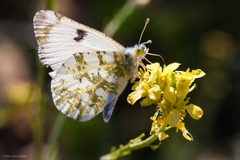
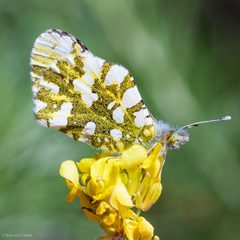
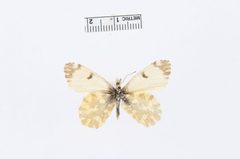
distinguished from similar Pieridae by green marbled pattern on underside of hindwing. May be confused in with Spring White (Pontia sisymbrii) and Cabbage White (Pieris rapae), which share similar size and white coloration. Perched individuals can be extremely difficult to locate due to camouflage . E. a. insulanus restricted to San Juan Islands and nonmigratory.
Images
Habitat
Open, sunny areas including valleys, hillsides, fields, and meadows. Often flies low along streams and trails. Requires presence of plants in mustard (Brassicaceae) for oviposition and larval development. At higher elevations, found in mountain meadows.
Distribution
Western North America from southern Alaska through western Canada (Alberta, Saskatchewan, Manitoba) to central California and northern New Mexico. E. a. insulanus (Island Marble) to San Juan Islands, Washington, with historical records from Vancouver Island, British Columbia.
Seasonality
One annually at higher elevations; two generations at lower elevations. on wing in spring at lower elevations, summer in mountain meadows. Adult lifespan approximately 7–9 days after from chrysalis.
Diet
Larvae feed exclusively on buds, flowers, and fruit of mustard plants (Brassicaceae). drink nectar from flowers of mustard family and other plants.
Host Associations
- Brassica rapa - larval field mustard, introduced Eurasian
- Sisymbrium altissimum - larval tall tumble mustard
- Lepidium virginicum - larval tall peppergrass
- Isatis tinctoria - larval Dyer's Woad
- Turritis glabra - larval Tower Mustard
- Boechera spp. - larval Rockcress
Life Cycle
laid on terminal flower buds of plants. Incubation approximately 10–12 days. Larvae feed on host plant buds, flowers, and fruit. in chrysalis; emerge in late spring or summer depending on elevation and . stage not explicitly documented in sources but likely as pupa given patterns.
Behavior
exhibit strong camouflage : when landing, orient body against background to conceal white forewings and display only green-marbled hindwing underside, rendering insect nearly invisible. Males patrol low (ca. 1 m above ground) seeking females, approaching white objects and light-colored butterflies within 20 cm. Courtship involves hovering; if female lands, male lands behind and bends to clasp hers. Both sexes fly rapidly at approximately 5 m/s and may travel 100+ meters without resting. Females disperse farther and faster than males.
Ecological Role
of mustard and other flowering plants as . Larvae function as herbivores on Brassicaceae. Serves as for health and climate change impacts in western North America.
Human Relevance
Subject of long-term monitoring by Art Shapiro since 1972, contributing to major studies of decline and climate change impacts. E. a. insulanus federally listed as endangered under Act (2020), with extensive conservation efforts by USFWS, Washington Department of Fish and Wildlife, San Juan Preservation Trust, National Park Service, and private landowners. Population declines in California attributed to climate change, use (neonicotinoids), and phenological mismatches.
Similar Taxa
- Pontia sisymbriiSpring White; similar size and white coloration, difficult to distinguish in
- Pieris rapaeCabbage White; ubiquitous introduced with similar appearance
- Euchloe hyantisPearly Marble; similar green marbling pattern, ranges from southern British Columbia to northern Mexico
- Euchloe creusaNorthern Marble; occurs in Alaska and adjacent Canada
- Euchloe nainaGreen Marble; highly restricted distribution in Alaska and adjacent Canada
Misconceptions
'Large Marble' is misleading; the is not particularly large, with wingspan comparable to average Pieridae members (ca. 5 cm maximum). The 'marble' refers to the reticulated green pattern on the hindwing underside, not body size.
Sources and further reading
- BugGuide
- Wikipedia
- GBIF taxonomy match
- iNaturalist taxon
- NCBI Taxonomy
- Catalogue of Life
- Mary Louise Flint's Article in The Acorn: 'Butterflies in Decline' | Bug Squad
- Art Shapiro: 'Using Butterflies to Understand Biotic Responses to Climate Change' | Bug Squad
- Where Are All the Butterflies? | Bug Squad
- Bug Eric: Marble-ous!
- Bug Eric: April 2016
- Population genetics of the endangered narrowly endemic Island Marble butterfly ( Euchloe ausonides insulanus )