
Pontia sisymbrii
(Boisduval, 1852)
Spring White, California White, Colorado White
Pontia sisymbrii, commonly known as the Spring White, is a small in the Pieridae. It is one of the earliest butterflies to appear in spring in western North America, often emerging before the vernal equinox. The exhibits , with males typically white and females sometimes yellowish. It is closely associated with mustard family plants and has a single annually at higher elevations, with two generations at lower elevations.

Pronunciation
How to pronounce Pontia sisymbrii: //ˈpɒntiə sɪˈsɪmbri.aɪ//
These audio files are automatically generated. While they are not always 100% accurate, they are a good starting point.
Identification
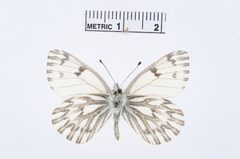
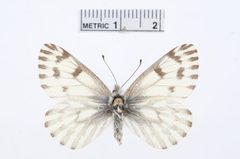
Distinguished from similar checkered whites (Pontia beckerii, P. protodice, P. occidentalis) by dark pattern on underside of hind wings. In , difficult to separate from Large Marble (Euchloe ausonides) and Cabbage White (Pieris rapae); perched specimens can be identified by underside wing pattern. Flies earlier in season than most other white butterflies in its range.
Images
Appearance
Small with wingspan of 31-40 mm. Upper wing surface mostly white with small black markings; females may be yellowish. Underside of hind wings shows dark pattern of , a key identification feature. Some specimens have nearly pure white upper surface.
Habitat
Foothills and higher elevations in mountainous areas. Frequents canyon bottoms and ridge tops where males hilltop to intercept females. Associated with prairie and dry meadow where plants grow.
Distribution
Western North America: most of U.S. west of Rocky Mountains, including mountains of Arizona and New Mexico; extends east into extreme western South Dakota and Nebraska Panhandle; south-central British Columbia; in Oregon and Washington, found east of Cascade Range and in Olympic Mountains. Present in western Canada and United States.
Seasonality
Early spring : on wing from late February through end of June. One annually at higher elevations, two generations at lower elevations. Among first butterflies to appear in spring, often before vernal equinox in Colorado Front Range.
Host Associations
- Caulanthus - larval Brassicaceae
- Streptanthus - larval Brassicaceae; S. breweri has orange spots that mimic , deterring oviposition
- Sisymbrium altissimum - larval Brassicaceae; hedge mustard
- Arabis glabra - larval Brassicaceae; rock-cress
- Arabis furcata - larval Brassicaceae; rock-cress
- Arabis holboelli - larval Brassicaceae; rock-cress
- Descurainia - larval Brassicaceae; tansy-mustard
Life Cycle
Females deposit single on stems and foliage of plants. Eggs hatch in approximately one week. Larvae progress through five instars; older caterpillars are yellow and blue-gray vertically striped with black speckles. occurs in chrysalis that is mottled brown or black with texture. Unlike most pierids, chrysalis lacks silk girdle and attaches only at tail end using hooks fastened to silk pad.
Behavior
Males exhibit , flying along ridge tops and buttes to intercept females flying up from below. Wary and easily startled; perches frequently but difficult to approach for photography. Can be found in canyon bottoms where topography funnels females.
Ecological Role
Herbivore as larva; as . Larval feeding on Brassicaceae. Potential prey for various and .
Human Relevance
None significant; not a pest . Serves as early-season indicator of spring arrival in western North America.
Similar Taxa
- Pontia protodiceCheckered White; similar in appearance but with different distribution and seasonality; P. sisymbrii flies earlier and has more restricted western range
- Pontia beckeriiBecker's White; similar checkered white pattern but different geographic range and preferences
- Pontia occidentalisWestern White; similar appearance but differs in distribution and subtle wing pattern details
- Euchloe ausonidesLarge Marble; extremely difficult to distinguish in ; perched specimens separable by underside wing pattern and marble-like reticulation on hindwing underside of E. ausonides
- Pieris rapaeCabbage White; similar white coloration but lacks dark pattern on underside; different and seasonality
More Details
Subspecies
Five recognized: P. s. sisymbrii, P. s. elivata (Barnes & Benjamin, 1926), P. s. flavitincta (Comstock, 1924), P. s. nigravenosa (Austin & Emmel, 2003), P. s. transversa (Holland, 1995)
Egg mimicry
In northern California, Streptanthus breweri (Brewer's Jewelflower) produces orange spots that mimic , causing females to avoid these plants; this reduces risk as caterpillars are known to cannibalize each other when too numerous on one plant