
Pontia protodice
(Boisduval & Leconte, 1830)
Checkered White, Southern Cabbage Butterfly
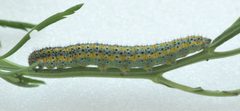
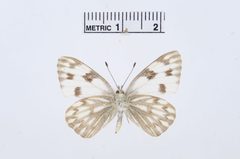
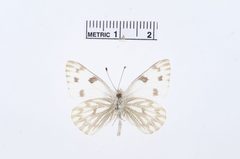
Pontia protodice, commonly known as the Checkered White or Southern Cabbage Butterfly, is a North American pierid widespread in the southern United States and northern Mexico. The exhibits pronounced in wing patterning, with females displaying more extensive black and gray markings than males. are highly vagile and have been documented making significant seasonal incursions northward beyond their core range. The green larva, known as the Southern Cabbageworm, feeds on a diverse array of Brassicaceous plants.
Pronunciation
How to pronounce Pontia protodice: //ˈpɒnʃə proʊˈtoʊdaɪsi//
These audio files are automatically generated. While they are not always 100% accurate, they are a good starting point.
Identification
are distinguished from similar pierid butterflies by the checkered pattern of black and gray markings on white wings, more extensive in females than males. The underside of the hindwings shows extensive yellow-brown veining. Wingspan ranges 3.2–4.4 cm. Males patrol -plant areas in a characteristically straight, rapid pattern described as 'like it's late for an important date,' differing from the more erratic flight of Pieris rapae. Females exhibit a distinctive rejection posture when unreceptive to mating: wings fully opened with tips below horizontal, elevated 45–60 degrees, and genitalia extruded.
Images
Habitat
Open, disturbed dry areas including desert, plains, vacant lots, railroad corridors, airports, dry grassland, and urban environments. Also occurs in sparsely wooded areas, grasslands, and meadows in prairie and parkland regions, typically where shade is not heavy. Absent from heavily forested areas and regions with dense cover.
Distribution
Core range in southern United States and northern Mexico. Regularly occurs northward into the central and northern U.S. and southern Canada, though are irregular and often represent seasonal immigration rather than permanent establishment. Absent from Pacific Northwest and New England; populations east of the Appalachians have become increasingly erratic. GBIF records indicate irregular presence in Alberta, Manitoba, and Saskatchewan, Canada.
Seasonality
Most widespread and abundant from late summer through autumn. In California's Central Valley, historically abundant at low elevations in the 1970s but now rarely seen before September and October in most years. At Sierra Valley, colonizes annually from desert regions in May or June, becoming common by late summer. Overwinters locally and sporadically in limited areas, primarily as pupae.
Diet
nectar on mustards (Brassicaceae), composites (Asteraceae), alfalfa (Medicago sativa), and a wide variety of other flowering plants including legumes. Larvae feed on buds, flowers, and fruit of plants, with older larvae also consuming rosettes when larger plants are .
Host Associations
- Arabis petiolaris - larval Brazos rockcress
- Senna obtusifolia - larval sicklepod
- Brassica nigra - larval black mustard
- Brassica oleracea - larval broccoli, Brussels sprouts, cabbage, cauliflower
- Brassica rapa - larval turnip
- Descurainia pinnata - larval pinnate tansy-mustard
- Descurainia sophia - larval flixweed tansy-mustard
- Lepidium densiflorum - larval prairie pepperweed
- Lepidium virginicum - larval Virginia pepper-grass
- Raphanus sativus - larval radish
- Sisymbrium altissimum - larval tumble mustard
- Thlaspi arvense - larval field pennycress
- Hirschfeldia incana - larval short-lived , formerly Brassica geniculata
Life Cycle
stage: orange eggs laid conspicuously near the top of plants. Larval stage: five instars; mature larvae black-dotted, bluish-green to gray with yellow , lateral, and sublateral stripes. Pupal stage: overwinters as pupa; color variable from blue-gray to cream; pupa lacks the silk girdle typical of many pierids, attaching only at the caudal end. stage: emerges after winter ; males typically eclipse earlier than females.
Behavior
Males patrol -plant areas to locate females, assessing female age through UV reflectance patterns on worn wings—older females have more melanic markings and greater UV absorption due to loss. Males prefer larger females with longer forewings and younger females for longer copulation duration. Males transfer substantial nutrient investment (7–8% of precopulatory body mass) via during mating, with smaller males contributing proportionally more. Females actively solicit males when spermatophore contents deplete, typically 5–7 days post-mating. Females employ thermoregulatory reflectance basking, orienting the body surface toward the sun with wings held open to reflect radiation. High male-to-female ratios in early season drive female from dense colonies to colonize new .
Ecological Role
Larval herbivore on Brassicaceae; . Significant seasonal colonizer of disturbed and open . Serves as prey for various ; specific relationships not documented in available sources.
Human Relevance
Larva known as Southern Cabbageworm, a minor agricultural pest on cultivated Brassica crops including cabbage, broccoli, cauliflower, and turnip. are common subjects for observation and photography. Occasionally abundant in irrigated alfalfa fields where adults visit flowers. Not considered a major economic pest compared to Pieris rapae.
Similar Taxa
- Pieris rapaeSimilar size and white base color; distinguished by more erratic pattern, less extensive dark markings especially in females, and presence year-round in many areas rather than late-season peak abundance.
- Pontia sisymbriiSpring White overlaps in western range; flies earlier in season (spring rather than late summer), has dark-patterned hindwing underside but with different venation pattern, and is more wary with difficult-to-approach perching .
- Euchloe ausonidesLarge Marble has similar size and white coloration; distinguished by reticulated 'marble' pattern on hindwing underside, spring period at lower elevations, and more effective camouflage when perched.
More Details
Sexual dimorphism in UV signaling
Female wing surfaces are partially UV reflective, with reflectance changing as females age due to loss and tattering. Males use this as a reliable cue for female age assessment, preferring less worn (more UV reflective) females.
Rejection posture confusion
The female rejection posture—wings spread, elevated, genitalia extruded—has been misinterpreted as a mating invitation by observers unfamiliar with the , due to superficial similarity to attraction displays in other such as Heliconius.
Historical population shifts
In California's Central Valley, this underwent marked decline from 1970s abundance at low elevations; formerly overwintered regularly on dredge tailings along the American River, but now rarely persists through winter in most of its historical range.
Sources and further reading
- BugGuide
- Wikipedia
- GBIF taxonomy match
- iNaturalist taxon
- NCBI Taxonomy
- Catalogue of Life
- A Checkered Past, a Checkered Future or Just Checkered? | Bug Squad
- Bug Eric: September 2010
- Bug Eric: (Wild) Butterfly Magic
- Bug Eric: Spring White
- Bug Eric: Marble-ous!
- Bug Eric: April 2016
- Southern Cabbageworm (larva), Checkered White (adult) Pontia (=Pieris) protodice (Biosduval & Leconte) (Insecta: Lepidoptera: Pieridae: Pierinae)