
Euchloe
Hübner, 1819
Dappled Whites, Marbles
Species Guides
3- Euchloe ausonides(Large Marble)
- Euchloe hyantis(pearly marble)
- Euchloe olympia(Olympia Marble)
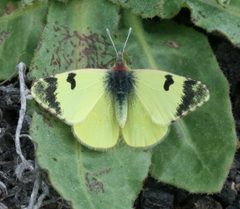
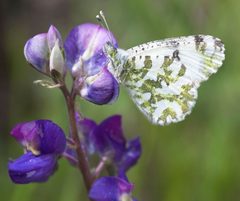
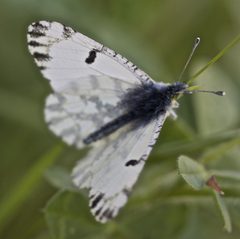
Euchloe is a of pierid butterflies in the tribe Anthocharini with a Holarctic distribution spanning Europe, Central Asia, and North America. Old World are commonly called dappled whites, while New World species are known as marbles. The genus includes approximately 30 described species, with several exhibiting narrow ranges and conservation concern. Some species demonstrate remarkable camouflage abilities through background matching and wing-folding .
Pronunciation
How to pronounce Euchloe: //ˈjuːkloʊ.i//
These audio files are automatically generated. While they are not always 100% accurate, they are a good starting point.
Identification
Members of Euchloe can be distinguished from other Pieridae by the distinctive reticulated or marbled pattern on the underside of the hindwing, which gives the group its . The forewings are typically white or cream-colored. When perched, many fold their wings to conceal the bright forewing and expose only the cryptically patterned underside, rendering them nearly invisible against appropriate backgrounds. Species-level identification requires examination of wing pattern details, geographic location, and in some cases genitalia dissection.
Images
Habitat
occupy diverse including prairies, dry meadows, mountain meadows, and open rocky areas. Many species are associated with specific plant , particularly mustards (Brassicaceae). The Island Marble (E. ausonides insulanus) is restricted to coastal prairie habitat on the San Juan Islands. Some Central Asian species occur in arid and semi-arid environments with sparse vegetation.
Distribution
Holarctic distribution with centers of diversity in Europe, Central Asia, and western North America. North American range from Alaska through western Canada to California, Arizona, and New Mexico. European and Central Asian species extend from the Iberian Peninsula eastward through the Mediterranean, Middle East, and into Central Asia including Tajikistan.
Seasonality
periods vary by and elevation. At lower elevations, some species have two annually with spring and summer flight periods. At higher elevations, most species have a single generation with summer flight. The Large Marble (E. ausonides) flies in spring at lower elevations and in summer in mountain meadows.
Diet
feed on nectar from flowers. Larvae feed on plants in the Brassicaceae, including rockcress (Arabis), Dyer's Woad (Isatis tinctoria), Tower Mustard (Turritis glabra), and Streptanthus . Specific plant associations vary among species.
Host Associations
- Arabis - larval rockcress
- Isatis tinctoria - larval Dyer's Woad
- Turritis glabra - larval Tower Mustard
- Streptanthus tortuosus - larval documented for E. hyantis
- Brassicaceae - larval -level association for
Life Cycle
Complete with , larva, pupa, and stages. Larvae are slender with vertical striping in yellow, blue-gray, and black speckling that provides camouflage against plant stems. occurs in a chrysalis. Voltinism varies: some have one per year at high elevations, two at lower elevations. The decision to enter is controlled by environmental cues including and temperature.
Behavior
exhibit strong cryptic when perched, selecting backgrounds that match their hindwing underside pattern and orienting their bodies to maximize concealment. Males of some engage in behavior, flying rapidly along ridgelines to intercept females. Males of E. hyantis have been described as fast, erratic fliers that rarely pause except briefly at flowers.
Ecological Role
Larvae function as herbivores on Brassicaceae, potentially influencing plant . serve as when visiting flowers for nectar. The has been used extensively as a study system for understanding biotic responses to climate change, with long-term monitoring data from central California documenting declines and phenological shifts.
Human Relevance
Several are of conservation concern due to restricted ranges and declines. The Island Marble (E. ausonides insulanus) is highly endangered with a single known population on the San Juan Islands of Washington State. The Large Marble (E. ausonides) has experienced regional extinction across much of its former range in California's Central Valley. Euchloe species have contributed to scientific understanding of climate change impacts on insects through Art Shapiro's 50+ year monitoring program in California.
Similar Taxa
- PontiaSimilar size and white wing coloration; Spring White (P. sisymbrii) can be confused with marbles in , but lacks the distinctive marbled hindwing underside pattern of Euchloe
- PierisCabbage White (P. rapae) overlaps in and period; distinguished by lack of marbled hindwing pattern and different flight
- AnthocharisShared tribe Anthocharini; orangetips have orange wing tips not present in Euchloe, and different underside patterns
More Details
Conservation status
Multiple Euchloe are experiencing significant declines. E. ausonides was regionally extinct across low-elevation sites in California by 2005. E. ausonides insulanus was thought extinct for approximately 90 years before rediscovery in 1998, and currently exhibits low genetic diversity, small effective population size, and high inbreeding. E. tomiris in Tajikistan has low abundance and fragmented distribution threatened by grazing and agricultural conversion.
Research significance
Euchloe ausonides has been a focal in one of the longest-running monitoring programs in North America, initiated by Art Shapiro in 1972. Research on this species has demonstrated climate-driven phenological shifts, with advancing dates and experiencing voltinism changes. The exemplifies challenges facing temperate butterflies under climate change, including disrupted cues and butterfly-plant phenological mismatches.
Sources and further reading
- BugGuide
- Wikipedia
- GBIF taxonomy match
- iNaturalist taxon
- NCBI Taxonomy
- Catalogue of Life
- Mary Louise Flint's Article in The Acorn: 'Butterflies in Decline' | Bug Squad
- Art Shapiro: 'Using Butterflies to Understand Biotic Responses to Climate Change' | Bug Squad
- Where Are All the Butterflies? | Bug Squad
- An Admiral at the Marina | Bug Squad
- Bug Eric: Marble-ous!
- Bug Eric: April 2016
- Habitat: Euchloe hyantis andrewsi
- Studies on Nearctic Euchloe. Part 8. Distribution, ecology, and variation of Euchloe olympia (Pieridae) populations
- Studies on Nearctic Euchloe. Part 5. Distribution
- Оценка состояния Euchloe tomiris Christoph, 1884 (Lepidoptera, Pieridae) и меры по сохранению ее популяции в Таджикистане
- Designation of Lectotype and synonymy for Euchloe lotta Beutenmuller (Lepidoptera: Pieridae)
- Intraspecific Host Plant Choice: Lack of Consequences for Streptanthus tortuosus (Cruciferae) and Euchloe hyantis (Lepidoptera: Pieridae)
- Population genetics of the endangered narrowly endemic Island Marble butterfly ( Euchloe ausonides insulanus )
- The genome sequence of the Portuguese Dappled White, Euchloe tagis (Hübner, 1804) (Lepidoptera: Pieridae).
- The genome sequence of the Mountain Dappled White, Euchloe simplonia (Boisduval, 1828) (Lepidoptera: Pieridae).