
Anthocharis
Boisduval, Rambur, Duméril & Graslin, 1833
orangetips, orange tips
Species Guides
6- Anthocharis cethura(Desert Orangetip)
- Anthocharis julia(Julia Orangetip)
- Anthocharis lanceolata(Gray Marble)
- Anthocharis midea(Falcate Orangetip)
- Anthocharis sara(Sara orangetip)
- Anthocharis thoosa(Southwestern Orangetip)
Anthocharis is a Holarctic of pierid butterflies comprising approximately 20 , commonly known as orangetips. These small butterflies are characterized by white to pale yellow wings with distinctive orange, red, or yellow markings on the forewings in males. The genus occurs across temperate regions of North America, Europe, and Asia, with species typically restricted to specific geographic areas rather than having broad distributions. All species are , with active primarily in spring.
Pronunciation
How to pronounce Anthocharis: /ˌænθoʊˈkærɪs/
These audio files are automatically generated. While they are not always 100% accurate, they are a good starting point.
Identification
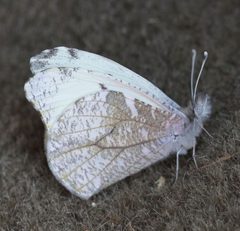
Males distinguished by orange, red, or yellow coloration at forewing apices; females generally lack these bright markings and appear white or pale yellow. Forewing with two of five subcostal branching before apex; upper radial vein only weakly united with subcostal; central discocellular vein relatively long. Hindwing underside often with greenish or grayish marbling in some . Species identification requires examination of wing pattern details, genitalia, or larval characteristics.
Images
Habitat
Open including meadows, woodland edges, hedgerows, riparian areas, and grasslands. Many associated with specific plant where larval plants occur.
Distribution
Holarctic distribution spanning temperate North America, Europe, and Asia. North American concentrated in western and southwestern regions; Palearctic species primarily in southern Europe and Mediterranean region with one species extending northward. No species occur in tropical regions.
Seasonality
; emerge and are active in spring, typically April through May in temperate regions. Single per year with pupal stage.
Diet
Larvae are on Brassicaceae (cruciferous plants), feeding on flowers, young leaves, and developing seed pods. feed on nectar from diverse flowering plants including plants and other early spring bloomers.
Life Cycle
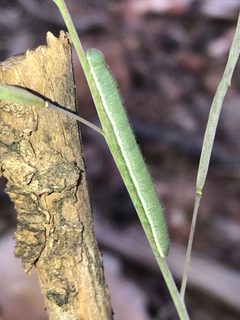
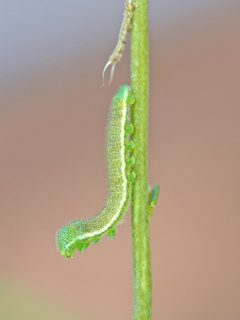
Complete with cycle. laid singly on plant flower buds or stems. Larvae develop through five instars, feeding on Brassicaceae tissues. occurs near host plant base or on adjacent vegetation; overwinters as chrysalis. emerge following spring warming.
Behavior
Males of many exhibit , flying to elevated terrain features to locate females. Males patrol linear territories along hedgerows, woodland edges, or ridgelines. Some species defend specific perches; others engage in with rapid vertical aerial pursuits. Females search visually for plants, preferentially ovipositing on taller, more conspicuous plants with sparse surrounding vegetation.
Ecological Role
of early spring flowers; herbivore regulating Brassicaceae through larval feeding. Some subject to population impacts from plants acting as ecological traps.
Similar Taxa
- EuchloeBoth are small white pierids with marbled hindwing undersides; Euchloe (marbles) lack orange forewing tips and typically show more extensive greenish marbling on hindwing underside, with different wing venation patterns.
- PierisPieris (whites and cabbage whites) are similar in size and general coloration but lack orange markings, have more rounded wing shapes, and different larval plant associations.
Sources and further reading
- BugGuide
- Wikipedia
- GBIF taxonomy match
- iNaturalist taxon
- NCBI Taxonomy
- Catalogue of Life
- Spring Has Sprung: Bees, Butterflies and Blossoms Grace the Dixon May Fair | Bug Squad
- Braconidae | Beetles In The Bush
- Bug Eric: Spring (Butterfly) Beauties
- Bug Eric: Hilltopping
- April | 2023 | Beetles In The Bush
- Bug Eric: Marble-ous!
- The population biology of the Orange Tip butterfly Anthocharis cardamines in Britain
- Host Plants, Nectar Source Plants, and Habitat Selection of Males and Females of Anthocharis cardamines (Lepidoptera)
- The Invasive Plant, Alliaria petiolata, Is an Ecological Trap for the Native Butterfly, Anthocharis midea, in North America
- Beyond yellow: host plants of <i>Anthocharis euphenoides</i> in NW Italy
- The ‘edgeeffect’ in butterfly oviposition: causality in Anthocharis cardarnines and related species
- Description of recent discovery of Anthocharis damone Boisduval, 1836 in Serbia and its distribution in Europe (Lepidoptera: Pieridae)
- Host plant conspicuousness and the distribution of eggs and larvae in the butterfly, Anthocharis scolymus (Lepidoptera: Pieridae)
- Observations on co-existing late-instar caterpillars of the Orange-tip butterfly, Anthocharis cardamines (Linnaeus) (Lepidoptera: Pieridae)
- DNA barcodes reveal different speciation scenarios in the four North American Anthocharis Boisduval, Rambur, [Duménil] & Graslin, [1833] (Lepidoptera: Pieridae: Pierinae: Anthocharidini) species groups
- XXI. On the distribution of the Charlonia group of the genus Anthocharis
- Possible Age-Dependent Variation in Egg-Loaded Host Selectivity of the Pierid Butterfly, Anthocharis scolymus (Lepidoptera: Pieridae): A Field Observation