
Anthocharis sara
Lucas, 1852
Sara orangetip, Pacific orangetip
Species Guides
4- Anthocharis sara gunderi(Santa Catalina Orangetip)
- Anthocharis sara pseudothoosa(False Thoosa Orangetip)
- Anthocharis sara sara(Sara Orangetip)
- Anthocharis sara sempervirens(Sara Orange-Tip)
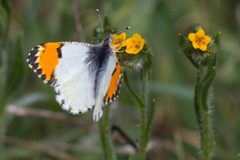
Anthocharis sara is a pierid native to western North America, ranging from Baja California north to extreme southwestern Oregon and east to the Sierra Nevada and western Nevada. It is one of three distinct in the Sara orangetip complex, separated from A. julia and A. thoosa by >2% mitochondrial COI barcode divergence and morphological characters of stages. The species exhibits strong seasonality with two annually and has been documented utilizing diverse mustard plants.
Pronunciation
How to pronounce Anthocharis sara: /ˌænθoʊˈkɛərɪs ˈsɛərə/
These audio files are automatically generated. While they are not always 100% accurate, they are a good starting point.
Identification
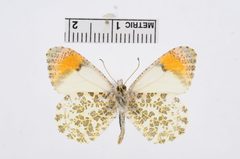
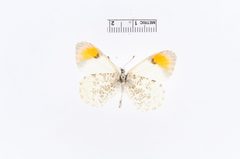
Distinguished from co-occurring Anthocharis by geographic range and, when stages are available, by larval and pupal cone curvature. reliably separates A. sara from A. julia and A. thoosa (>2% COI divergence). Males distinguished from females by UV-reflective wing tips visible with appropriate equipment. Four recognized: A. s. sara (widespread west of Sierra Nevada), A. s. pseudothoosa (east slope Sierra Nevada), A. s. gunderi (Santa Catalina and Santa Cruz islands), A. s. sempervirens (Redwood National Park).
Images
Habitat
Orchards, fields, meadows, and canyons. Males patrol along stream sides and roads in canyon bottoms during mating season.
Distribution
Pacific coast of North America from central Baja California north to extreme southwestern Oregon; interior on east slope of Sierra Nevada extending into far western Nevada. Disjunct population on Santa Catalina and Santa Cruz islands ( gunderi).
Seasonality
Two annually with strong seasonal restriction: first brood late January to April, second brood May to early July. Occasional overlap between . not present for approximately half the year.
Host Associations
- Arabis perennans - plantnative mustard
- Athysanus pusillus - plantnative mustard
- Brassica nigra - plantnative and non-native ; also listed among non-native in California
- Barbarea verna - plantnon-native in California
- Barbarea vulgaris - plantnon-native in California
- Brassica napus - plantnon-native in California
- Brassica rapa - plantnon-native in California
- Capsella bursa-pastoris - plantnon-native in California
- Hirschfeldia incana - plantnon-native in California
- Tropaeolum spp. - plantnon-native in California
- Raphanus sativus - plantnon-native in California
- Sinapis alba - plantnon-native in California
- Sinapis arvensis - plantnon-native in California
- Sisymbrium officinale - plantnon-native in California
Life Cycle
laid on stems, , and bases of petioles; less commonly on buds, flowers, and leaves. Larvae feed on buds, flowers, and fruits of plants. Pupae enter ; in captivity, diapause has been observed to extend up to three years.
Behavior
Males patrol linear paths along streams and roads in canyon bottoms to locate females, with males occupying the best sites. Males and females communicate via drumming.
Ecological Role
Larval herbivore on mustard plants; .
Human Relevance
Subject of photographic documentation and citizen science observation. sempervirens described from Redwood National Park. 'Pacific orangetip' now considered obsolete as it implied distribution encompassing multiple .
Similar Taxa
- Anthocharis juliaJulia orangetip; distinct in sara complex, separated by >2% COI barcode divergence and morphological characters of stages; ranges do not overlap with A. sara
- Anthocharis thoosaSouthwestern orangetip; distinct in sara complex, separated by >2% COI barcode divergence and morphological characters; shows largest intraspecific barcode divergence with identifiable metapopulation haplotypes
- Anthocharis mideaFalcate orangetip; eastern North American , replaced westward by A. sara; not reliably separated from A. limonea by barcodes alone
Misconceptions
The 'Pacific orangetip' is obsolete and misleading, as it was previously applied to what is now recognized as three separate (A. sara, A. julia, A. thoosa).
More Details
Taxonomic history
Part of the Anthocharis sara ; elevated to distinct status based on molecular and morphological evidence. Four currently recognized, with sempervirens described most recently (2008).
Molecular identification
of COI reliably distinguishes A. sara from A. julia and A. thoosa; no evidence of or hybridization detected between these three . Morphological identification of stages always agrees with barcode identification.
Sources and further reading
- BugGuide
- Wikipedia
- GBIF taxonomy match
- iNaturalist taxon
- NCBI Taxonomy
- Catalogue of Life
- Spring Has Sprung: Bees, Butterflies and Blossoms Grace the Dixon May Fair | Bug Squad
- For the Love of Bees | Bug Squad
- A Gathering of Beekeepers and a Gathering of Kids and Bees | Bug Squad
- Day hike at Little Lost Creek Conservation Area | Beetles In The Bush
- The Stonefly Diaries ~ a blog Part 1 - Buglife Blog - Buglife
- A Day in the Life of an Urban Insect Ecologist
- DNA barcodes reveal different speciation scenarios in the four North American Anthocharis Boisduval, Rambur, [Duménil] & Graslin, [1833] (Lepidoptera: Pieridae: Pierinae: Anthocharidini) species groups