
Anthocharis midea
(Hübner, 1809)
Falcate Orangetip
A pierid native to eastern North America, characterized by the orange-tipped forewings of males and distinctive green marbled hindwing undersides. emerge in early spring and live approximately one week. The specializes on Brassicaceae plants, with documented ecological trap dynamics involving the plant Alliaria petiolata.
Pronunciation
How to pronounce Anthocharis midea: //ænˈθɒkərɪs ˈmɪdiə//
These audio files are automatically generated. While they are not always 100% accurate, they are a good starting point.
Identification
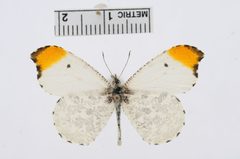
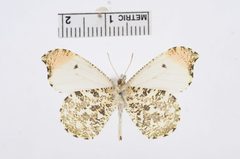
Distinguished from the only similar in range, Euchloe olympia (Olympia marble), by orange (not grayish-black) forewing apex in males and green (not yellow-green) hindwing marbling. The round black forewing spot also aids identification.
Images
Appearance
Wingspan 3.5–4.5 cm. Male forewing apex orange on upper surface; females lack orange tips. Both sexes have a round black spot in the forewing . Hindwing underside with intricate green marbling. Larva olive green with yellow mid- stripe and white spiracular stripe running length of body; body covered with short hairs and tiny black dots, reaching up to 3 cm. Chrysalis yellowish with black spots and a spike-like projection resembling a thorn.
Habitat
Open, wet woods along waterways; open swamps; less frequently dry woods and ridgetops. Oak-hickory forest understories and edges where native Brassicaceae occur.
Distribution
Eastern United States, extending to Texas and Oklahoma.
Seasonality
on wing April to May; March to May in southern Texas. with one per year.
Diet
forage for nectar from violets, mustards, and other available flowers. Larvae consume flowers, flower buds, seed pods, and young leaves of Brassicaceae plants; prefer flowers and reproductive structures over foliage.
Host Associations
- Cardamine concatenata - primary native oviposit on developing flowers and upper stems; larvae consume flowers, young leaves, and developing siliques
- Alliaria petiolata - ecological trapHighly attractive to ovipositing but lethal to larvae
- Cardamine diphylla - native
- Cardamine pratensis - native
- Arabis glabra - native
- Arabidopsis lyrata - native
- Arabis serotina - native
- Barbarea verna - native
- Boechera canadensis - native
- Boechera grahamii - native
- Boechera laevigata - native
- Cardamine angustata - native
- Cardamine bulbosa - native
- Cardamine hirsuta - native
- Cardamine parviflora - native
- Lepidium densiflorum - native
Life Cycle
Overwinters as chrysalis for two or more years possible. Emerges early spring (typically April in northern range, March in southern Texas). live approximately one week. Females lay singly on plant flowers, occasionally in multiples; eggs yellow-green turning red before hatching within one week. Larvae feed mainly at night for up to 14 days, becoming increasingly mobile in late instars to seek new food sources. occurs in mid-June near base of host plants or on trees. One per year.
Behavior
Males patrol hilltops and flats throughout the day seeking females. Larvae are cannibalistic, consuming smaller larvae on the same plant. exhibit seasonal shift in oviposition preference: prefer native Cardamine concatenata early in season, but strongly prefer Alliaria petiolata later in season. rapid and erratic; adults often reluctant to perch.
Ecological Role
herbivore on native Brassicaceae. Subject to ecological trap dynamics with Alliaria petiolata that may cause local declines and drive selection for altered oviposition or larval .
Human Relevance
Serves as a study system for ecological trap dynamics and impacts on native herbivores. No significant direct economic or cultural importance documented.
Similar Taxa
- Euchloe olympiaOnly similar in range; distinguished by grayish-black (not orange) forewing apex and yellow-green (not green) hindwing marbling
More Details
Ecological Trap Dynamics
The plant Alliaria petiolata serves as a severe ecological trap: preferentially oviposit on it later in the season and lay more overall and in multiples, yet larvae fed little and died when offered this plant in laboratory studies. Drought stress and larval age did not improve survival on A. petiolata.
Chrysalis Diapause
The chrysalis may overwinter for two or more years, suggesting potential for extended under certain conditions.