
Anthocharidini
Marbles and Orangetips
Genus Guides
2- Anthocharis(orangetips)
- Euchloe(Dappled Whites)
Anthocharidini is a tribe of butterflies in the Pieridae, commonly known as marbles and orangetips. The tribe includes such as Anthocharis and Euchloe in North America. studies have revealed complex speciation patterns among North American Anthocharis , with four distinct species groups showing varying levels of genetic divergence and different evolutionary histories.
Pronunciation
How to pronounce Anthocharidini: //ˌænθoʊkəˈrɪdɪnaɪ//
These audio files are automatically generated. While they are not always 100% accurate, they are a good starting point.
Identification
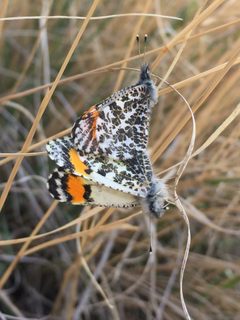
often exhibit orange or yellow wing coloration, with some showing distinctive orange patches on forewings. Larvae of Anthocharis species can be identified to species group by fifth instar and pupal cone curvature. (mitochondrial COI) reliably separates most species groups, though some recently diverged species pairs may show overlapping barcode variation.
Images
Distribution
Widespread across the Northern Hemisphere. North American representatives include: the lanceolata and sara groups in western North America; the cethura group in southwestern North America; and the midea group ranging from northeastern USA south to Hidalgo, Mexico.
Life Cycle
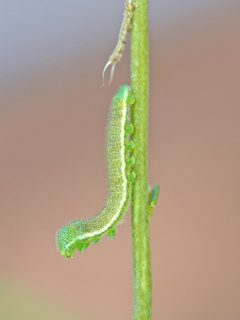
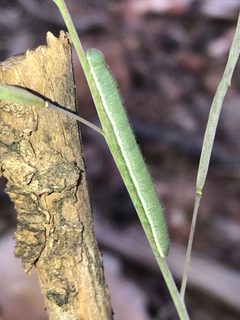
Fifth instar larvae and pupal cone curvature serve as diagnostic morphological characters for identification in Anthocharis.
Similar Taxa
More Details
Speciation patterns in North American Anthocharis
barcode studies reveal four groups with distinct evolutionary histories: (1) lanceolata group with deepest divergence (~2.7% between species); (2) sara group with three well-defined species and notable intraspecific divergence in A. thoosa; (3) cethura group with minimal divergence, treated as single variable species; (4) midea group showing north-south barcode gradient suggesting recent vicariant speciation with incomplete genetic separation
Sources and further reading
- BugGuide
- iNaturalist taxon
- Genetic, Phenetic, and Distributional Relationships of NearcticEuchloe(Pieridae, Pierinae, Anthocharidini)
- DNA barcodes reveal different speciation scenarios in the four North American Anthocharis Boisduval, Rambur, [Duménil] & Graslin, [1833] (Lepidoptera: Pieridae: Pierinae: Anthocharidini) species groups