
Anthocharis julia
Edwards, 1872
Julia Orangetip, Southern Rocky Mountain Orangetip
Species Guides
6- Anthocharis julia alaskensis(Alaskan Orange Tip)
- Anthocharis julia browningi(Utah Julia Orangetip)
- Anthocharis julia flora(Flora Orangetip)
- Anthocharis julia julia(Southern Rocky Mountain orangetip)
- Anthocharis julia stella(Stella Orangetip)
- Anthocharis julia sulfuris
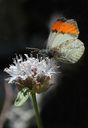
Anthocharis julia is a in the Pieridae, commonly known as the Julia Orangetip or Southern Rocky Mountain Orangetip. It is one of three species in the sara species group, distinguished by more than 2% mitochondrial COI barcode divergence from A. sara and A. thoosa. Molecular and morphological evidence consistently support its species status with no detected or hybridization. The species is to the southern Rocky Mountains on the eastern side of the range.

Pronunciation
How to pronounce Anthocharis julia: /ænˈθɒkərɪs ˈdʒuːliə/
These audio files are automatically generated. While they are not always 100% accurate, they are a good starting point.
Identification
Can be distinguished from other Anthocharis by morphological characters of fifth instar larvae and pupal cone curvature; reliably separates it from A. sara and A. thoosa with greater than 2% sequence divergence. Identification by of stages always agrees with barcode identification.
Images
Habitat
Forested riparian areas, canyons among foothills, and washes, usually in oak woodland.
Distribution
Southern Rocky Mountains on the eastern side of the range.
Diet
feed on flower nectar from plants as well as thistles, fiddleneck, and brodiaeas.
Host Associations
- Arabis - larval rock cress
Life Cycle
Caterpillars feed on rock cress (Arabis) .
Similar Taxa
- Anthocharis saraMember of same group; distinguished by barcode divergence and morphological characters of stages
- Anthocharis thoosaMember of same group; distinguished by barcode divergence and morphological characters of stages; A. thoosa exhibits larger intraspecific divergence in DNA barcodes with identifiable metapopulation haplotypes
Sources and further reading
- BugGuide
- Wikipedia
- GBIF taxonomy match
- iNaturalist taxon
- NCBI Taxonomy
- Catalogue of Life
- Learning About the Bees and the Nutrition They Need | Bug Squad
- Mosquito Expert Julián Hillyer's Topic: 'Not So Heartless!' | Bug Squad
- ecotourism management | Blog
- Melanthiaceae | Beetles In The Bush
- Need to Feed Mosquitoes? Head for the Freezer Aisle
- DNA barcodes reveal different speciation scenarios in the four North American Anthocharis Boisduval, Rambur, [Duménil] & Graslin, [1833] (Lepidoptera: Pieridae: Pierinae: Anthocharidini) species groups