
Anthocharis cethura
Felder & Felder, 1865
Desert Orangetip, Felder's Orangetip
Species Guides
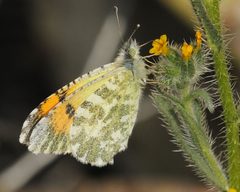
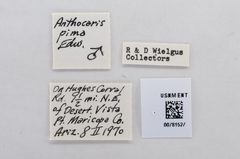
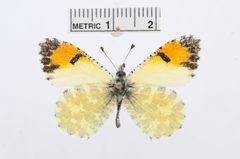
1- Anthocharis cethura pima(Pima Desert Orangetip)
Anthocharis cethura is a in the Pierinae, native to the southwestern United States and northern Mexico. It inhabits rocky desert hills and ridges, where males engage in to locate mates. The exhibits spring activity and has been documented feeding on mustard plants as larvae. Multiple are recognized, including A. c. catalina to Santa Catalina Island, California.
Pronunciation
How to pronounce Anthocharis cethura: //ˌænθoʊˈkɛrɪs sɛˈθʊrə//
These audio files are automatically generated. While they are not always 100% accurate, they are a good starting point.
Identification
Distinguished from other Anthocharis by combination of geographic range (southwestern US and northern Mexico), rocky desert hill , and wing pattern with orange forewing patch outlined in black and white. The cethura group shows the smallest barcode divergence among North American Anthocharis groups, with A. c. morrisoni being most distinct. Differs from A. midea (falcate orangetip) which occurs in eastern and central North America.
Images
Appearance
Wingspan 2.6–4 cm. Wings yellow with orange patch toward front of forewing, outlined in black and white. Wing edges spotted with black. Underside of hindwing has greenish bands. Males and females appear similar. A. c. morrisoni is the most sexually dimorphic and most distinct by barcodes.
Habitat
Rocky desert hills and ridges. Occupies elevated terrain above surrounding landscape, facilitating by males.
Distribution
Southwestern United States and northern Mexico. A. c. catalina to Santa Catalina Island, California.
Seasonality
appear early in spring. Males active midday; females active later in day.
Diet
Larvae feed on plants of the mustard (Brassicaceae). Documented plants include lyreleaf jewelflower (Streptanthus carinatus), London rocket (Sisymbrium irio), western tansymustard (Descurainia pinnata), sand fringepod (Thysanocarpus curvipes), and California mustard (Streptanthus lasiophyllus).
Host Associations
- Streptanthus carinatus - larval lyreleaf jewelflower
- Sisymbrium irio - larval London rocket
- Descurainia pinnata - larval western tansymustard
- Thysanocarpus curvipes - larval sand fringepod
- Streptanthus lasiophyllus - larval California mustard
Life Cycle
laid singly on plants. Eggs blue-green when fresh, turning orange. Early instar caterpillar green with purple stripe outlined in white. Final instar white with mottled markings.
Behavior
Males engage in , patrolling ridge summits to locate females. quick and erratic. Males congregate in midday sun awaiting female ; females active later in day. Males may spiral vertically in aerial contests when competing for access to females.
Ecological Role
of spring-blooming plants in desert . Larvae function as herbivores on mustard plants.
Similar Taxa
- Anthocharis mideaFalcate orangetip overlaps in general appearance but occurs in eastern and central North America rather than southwestern deserts; distinguished by geography and
- Anthocharis saraSara orangetip occurs in western North America but separated by more than 2% barcode divergence and different larval associations
- Eurema nicippeSleepy Orange may co-occur and share , but lacks orange forewing patch with black and white outline
More Details
Subspecies diversity
Multiple recognized. A. c. catalina to Santa Catalina Island, California. A. c. morrisoni is the most sexually dimorphic subspecies and most distinct by barcodes.
Genetic differentiation
The cethura group shows the smallest barcode divergence among the four North American Anthocharis groups, supporting treatment as a single species variable in yellow coloration expression.
Sources and further reading
- BugGuide
- Wikipedia
- GBIF taxonomy match
- iNaturalist taxon
- NCBI Taxonomy
- Catalogue of Life
- Spring Has Sprung: Bees, Butterflies and Blossoms Grace the Dixon May Fair | Bug Squad
- Bug Eric: Spring (Butterfly) Beauties
- Bug Eric: Hilltopping
- Braconidae | Beetles In The Bush
- April | 2023 | Beetles In The Bush
- DNA barcodes reveal different speciation scenarios in the four North American Anthocharis Boisduval, Rambur, [Duménil] & Graslin, [1833] (Lepidoptera: Pieridae: Pierinae: Anthocharidini) species groups