
Oeneis bore
Esper, 1790
white-veined Arctic, Arctic grayling
Oeneis bore is a circumpolar in the Satyrinae, occurring across Arctic regions of North America and Eurasia. It inhabits cold, open environments including tundra, taiga, and alpine slopes. The exhibits in wing coloration and is with a two-year in many . Larvae feed on sedges and grasses, while nectar on available flowers.
Pronunciation
How to pronounce Oeneis bore: /ˈiː.ni.iːs ˈbɔː.reɪ/
These audio files are automatically generated. While they are not always 100% accurate, they are a good starting point.
Identification
Distinguished from similar Arctic by the white-veined pattern on the wing surface and the dark nodal spot on the male forewing. Differs from Oeneis melissa (Melissa Arctic) and Oeneis polixenes (Polixenes Arctic) in wing pattern details and geographic distribution. The combination of greyish-brown male coloration, tawny female coloration, and specific wing markings separates it from .
Images
Appearance
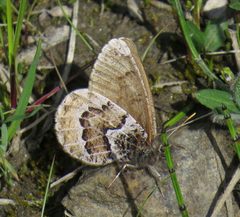
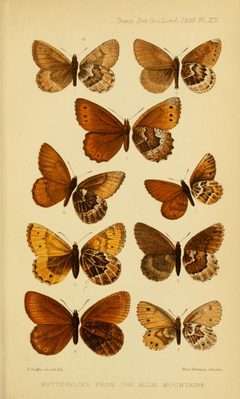
Medium-sized with wingspan 37–49 mm. surface dull greyish-brown in males, often tawny in females. Males possess a dark grey node at the center of the forewing. surface typically shows pale markings including the characteristic white that give the its . Wings relatively rounded with scalloped margins typical of the .
Habitat
Grassy alpine slopes, tundra, taiga, and subarctic bogs. Occupies cold, open with low vegetation structure. Found from sea level in Arctic regions to alpine zones in mountainous areas at southern range limits.
Distribution
Circumpolar Arctic distribution: Arctic Europe including Lapland, northern Russia across Siberia to Yakutia and Magadan, Arctic Canada from Labrador to British Columbia and Alaska. Disjunct southern in Gaspé Peninsula, western Alberta, and Rocky Mountain states (Montana, Wyoming, Colorado).
Seasonality
active during brief Arctic summer, typically June to July depending on latitude and elevation. Two-year common in northern ; some populations may complete cycle in one year in favorable southern locations.
Diet
Larvae feed on sedges (Carex misandra) and grasses including Festuca mibra, Festuca brachyphylla, and Festuca vivipara. Oviposition observed on dead grass leaves. feed on nectar from available flowers.
Life Cycle
or semivoltine depending on and climate. laid on plant leaves, often on dead grass foliage. Larvae feed on sedges and grasses, once or twice depending on latitude. occurs in vegetation or soil. emerge in early summer for brief period.
Behavior
fly low and erratically over tundra vegetation. Males patrol for females in suitable . Both sexes frequently bask with wings open to absorb solar radiation in cold environments. Adults are relatively sedentary within suitable habitat patches.
Ecological Role
of Arctic and alpine flowers during period. Larvae serve as herbivore converting grass and sedge . Prey item for various Arctic including birds and arthropods. for intact tundra and alpine .
Human Relevance
Subject of ecological and biogeographic research due to circumpolar distribution and sensitivity to climate change. Collected by lepidopterists; specimens present in major museum collections including the Bohart Museum. Not of direct economic importance.
Similar Taxa
- Oeneis melissaMelissa Arctic; similar size and but differs in wing pattern details and distribution
- Oeneis polixenesPolixenes Arctic; overlaps in range but separable by wing markings and male genitalia
More Details
Subspecies
Multiple recognized across range: O. b. bore (Arctic Europe, Arctic Siberia), O. b. taygete (Labrador, northern Quebec), O. b. edwardsi (southern Alberta, British Columbia, Montana, Wyoming, Colorado), O. b. fordi (southwestern Alaska), O. b. gaspeensis (southern Quebec), O. b. hanburyi (Yukon, Northwest Territories, British Columbia, northern Manitoba), O. b. mckinleyensis (Alaska), O. b. pansa (Yakutia, Magadan)
Sources and further reading
- BugGuide
- Wikipedia
- GBIF taxonomy match
- iNaturalist taxon
- NCBI Taxonomy
- Catalogue of Life
- Oh, the Butterflies You'll See at the Bohart During UC Davis Biodiversity Museum Day | Bug Squad
- Rising from the Ashes--Some Day | Bug Squad
- Stalk-boring insect pests - AgriLife Extension Entomology
- Recycling ash: Banded Ash Borer, Neoclytus caprea — Bug of the Week
- When is a locust borer not a locust borer? | Beetles In The Bush
- The lesser ash threat? Banded ash clearwing borer, Podosesia aureocincta — Bug of the Week