
Polygonia gracilis
(Grote & Robinson, 1867)
Hoary Comma
Species Guides
2- Polygonia gracilis gracilis
- Polygonia gracilis zephyrus(Zephyr Comma)
Polygonia gracilis, commonly known as the Hoary Comma, is a widespread across North America. It inhabits forested and mountainous regions from Alaska and Canada southward through the Rocky Mountains to New Mexico and the Pacific coast. The species is recognized by its distinctive wing shape with ragged, notched margins. are known to overwinter, allowing for early spring activity in suitable .
Pronunciation
How to pronounce Polygonia gracilis: /pɔliˈɡoʊniə ˈɡrɑːsɪlɪs/
These audio files are automatically generated. While they are not always 100% accurate, they are a good starting point.
Identification
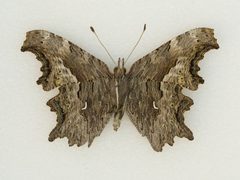
Distinguished from other Polygonia by the hoary (grayish-white) appearance of the underside, particularly the silvery comma mark. The Green Comma (Polygonia faunus) has brighter greenish undersides with more yellow markings. The Eastern Comma (Polygonia comma) shows more orange and brown on the underside with a hooked rather than straight comma mark. The Gray Comma (Polygonia progne) has more uniformly gray undersides without the strong contrast. The ragged wing margins are shared across the but the specific coloration and pattern of the underside separates P. gracilis.
Images
Appearance
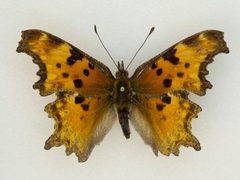
Medium-sized with wingspan approximately 45-55 mm. Upper wing surface is orange-brown with dark brown to black markings and spots. Underside is mottled gray-brown with a small, silvery-white comma-shaped mark near the wing margin, which gives the group its . Wings have a characteristic ragged, notched edge appearance. The body is relatively robust and hairy.
Habitat
and montane forests, including coniferous and mixed woodlands. Found in forest openings, edges, and riparian corridors. In western mountains, occurs from low elevations up to subalpine zones. Associated with areas where plants grow in sunny patches within forested landscapes.
Distribution
North America from Alaska across southern Canada (Yukon, British Columbia, Alberta, Saskatchewan, Manitoba) to New England and the Maritime Provinces. Southward through the Rocky Mountains to New Mexico, and along the Pacific coast from British Columbia to California. Absent from the southeastern United States and most of the Great Plains.
Seasonality
are active from early spring through fall, with peak periods varying by latitude and elevation. adults emerge on warm days in early spring, often before snow melt is complete. New adults appear in mid-summer. In southern parts of the range, two or more generations may occur; in the north, typically one generation with adults overwintering.
Diet
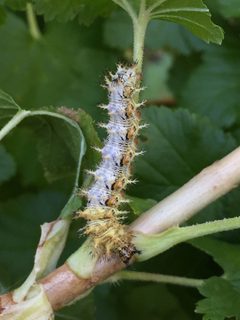
feed on nectar from flowers, tree sap, rotting fruit, and animal droppings. Larvae feed on leaves of various plants including currants (Ribes ), gooseberries, and possibly other shrubs in the Grossulariaceae .
Host Associations
- Ribes - larval plantprimary
Life Cycle
are laid singly on plant leaves. Larvae feed on leaves and rest on the undersides. occurs on the host plant or nearby vegetation. of the final overwinter in sheltered locations such as under bark, in rock crevices, or in leaf litter, emerging in spring to mate and lay eggs.
Behavior
are strong, rapid fliers that often perch on tree trunks and rocks with wings closed, displaying the cryptic underside. They are known to bask on warm surfaces and aggressively defend territories. When disturbed, they may fly rapidly upward and disappear into tree . adults can be active on warm winter days in mild climates.
Ecological Role
serve as when feeding on nectar. Larvae are herbivores that consume leaves of shrubs, contributing to nutrient cycling in forest . The functions as prey for birds, spiders, and other at various life stages.
Human Relevance
Occasional minor pest in currant and gooseberry when larvae are abundant. Valued by watchers and photographers. Used as an for monitoring climate change effects on montane and butterfly .
Similar Taxa
- Polygonia faunusGreen Comma has brighter greenish-yellow underside markings rather than hoary gray-brown
- Polygonia commaEastern Comma has more orange on underside and hooked comma mark; ranges overlap partially but comma is more eastern
- Polygonia progneGray Comma has more uniform gray underside without strong silvery comma contrast
- Nymphalis antiopaMourning Cloak is larger with smooth wing margins and distinctive yellow border, no comma mark
More Details
Overwintering biology
The ability to overwinter as allows this to be among the first butterflies active in spring at high latitudes and elevations, sometimes appearing when snow still covers the ground in forest clearings.
Taxonomic note
The was described by Augustus Radcliffe Grote and Coleman Townsend Robinson in 1867. The specific epithet 'gracilis' refers to the slender or graceful appearance, though this characteristic is not strongly diagnostic.
Sources and further reading
- BugGuide
- GBIF taxonomy match
- iNaturalist taxon
- Catalogue of Life
- 'Battus philenor! Battus philenor!' | Bug Squad
- Grasshopper Collections and Survey
- Bichos Argentinos #2 – Pseudomyrmex sp. | Beetles In The Bush
- Traffic Jam Treehoppers | Beetles In The Bush
- Why two prehistoric sharks found in Ohio got new names
- Bug Eric: City Nature Challenge 2023 Recap