
Polygonia comma
(Harris, 1852)
Eastern Comma, Hop Merchant, Comma Anglewing
Polygonia comma, the eastern comma, is a North American in the Nymphalidae. It exhibits seasonal , with summer and winter forms differing in wing coloration. The is characterized by a distinctive silvery comma-shaped mark on the underside of the hindwing. feed on sap, rotting fruit, and minerals from puddling rather than nectar. Caterpillars are , feeding on a broad range of plants including nettles, hops, elms, and birches. The species overwinters as adults, with some individuals also migrating south.
Pronunciation
How to pronounce Polygonia comma: /pɒlɪˈɡoʊniə ˈkɒmə/
These audio files are automatically generated. While they are not always 100% accurate, they are a good starting point.
Identification
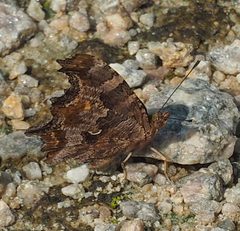
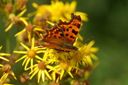
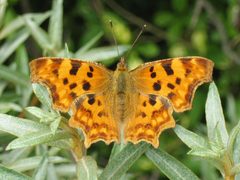
The eastern comma can be distinguished from similar Polygonia by the shape of the comma mark on the underside of the hindwing. The dark summer form has all-black hindwings above, while the winter form has reddish-orange hindwings above. The pale form may be confused with the satyr comma (P. satyrus), but differs in upperside color (orange-brown vs. tawny yellowish-brown), underside pattern (mottled vs. longitudinally streaked), and hindwing submarginal spots (separate and surrounded by dark shading vs. larger and running together into a pale band). The species is frequently confused with the dark form of the question mark (P. interrogationis), from which it is distinguished by comma mark shape.
Images
Habitat
Woods near rivers, ponds, marshes, swamps, and other water sources. Prefers moist woodland environments.
Distribution
North America. Present in Canada (Manitoba, Saskatchewan) and the United States (including Vermont and throughout eastern North America).
Seasonality
are active from spring through fall. The produces multiple per year in southern portions of its range, with partially in some areas. Winter-form adults overwinter, with some south. Activity resumes in spring when overwintered adults become active.
Diet
seldom visit flowers. They feed on sap, rotting fruit, salts and minerals from puddling, and .
Life Cycle
Green are laid singly or in stacks under plant leaves and stems. The spiny larva varies in color from pale green to yellow to white to black. Larvae are solitary and feed on leaves at night. Older larvae construct daytime leaf shelters by pulling a single leaf together with silk. The chrysalis is brown and covered with spines. The exhibits facultative regulated by , with short day lengths inducing diapause and long day lengths promoting direct development.
Behavior
Larvae feed nocturnally and construct silk shelters for daytime concealment. exhibit seasonal in response to cues. Males engage in territorial . The demonstrates high transcriptional plasticity in response to plant switches, enabling utilization of diverse host plants.
Similar Taxa
- Polygonia interrogationisFrequently confused with dark form of eastern comma; distinguished by shape of comma mark on hindwing underside
- Polygonia satyrusPale form confused with satyr comma; distinguished by upperside color (orange-brown vs. tawny yellowish-brown), underside pattern (mottled vs. longitudinally streaked), and hindwing submarginal spot pattern
Sources and further reading
- BugGuide
- Wikipedia
- GBIF taxonomy match
- iNaturalist taxon
- Catalogue of Life
- 'Battus philenor! Battus philenor!' | Bug Squad
- Archive — Bug of the Week
- Bug Eric: City Nature Challenge 2023 Recap
- Friday Editor’s Tip: Lose the formatting! | Beetles In The Bush
- Bug Eric: Emerald Valley, 2016
- Navy Entomologists: Protecting Sailors and Marines Around the World
- Eastern comma, hop merchant, comma angelwing, Polygonia comma (Harris) (Insecta: Lepidoptera: Nymphalidae: Nymphalinae)
- Genetics of diapause in the comma butterfly Polygonia c‐album
- Host plant preferences in the comma butterfly (Polygonia c-album): Do parents and offspring agree?
- Effects of changing photoperiods in the life cycle regulation of the comma butterfly, Polygonia c‐album (Nymphalidae)
- Genetics of host-plant preference in the comma butterfly Polygonia c-album (Nymphalidae), and evolutionary implications
- Plasticity for the win: Flexible transcriptional response to host plant switches in the comma butterfly (Polygonia c-album)
- Phylogenetic relatedness and host plant growth form influence gene expression of the polyphagous comma butterfly (Polygonia c-album)
- Field and Laboratory Studies on the Ecology, Reproduction, and Adult Diapause of the Asian Comma Butterfly, Polygonia c-aureum L. (Lepidoptera: Nymphalidae)
- Effects of photoperiod and age on the development of two types of the fat body in the Asian comma butterfly, Polygonia c-aureum (Lepidoptera: Nymphalidae), in relation to adult diapause
- Temporal shift between daily sperm movement and mating (sperm reflux) in the Asian comma butterfly, Polygonia c‐aureum
- Additional distribution records of the rare Nepal Comma Polygonia c-album agnicula (Moore, 1872) (Insecta: Lepidoptera: Nymphalidae) from Rara National Park, Nepal
- Plasticity for the win: Flexible transcriptional response to host plant switches in the comma butterfly (Polygonia c‐album)