
Polygonia interrogationis
(Fabricius, 1798)
Question Mark, question mark butterfly
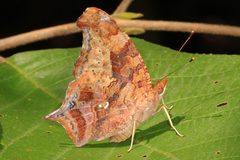
Polygonia interrogationis, commonly called the question mark , is a North American nymphalid butterfly recognized by the distinctive silver ?-shaped mark on the underside of its hindwing. have a wingspan of 4.5–7.6 cm and exhibit cryptic coloration resembling a dead leaf when wings are closed. The produces two annually, with adults active from May through September. Winter-form adults hibernate in sheltered locations and emerge in spring to reproduce.

Pronunciation
How to pronounce Polygonia interrogationis: //ˌpɒlɪˈɡoʊniə ˌɪntərəˌɡeɪʃiːˈoʊnɪs//
These audio files are automatically generated. While they are not always 100% accurate, they are a good starting point.
Identification
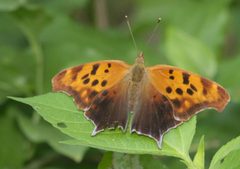
The silver ?-shaped mark on the underside of the hindwing is diagnostic and gives the its . Distinguished from the similar Eastern Comma (Polygonia comma) by the ? mark versus the comma-shaped mark of P. comma. The forewing of P. interrogationis also has a more pronounced hooked tip. From above, P. interrogationis has more extensive dark markings on the hindwing than P. comma. The Satyr Anglewing (Polygonia satyrus) has more rounded wing margins and different underside patterning.
Images
Habitat
Wooded areas, city parks, and suburban environments characterized by a combination of trees and open space. Riparian corridors and forest edges are frequently occupied. Hibernating seek shelter in tree hollows, under loose bark, or in human structures.
Distribution
Eastern North America from southern Canada (southern Ontario, Quebec, and the Maritimes) throughout the eastern United States, west to the eastern edge of the Rocky Mountains, and south to southern Arizona and Mexico. Absent from peninsular Florida. The is migratory with individuals occasionally dispersing beyond the core range.
Seasonality
fly from May through September. Two per year: spring emerges from adults and flies until late May; summer adults emerge May–September and produce developing into the winter form; winter-form adults appear in late August and enter hibernation until the following spring.
Diet
feed primarily on rotting fruit, tree sap, , and carrion. Nectar from flowers is used only when preferred resources are unavailable—a dietary particularly beneficial to spring and adults when nectar sources are scarce. Larvae feed on leaves of plants including American elm (Ulmus americana), red elm (Ulmus rubra), hackberry (Celtis spp.), Japanese hop (Humulus japonicus), stinging nettle (Urtica spp.), false nettle (Boehmeria cylindrica), and clearweed (Pilea pumila).
Host Associations
- Ulmus americana - larval American elm
- Ulmus rubra - larval red elm
- Celtis - larval hackberry
- Humulus japonicus - larval Japanese hop
- Urtica - larval stinging nettles
- Boehmeria cylindrica - larval false nettle
- Pilea pumila - larval clearweed
Life Cycle
Holometabolous with four stages: , larva (caterpillar), pupa (chrysalis), and . Females lay eggs singly or stacked beneath leaves of plants that are often not larval ; hatchlings must locate suitable food. Larvae pass through multiple instars, with wing pattern development beginning in the final instar. occurs without a cocoon. The produces two annually with winter-form adults entering reproductive and hibernating.
Behavior
are strong, agile fliers that frequently perch with wings closed, relying on to avoid detection. When disturbed, they may flash their bright orange upper wings to startle before settling back into camouflage. Adults of both sexes engage in puddling on moist soil and . Males patrol territories and seek females perching on trees or in grass; courtship precedes mating. Hibernating adults may be active on warm winter days but do not feed.
Ecological Role
contribute to nutrient cycling by consuming rotting organic matter and serve as prey for birds, spiders, and predatory insects. Larvae function as herbivores on woody and herbaceous plants, with their spiny defenses reducing pressure and potentially influencing . The serves as for including tachinid flies and .
Human Relevance
A familiar in parks and suburban areas, appreciated for its distinctive appearance and seasonal predictability. occasionally enter buildings seeking hibernation sites. Not considered an agricultural pest. Sometimes mistaken for the similar Eastern Comma. Featured in citizen science projects and butterfly monitoring programs.
Similar Taxa
- Polygonia commaShares dead-leaf and orange-brown coloration; distinguished by comma-shaped (not ?-shaped) silver mark on hindwing underside and less hooked forewing tip.
- Polygonia satyrusSimilar wing shape but with more rounded margins and different underside pattern lacking the diagnostic ? mark; more western in distribution.
- Polygonia progneGray comma with more uniformly gray underside and less contrasting markings; ? mark reduced or absent.
More Details
Etymology
The specific epithet interrogationis and "question mark" derive directly from the silver ?-shaped marking on the hindwing underside, described as "a curved line and a dot" that together form the punctuation mark.
Seasonal Polymorphism
The exhibits pronounced seasonal dimorphism in wing coloration. Summer-form have dark hindwings above with limited orange, while winter-form adults display more extensive orange. This correlates with : winter forms must survive hibernation and benefit from different thermal properties.
Sources and further reading
- BugGuide
- Wikipedia
- GBIF taxonomy match
- iNaturalist taxon
- Catalogue of Life
- 'Battus philenor! Battus philenor!' | Bug Squad
- Bug Eric: City Nature Challenge 2023 Recap
- Nettles and poop on the menu for the Eastern Comma butterfly, Polygonia comma — Bug of the Week
- Christmas in January | Beetles In The Bush
- Archive — Bug of the Week
- Bibliography | Beetles In The Bush
- Question Mark Polygonia interrogationis (Fabricius) (Insecta: Lepidoptera: Nymphalidae: Nymphalinae)