
Polygonia progne
(Cramer, 1775)
Gray Comma, Grey Comma
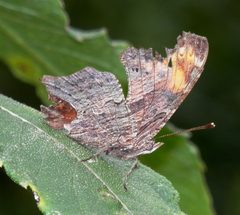
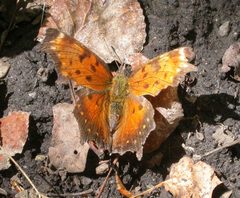
Polygonia progne, the gray comma, is a North American in the Nymphalidae. display seasonal dimorphism: summer forms have bright orange-brown upper wings with dark hindwing borders, while both forms show few yellow marginal spots. The species is notable for its L-shaped silver markings on charcoal gray undersides and its deeply notched wing margins that create an angular silhouette. It produces two annually, with the second generation's hatching in October to overwinter as larvae.
Pronunciation
How to pronounce Polygonia progne: /pɔlɪˈɡoʊniə ˈproʊɡni/
These audio files are automatically generated. While they are not always 100% accurate, they are a good starting point.
Identification
Distinguished from similar Polygonia by the L-shaped (not comma-shaped) silver marking on the underside of the hindwing. The gray comma lacks the continuous dark marginal band on the upper hindwing seen in the eastern comma (Polygonia comma). The satyr anglewing (Polygonia satyrus) has more prominent eyespots on the underside. The gray comma's summer form dark hindwing border is less extensive than in some .
Images
Appearance
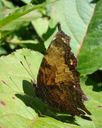
Wingspan 4.4–6.3 cm. Upper wing surface bright orange-brown in summer forms, often with dark border on hindwing; both seasonal forms have few yellow spots on wing margins. Underside charcoal gray with distinctive L-shaped silver markings. Wings deeply notched at margins, creating angular 'anglewing' profile unlike typical rounded wings.
Habitat
Found in hilly terrain and canyon lands, often along dirt roads and stream beds. Associated with deciduous forest understory where larval plants occur.
Distribution
North America: Canada (Alberta, Manitoba, Saskatchewan, Ontario, Quebec, New Brunswick), United States (northeastern and north-central states, Rocky Mountain region, Pacific Northwest). Records from Vermont confirmed.
Seasonality
Two periods annually: April–May (spring ) and June–August (summer generation). of the first flight mate and oviposit; resulting larvae form the summer generation. Summer generation hatch in October, with larvae entering hibernation.
Diet
Larvae feed on gooseberry (Ribes spp.) and azalea (Rhododendron spp.). consume plant sap and rarely flower nectar.
Host Associations
- Gooseberry - larval food plantRibes spp.
- Azalea - larval food plantRhododendron spp.
Life Cycle
(two per year). laid by spring-generation hatch and develop into summer-generation adults. Summer-generation eggs laid in late summer hatch in October; larvae hibernate through winter. Larvae possess stout defensive spines.
Behavior
of the Polygonia have been observed feeding on and rotting fruit to obtain nitrogen. The angular wing margins and dead-leaf-mimicking underside pattern provide when wings are closed over the body at rest.
Ecological Role
Larvae function as herbivores on woody shrubs. may contribute to nutrient cycling through sap-feeding and consumption of decaying organic matter. Serves as prey for various and vertebrate .
Human Relevance
Subject of citizen science observations and monitoring programs. Not considered an agricultural or garden pest.
Similar Taxa
- Polygonia commaHas comma-shaped (not L-shaped) silver marking on underside; continuous dark marginal band on upper hindwing
- Polygonia satyrusMore prominent eyespots on underside; different wing pattern and distribution
- Polygonia interrogationisQuestion mark-shaped silver marking on underside; larger size and different range
More Details
Seasonal Dimorphism
Summer form have reduced dark markings on upper wings compared to spring form; this phenotypic plasticity is environmentally cued.
Etymology
Specific epithet 'progne' refers to Procne, a figure in Greek mythology; the refers to the gray underside coloration and the L-shaped marking reminiscent of a comma punctuation mark.
Sources and further reading
- BugGuide
- Wikipedia
- GBIF taxonomy match
- iNaturalist taxon
- Catalogue of Life
- 'Battus philenor! Battus philenor!' | Bug Squad
- Do Moths Usually Land with Their Wings Down? | Bug Squad
- Nettles and poop on the menu for the Eastern Comma butterfly, Polygonia comma — Bug of the Week
- Polygonia-comma - Entomology Today
- Bug Eric: City Nature Challenge 2023 Recap
- Archive — Bug of the Week