
Polygonia faunus
(Edwards, 1862)
Green Comma, Faunus Anglewing
Polygonia faunus is a North American nymphalid commonly known as the green comma or Faunus anglewing. It inhabits forests, woodlands, and mountainous regions across western and eastern North America, from Alaska to California and eastward to New England. display distinctive ragged wing margins and cryptic coloration that aids in avoidance. The is , with one per year, and adults overwinter to emerge in spring.
Pronunciation
How to pronounce Polygonia faunus: //ˌpɒ.lɪˈɡoʊ.ni.ə ˈfɔː.nəs//
These audio files are automatically generated. While they are not always 100% accurate, they are a good starting point.
Identification
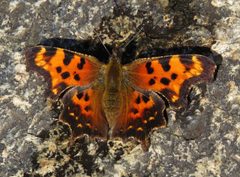
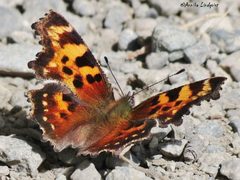
Distinguished from similar Polygonia by the irregular, ragged wing margins and the submarginal row of green spots on the underside of the hindwings. The hindwing bears a distinctive L- or C-shaped silver spot. Upperside is reddish brown with wide dark borders and a row of yellow spots on the hindwing margin. Underside is gray-brown with lighter outer half; males show greenish lichen-simulating submarginal spots while females have more uniform dull gray undersides. Wingspan ranges 45–64 mm. Most similar to eastern comma (P. comma) but differs in wing margin irregularity and green spotting pattern.
Images
Habitat
Occurs primarily in forests, mountain woodlands, near streams, and in canyons. Found in , damp mountain meadows, and stream sides. Associated with mature deciduous and mixed forests where plants grow.
Distribution
North America, ranging from central Alaska south to central California and northern New Mexico. Present across the Great Lakes region to New England, the Maritimes, and the southern Appalachians. Genetic studies identify three main clusters: California, Arizona, and New Mexico+Colorado, with additional eastern showing little genetic structuring due to .
Seasonality
fly from May to September depending on location. with one per year. Adults overwinter and re-emerge in spring.
Diet
Larvae feed on plants from Betulaceae, Ericaceae, Grossulariaceae, and Salicaceae. Specific associations include Salix (willows), Betula (birch), Ribes (currants/gooseberries), and Rhododendron. Can utilize Urticaceae (nettles) in laboratory conditions. feed on rotting fruit, tree sap, and vertebrate scat.
Life Cycle
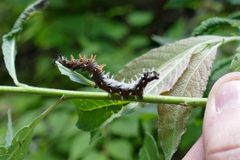
Solitary larvae feed on plant leaves. occurs on or near host plants. emerge, fly during summer months, then enter to overwinter. One per year ().
Behavior
overwinter in sheltered locations and re-emerge in spring. Males and females engage in territorial around food sources such as . Adults are known to puddle at moist soil and visit rotting fruit, sap flows, and animal for nutrients.
Ecological Role
Larval herbivore on woody shrubs and trees; and nutrient cycler through feeding on decaying organic matter. Serves as prey for various including birds, spiders, and predatory insects.
Human Relevance
Subject of ecological and genetic research. Occasional subject of watching and photography. No significant agricultural or economic impact.
Similar Taxa
- Polygonia comma (Eastern Comma)Similar size and coloration, but P. comma has more regular wing margins and lacks the green submarginal spots on the underside; hindwing silver spot is comma-shaped rather than L- or C-shaped.
- Polygonia c-album (Comma Butterfly)European not naturally occurring in North America; distinguished by seasonal dimorphism and multiple per year, features absent in North American Polygonia species.
- Polygonia interrogationis (Question Mark)Larger with more rounded wing margins and different underside pattern featuring a silvery question mark-shaped spot rather than comma or L-shaped mark.
Sources and further reading
- BugGuide
- Wikipedia
- GBIF taxonomy match
- iNaturalist taxon
- Catalogue of Life
- 'Battus philenor! Battus philenor!' | Bug Squad
- Do Moths Usually Land with Their Wings Down? | Bug Squad
- Nettles and poop on the menu for the Eastern Comma butterfly, Polygonia comma — Bug of the Week
- Polygonia-comma - Entomology Today
- Bug Eric: City Nature Challenge 2023 Recap
- Archive — Bug of the Week
- Investigating Concordance among Genetic Data, Subspecies Circumscriptions and Hostplant Use in the Nymphalid Butterfly Polygonia faunus