
Carcharodini
Genus Guides
5- Arteurotia
- Hesperopsis
- Pellicia
- Pholisora(sootywing)
- Staphylus(Scallopwings)
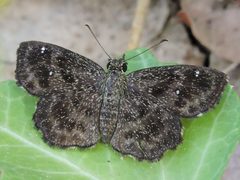
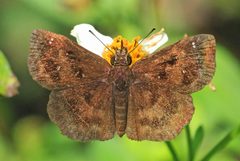
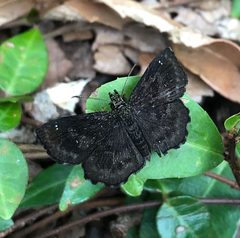
Carcharodini is a tribe of within the Pyrginae, comprising approximately 35 distributed throughout tropical regions worldwide. The group is considered plesiomorphic and morphologically inconspicuous compared to other Pyrginae tribes. Taxonomic boundaries have been revised based on phylogenetic studies to maintain monophyly, with Carcharodini now treated as distinct from the historically broader Pyrgini. Members occur in both New World and Afrotropical regions, with most genera restricted to the Americas.
Pronunciation
How to pronounce Carcharodini: /kɑːr.kəˈroʊ.dɪˌnaɪ/
These audio files are automatically generated. While they are not always 100% accurate, they are a good starting point.
Identification
Carcharodini are generally inconspicuous and lack the striking wing patterns seen in related tribes such as Achlyodidini. They can be distinguished from Pyrgini sensu stricto by plesiomorphic morphological features and phylogenetic placement. Within the tribe, such as Spialia exhibit characteristic chequered wing patterns. Detailed identification requires examination of genitalic structures; female genitalia have proven taxonomically informative in recent revisions.
Images
Habitat
occupy diverse tropical . Nisoniades macarius has been documented in anthropized open areas within the Caatinga biome, characterized by semi-arid climate and xerophilous vegetation. Afrotropical Spialia species occur in various Kenyan habitats. The tribe's broad tropical distribution encompasses multiple biomes.
Distribution
Distributed throughout tropical regions worldwide. Most are restricted to the New World, with Nisoniades ranging from South Texas to southern South America. Afrotropical representatives include Spialia and Gomalia in Kenya and surrounding regions. Specific documented localities include Colombia, Venezuela, Peru, Brazil, and Kenya.
Diet
Larvae feed on specific plant . Nisoniades macarius larvae consume Ipomoea asarifolia (Convolvulaceae). Multiple Spialia and Gomalia elma elma feed on species of Malvaceae. Host plant associations appear family-specific but vary by and geographic region.
Host Associations
- Ipomoea asarifolia (Desr.) Roem. & Schult. - larval plantConvolvulaceae; recorded for Nisoniades macarius
- Malvaceae - larval plant documented for Spialia kituina, S. spio, S. diomus, S. colotes transvaaliae, S. dromus, S. ploetzi, S. zebra bifida, and Gomalia elma elma
- Eulophidae - parasitize earlier larval instars of Nisoniades macarius
Life Cycle
Nisoniades macarius completes development from to in 31-35 days, passing through six larval instars. First instar lasts 3-8 days, second 3-5 days, third 2-5 days, fourth 2-6 days, fifth 3-6 days, and sixth 5-9 days. Eggs are dome-shaped, approximately 0.5 mm in height and width, white to greenish, darkening before hatching. capsule width is the most effective character for differentiating larval instars; first instar larvae are distinguished by evident primary setae on the head. Partial have been described for eight Spialia and Gomalia elma elma.
Behavior
Larval shelter-building varies by instar in Nisoniades macarius. First through third instar larvae construct center-cut shelters (type 3), while fourth through sixth instar larvae build two-cut shelters (type 5).
Ecological Role
Larvae serve as for , including Eulophidae. The tribe contributes to tropical diversity and participates in plant-insect interactions as herbivores.
Similar Taxa
- Pyrgini sensu strictoHistorically included Carcharodini; now separated based on phylogenetic studies to achieve monophyly. Carcharodini retains more plesiomorphic characteristics.
- AchlyodidiniMost closely related tribe to Pyrgini sensu stricto; strikingly different in appearance from Carcharodini, which are morphologically inconspicuous by comparison.
- CelaenorrhiniConvergent with Carcharodini and Pyrgini; all three tribes contain chequered skippers with similar ecological patterns.
More Details
Taxonomic History
Formerly included within a broadly defined Pyrgini containing numerous . Reorganization of Pyrginae based on phylogenetic studies led to recognition of Carcharodini as a distinct tribe to maintain monophyletic groupings. The old circumscription of Pyrgini was largely correct phylogenetically, but modern treats Carcharodini separately.
Research Status
Natural history of Carcharodini members remains poorly explored. Complete descriptions of stages are available primarily for Old World ; Neotropical information has been restricted to partial morphological descriptions, plant records, and observations until recent studies.
Sources and further reading
- BugGuide
- Wikipedia
- iNaturalist taxon
- Immature stages of Nisoniades macarius (Hesperiidae: Pyrginae: Carcharodini): biology, morphology and behavior
- Observations on the biology of Afrotropical Hesperiidae (Lepidoptera) with particular reference to Kenya. Part 10. Pyrginae, Carcharodini
- Integrative taxonomic revision of Capilla Grishin, 2023, subgenus of Staphylus Godman & Salvin, 1896 (Lepidoptera, Hesperiidae, Pyrginae, Carcharodini), with descriptions of four new species
- Genomics-based taxonomic rearrangement of Achlyodini and Carcharodini (Lepidoptera: Hesperiidae: Pyrginae).