
Staphylus
Godman & Salvin, 1896
Scallopwings
Species Guides
3- Staphylus ceos(golden-headed scallopwing)
- Staphylus hayhurstii(Hayhurst's scallopwing)
- Staphylus mazans(Mazans Scallopwing)
Staphylus is a of ( Hesperiidae, Pyrginae, tribe Carcharodini) commonly known as scallopwings. The genus is found primarily in the Neotropical region, with distributed across South America, the Caribbean, Mexico, Central America, and the southern United States. The subgenus Capilla was revised in 2023, with four new species described and female genitalia illustrated for six species for the first time.
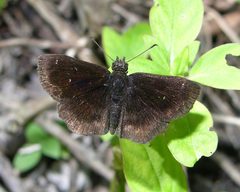
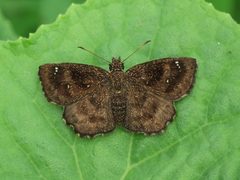
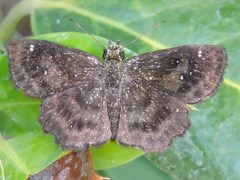
Pronunciation
How to pronounce Staphylus: //ˈstæfɪləs//
These audio files are automatically generated. While they are not always 100% accurate, they are a good starting point.
Identification
Members of this can be distinguished from similar skippers by scalloped wing margins, a trait reflected in their . The subgenus Capilla contains with distinctive morphological features now documented through redescriptions and identification keys. Female genitalia has been characterized for several species as a taxonomic diagnostic tool.
Images
Distribution
Primarily Neotropical. Range extends from South America through the Caribbean, Mexico, and Central America into the southern United States. Specific documented localities include Colombia, Venezuela, Peru, and Brazil. The Staphylus hayhurstii has been recorded in Colorado, USA, outside the core range.
Similar Taxa
- AmblyscirtesBoth are of grass-skippers in Hesperiidae, but Staphylus has scalloped wing margins while Amblyscirtes typically lack this feature.
- SystaseaSome Staphylus superficially resemble metalmarks; Systasea zampa (Arizona Powdered-Skipper) has been confused with metalmarks similar to how Staphylus ceos resembles them at first glance.
Sources and further reading
- BugGuide
- Wikipedia
- GBIF taxonomy match
- iNaturalist taxon
- NCBI Taxonomy
- Catalogue of Life
- Bug Eric: Spring (Butterfly) Beauties
- Bug Eric: Another Rarity: Nysa Roadside-Skipper in Colorado
- The complete life history of Staphylus
- Integrative taxonomic revision of Capilla Grishin, 2023, subgenus of Staphylus Godman & Salvin, 1896 (Lepidoptera, Hesperiidae, Pyrginae, Carcharodini), with descriptions of four new species