
Coranarta luteola
Grote & Robinson, 1865
Small Dark Yellow Underwing
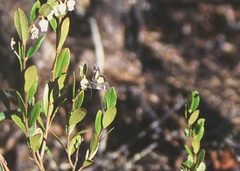
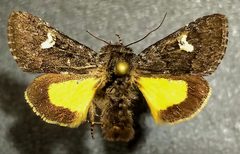
Coranarta luteola is a small noctuid native to North America. First described in 1865, it occurs from Alaska and Labrador south through the Rocky Mountains to Colorado, and eastward to Maine. The has a forewing length of 11–12 mm. Its larvae feed on laurels (Kalmia species), while visit flowers, particularly Andromeda polifolia. The species is listed as endangered in Connecticut.
Pronunciation
How to pronounce Coranarta luteola: /kəʊˈrænaːrtə luːˈtiːəʊlə/
These audio files are automatically generated. While they are not always 100% accurate, they are a good starting point.
Identification
A small noctuid with forewings measuring 11–12 mm in length. Distinguished from similar underwing moths (Catocala and related ) by its smaller size and distribution. The specific epithet 'luteola' refers to yellow coloration, likely of the hindwings typical of underwing moths.
Images
Habitat
forest zones, particularly in areas with laurel understory. Associated with riparian and wetland edges where Kalmia microphylla and Kalmia polifolia occur.
Distribution
North America from Alaska to Labrador. Range extends south to Minnesota and Wisconsin in the Midwest, Maine in the east, and Colorado in the Rocky Mountains. Present in Canadian provinces of Alberta, Manitoba, and Saskatchewan, and US states including Vermont.
Diet
Larvae feed on laurels, specifically Kalmia microphylla and Kalmia polifolia. feed on flowers, with documented preference for Andromeda polifolia.
Host Associations
- Kalmia microphylla - larval food plant
- Kalmia polifolia - larval food plant
- Andromeda polifolia - nectar sourceparticularly favored by
Ecological Role
Larval herbivore on ericaceous shrubs in . of wetland ericaceous plants.
Human Relevance
Listed as endangered in Connecticut, indicating conservation concern at the southern edge of its range. No significant economic impact; not considered a pest .
Similar Taxa
- Catocala spp.Similar 'underwing' with brightly colored hindwings concealed at rest; Coranarta is smaller and restricted to zones
- Other Coranarta species contains few ; C. luteola distinguished by distribution and association with Kalmia plants
Sources and further reading
- BugGuide
- Wikipedia
- GBIF taxonomy match
- iNaturalist taxon
- NCBI Taxonomy
- Catalogue of Life
- These Beetles Don't Want to Hold Your Hand | Bug Squad
- Publications | Entomology Research Museum
- Beautiful beetles and gnarly elm leaves: Larger elm leaf beetle, Monocesta coryli, and elm leaf beetle, Xanthogaleruca luteola — Bug of the Week
- Archive — Bug of the Week