
Papaipema sulphurata
Bird, 1926
Water-willow Stem Borer, Decodon Stem Borer, Swamp Loosestrife Borer Moth
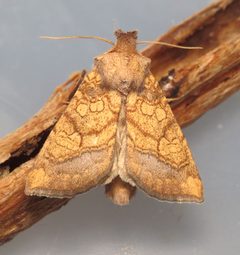
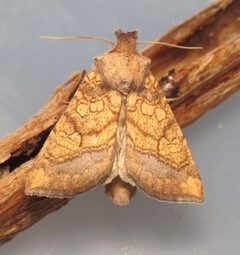
Papaipema sulphurata is a noctuid to southeastern Massachusetts, including Martha's Vineyard and Nantucket. The is an obligate on Decodon verticillatus (water-willow or swamp loosestrife), with larvae that tunnel into stems and feed on vascular tissue. fly in autumn, with a wingspan of 32–38 mm. The species is considered rare due to its restricted range and specific plant requirements.
Pronunciation
How to pronounce Papaipema sulphurata: /ˌpæpaɪˈpiːmə ˌsʌlfjuˈreɪtə/
These audio files are automatically generated. While they are not always 100% accurate, they are a good starting point.
Identification
Distinguished from other Papaipema by combination of: (1) restricted range in southeastern Massachusetts; (2) association with Decodon verticillatus; (3) forewing pattern of pale ochre spots outlined in brown on buff background with dark basal and peripheral bands. Similar species Papaipema cataphracta (water-willow stem borer) is a nomenclatural confusion—P. sulphurata is the valid name for this Massachusetts .
Images
Habitat
Wetland where Decodon verticillatus (water-willow) grows: swampland, ditches, and shallow water at edges of ponds, lakes, and streams. plant typically forms tangled clumps in standing or slow-moving water.
Distribution
to southeastern Massachusetts, USA. Confirmed from Martha's Vineyard and Nantucket Islands. Not found elsewhere despite plant's broader range (Maine to Florida, west to Minnesota, Tennessee, Louisiana).
Seasonality
active September and October. laid on stems during this period. Larvae develop through winter and spring, pupating August–September.
Diet
Larval stage feeds on vascular tissue of Decodon verticillatus stems. do not feed (typical for noctuid , though not explicitly documented for this ).
Host Associations
- Decodon verticillatus - obligate larval Larvae tunnel into stems, feed on vascular tissue, create galleries. water-willow, swamp loosestrife.
Life Cycle
laid on water-willow stems in September–October. Eggs overwinter, hatch in spring. Larvae tunnel into stems, moult several times, feed on vascular tissue, create internal galleries. occurs in August–September within stem. emerge within a month, completing cycle.
Behavior
Larvae are stem borers, creating internal galleries in plant stems. are fliers. No other documented.
Ecological Role
herbivore acting as a regulator on Decodon verticillatus. Stem-boring habit may influence plant architecture and resource allocation. Potential prey for wetland-associated , though specific interactions undocumented.
Human Relevance
Subject of conservation concern due to narrow and specificity. Potential for wetland health in southeastern Massachusetts. No economic or agricultural significance.
Similar Taxa
- Papaipema cataphractaFormerly confused nomenclaturally; Wikipedia incorrectly applied this name to P. sulphurata. P. cataphracta is a distinct (burdock borer) with different plants (Arctium spp.) and broader distribution.
- Other Papaipema speciesMany Papaipema are stem borers on specific plants; identification requires host association and geographic range. P. sulphurata distinguished by Massachusetts and Decodon specialization.
Misconceptions
Wikipedia historically confused P. sulphurata with P. cataphracta; the water-willow stem borer is correctly P. sulphurata, while P. cataphracta feeds on burdock (Arctium). The 'water-willow stem borer' has been applied to both in error.
More Details
Conservation status
Not formally listed but considered rare due to extremely restricted range and dependence on specific wetland . Vulnerable to habitat loss and hydrological changes in southeastern Massachusetts.
Nomenclatural history
Described by Bird in 1926. Long overlooked due to confusion with P. cataphracta. Recognition as distinct highlights importance of -specificity in noctuid .