
Papaipema nebris
Guenée, 1852
stalk borer
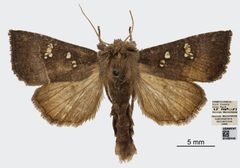
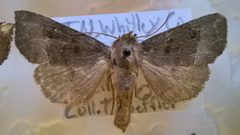
Papaipema nebris, commonly known as the stalk borer, is a noctuid whose larvae tunnel into the stems of herbaceous plants. The is distributed across eastern North America, from southern Canada to the Gulf of Mexico, with the notable exception of Florida. are and active during summer months. The species is of agricultural concern due to larval damage to corn and other crops.
Pronunciation
How to pronounce Papaipema nebris: /pɑˌpaɪˈpɛmə ˈnɛbrɪs/
These audio files are automatically generated. While they are not always 100% accurate, they are a good starting point.
Identification
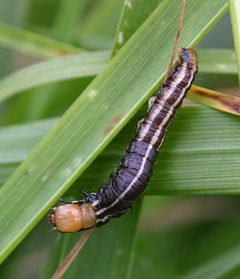
resemble other small brown noctuids but can be distinguished by the combination of pale hindwings and the overall muted, speckled forewing pattern without strong contrasting markings. Larvae are identified by the dark stripe against a pale body and their location inside plant stems. Dissection of genitalia may be required for definitive identification from similar Papaipema .
Images
Habitat
Agricultural fields, meadows, roadsides, and disturbed grassy areas where herbaceous plants grow. Larvae require living plant stems for development.
Distribution
Eastern North America from southern Canada (Manitoba, Ontario, Quebec) through the eastern United States to the Gulf of Mexico. Absent from Florida and most of the western United States beyond the Rocky Mountains.
Seasonality
fly from June to September, with peak activity in July and August. Larvae are present in plant stems from spring through early summer, as .
Diet
Larvae are stem borers of herbaceous plants, feeding internally on pith tissue. Documented include corn (Zea mays), giant ragweed (Ambrosia trifida), cocklebur (Xanthium), and various other asteraceous and grass-like plants. do not feed.
Host Associations
- Zea mays - larval major agricultural pest
- Ambrosia trifida - larval native , common in disturbed
- Xanthium - larval native
Life Cycle
are laid on plant stems or nearby debris in late summer and fall, until spring. Larvae hatch and tunnel into stems, feeding for 4–6 weeks before pupating within the stem or in soil. There is one per year.
Behavior
Larvae bore into plant stems near the soil line, creating entry holes with visible . They move between plants if quality declines. are attracted to light and have been documented at UV light traps.
Ecological Role
As a native stem borer, larvae contribute to nutrient cycling by weakening or killing herbaceous vegetation. In agricultural settings, they function as a pest affecting crop yield.
Human Relevance
Recognized as a sporadic pest of corn, causing dead in young plants and stalk breakage in older plants. Management in agriculture involves destroying to eliminate and targeted application.
Similar Taxa
- Papaipema nitelaSimilar size and coloration; distinguished by more contrasting forewing pattern and different larval preferences (solidago stems)
- Papaipema pterisiiOverlapping range and appearance; distinguished by association with ferns as larval
- Busseola fuscaAfrican maize stalk borer with similar larval habits; distinguished by geographic separation and darker coloration
Misconceptions
Despite the 'stalk borer,' this is not closely related to the European corn borer (Ostrinia nubilalis), which belongs to Crambidae and has different and .
More Details
Agricultural Impact
Economic damage is most severe in no-till corn systems where provides . Larval feeding destroys the growing point in young corn, causing 'dead '—a condition where the central leaves wilt and die while outer leaves remain green temporarily.
Taxonomic History
Originally described as Gortyna nebris by Guenée in 1852, later transferred to Papaipema based on larval and genitalic characters.