
Apamea zeta
(Treitschke, 1825)
Northern Arches, Zeta Moth
Apamea zeta is a medium-sized noctuid with a Holarctic distribution spanning Europe and northern North America. are active from July to August in Britain and display variable gray-green forewings with distinctive black markings. The exhibits notable morphological variation across its range, with several described forms and . Larvae are cutworms that feed on grasses, including fescues in alpine tundra .
Pronunciation
How to pronounce Apamea zeta: /əˈpeɪ.mi.ə ˈzɛ.tə/
These audio files are automatically generated. While they are not always 100% accurate, they are a good starting point.
Identification
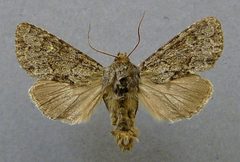
Distinguished from similar Apamea by the combination of dull gray-green forewing ground color with hoary gray overlay, the sinuate outer line that is not indented below the middle, and the well-marked blackish shade separating the two upper stigmata. The mealy overall appearance and specific arrangement of black wedge-shaped marks preceding the submarginal line are diagnostic. Dark form ab. pernix shows plainest markings; pale Italian form ab. curoi resembles very pale A. platinea but differs in fine blackish gray lines and reduced stigmata. Formerly treated as with A. zetina (now Haderonia zetina), which is smaller with greenish gray forewings and distinct markings.
Images
Appearance
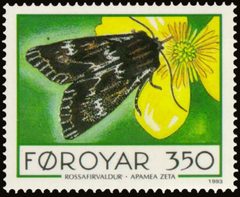
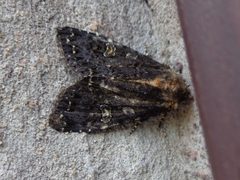
Wingspan 43–50 mm. Forewings dull gray-green overlaid with hoary gray , giving a mealy appearance. Inner and outer lines black, conversely edged with hoary gray and lunulate-dentate; outer line sinuate, not indented below middle. Stigmata gray edged with black, with two upper stigmata separated by a well-marked blackish shade. Submarginal line pale, often broken, indented on folds, preceded by black wedge-shaped marks. Hindwings fuscous, paler toward base. Several forms described: ab. pernix (darkest with plainest markings), ab. curoi (chalk gray, , from Italy), and others with reduced or intensified pattern elements.
Habitat
Grasslands, meadows, and alpine tundra. In North America, larvae occur on fescues in alpine tundra . occupy open grassy environments across the Holarctic range.
Distribution
Holarctic: throughout Europe and the northern half of North America. include A. z. assimilis (Northern Arches), A. z. cyanochlora (Bulgaria), A. z. downesi (North America), A. z. hellernica (Greece), A. z. marmorata (The Exile), A. z. murrayi (North America), A. z. nichollae (North America), A. z. pelagica (North America), A. z. sanderkovacsi (Romania), and nominate A. z. zeta (most of Europe).
Seasonality
on wing from July to August in Britain. Single-brooded; timing varies across latitudinal range.
Diet
Larvae are cutworms feeding on various grasses (Poaceae). In North America, specifically observed on fescues (Festuca spp.) in alpine tundra. feeding habits not documented.
Host Associations
- Festuca spp. - larval food plantfescues in alpine tundra, North America
- Poaceae - larval food plant various grasses
Life Cycle
Complete : , larva (), pupa, . Larval stage as soil-dwelling cutworms. presumably in soil. Adults emerge mid-summer. Single per year in Britain; details otherwise poorly documented.
Behavior
, attracted to light. Larvae subterranean, feeding at or below soil surface on grass roots and stems—typical . No other specific behaviors documented.
Ecological Role
Larval herbivore in grassland . As a , contributes to nutrient cycling through soil disturbance and plant material processing. Specific ecological interactions not well studied.
Human Relevance
Minor agricultural significance as a ; may damage grass crops or pasture. Not considered a major pest. Subject of taxonomic interest due to morphological variability and complex classification.
Similar Taxa
- Haderonia zetinaFormerly treated as ab. zetina; now recognized as distinct . Smaller size, greenish gray forewings with distinct markings, from Tian Shan Mountains.
- Apamea platineaPale form ab. curoi resembles very pale A. platinea but differs in fine blackish gray lines, reduced stigmata, and uniformly pale // without gray dusting.
- Apamea alticolaFormerly treated as A. z. alticola; now valid . Distinct with separate species status.
More Details
Taxonomic history
The shows complex taxonomic history with numerous described forms and former now elevated to species rank (A. alticola, Haderonia zetina). The original description by Treitschke in 1825 as Polia zeta reflects historical placement in a different . Modern treatments recognize A. zeta as a variable species with clinal variation across its Holarctic range, leading to recognition of multiple subspecies.
Morphological variation
Extreme variation documented including: ab. pernix (darkest), ab. curoi (pale Italian form), ab. marginata (uniform gray with conspicuous pale subterminal line), ab. transversata (strong blackish band), and rivalis (yellow-scaled variant from near Sea of Marmora). This variability has historically complicated identification and led to over-description of forms.
Sources and further reading
- BugGuide
- Wikipedia
- GBIF taxonomy match
- iNaturalist taxon
- NCBI Taxonomy
- Catalogue of Life
- Insects that feed on developing grain in the head - AgriLife Extension Entomology
- Insects and mites that feed on leaves - AgriLife Extension Entomology
- A Great Day for Vacaville Kids to Learn About Bees | Bug Squad
- An Eyewitness to the Fall of Saigon and a Glance at Mosquitoes and Malaria | Bug Squad
- Forage Sorghum Insects - AgriLife Extension Entomology
- Hay and Pasture Insects - AgriLife Extension Entomology