
Orgyia definita
Packard, 1865
Definite Tussock Moth, Definite-marked Tussock Moth
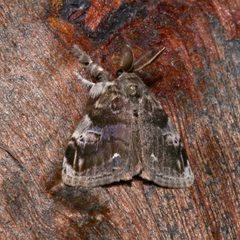
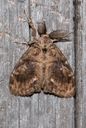
Orgyia definita is a tussock in the Erebidae, native to eastern North America. Males have functional wings with a wingspan of approximately 30 mm, while females are wingless—a distinctive trait shared with other Orgyia . The larvae feed on a broad range of woody deciduous plants. The species was first described by Alpheus Spring Packard in 1865.
Pronunciation
How to pronounce Orgyia definita: /ˈɔr.dʒi.a dɛˈfɪn.ɪ.ta/
These audio files are automatically generated. While they are not always 100% accurate, they are a good starting point.
Identification
Females are readily identified by their wingless condition, a trait shared with such as Orgyia antiqua and O. pseudotsugata. Males may be distinguished from similar Orgyia by genitalia or geographic range, though specific diagnostic features for O. definita males are not detailed in available sources. Larval identification to species level within Orgyia requires examination of morphological details not provided here.
Images
Habitat
Associated with deciduous forests and woodlands containing tree . Specific microhabitat preferences for are not documented.
Distribution
Eastern North America: from Minnesota east to New Brunswick, and south to South Carolina, Mississippi, and Louisiana. Records include Vermont.
Diet
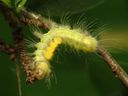
Larvae feed on leaves of Salix (willow), Quercus (oak), Tilia (basswood), Ulmus (elm), Betula (birch), Acer rubrum (red maple), and Hamamelis virginiana (American witch-hazel). feeding habits are not documented.
Host Associations
- Salix - larval food plantwillow
- Quercus - larval food plantoak
- Tilia - larval food plantbasswood
- Ulmus - larval food plantelm
- Betula - larval food plantbirch
- Acer rubrum - larval food plantred maple
- Hamamelis virginiana - larval food plantAmerican witch-hazel
Life Cycle
Complete with , larva, pupa, and stages. Females lay eggs on or near their cocoon after calling males using . Detailed and number of per year are not documented.
Behavior
Females are sedentary and remain near their cocoon, emitting to attract flying males. This has been observed in and is characteristic of the .
Ecological Role
Larval herbivore on deciduous trees and shrubs. May serve as for , as documented for congeneric (e.g., Orgyia pseudotsugata parasitized by Pimpla sanguinipes).
Human Relevance
Not documented as a significant pest . The broad range of larvae suggests potential for localized defoliation, but no economic or ecological impacts are reported in available sources.
Similar Taxa
- Orgyia antiquaAlso has wingless females and winged males; overlaps in general . Distinguished by geographic range (palearctic distribution for O. antiqua versus eastern Nearctic for O. definita) and larval coloration patterns.
- Orgyia pseudotsugataDouglas-fir tussock , also with wingless females. Distinguished by primary association with conifers (Pseudotsuga, Abies) versus broadleaf deciduous hosts for O. definita, and western Nearctic distribution.
- Orgyia vetustaWestern tussock moth, also with wingless females. Distinguished by western Nearctic distribution and different larval preferences.
More Details
Taxonomic Note
The was described by Packard in 1865 (some sources cite 1864). It is classified in Lymantriinae, tribe Orgyiini. The wingless female condition is an of the Orgyia within Lymantriinae.
Observation Data
As of source date, iNaturalist records 8,874 observations, indicating the is relatively well-documented by citizen scientists within its range.