
Gynaephora
Hübner, 1819
Arctic woolly bear moths, grassland caterpillars (Qinghai-Tibetan Plateau species)
Species Guides
1- Gynaephora rossii(Ross' tussock moth)
A of tussock moths (Lymantriinae: Erebidae) distributed across the Holarctic in alpine, Arctic, and Subarctic regions. Best known for exceptionally slow larval development, with some requiring multiple years to complete their . Females are flightless or nearly so, while males are strong fliers that actively search for mates. The genus includes both Arctic species (e.g., G. groenlandica, G. rossii) and high-altitude Asian species (e.g., G. alpherakii, G. menyuanensis) that are significant pests of alpine meadows on the Qinghai-Tibetan Plateau.
Pronunciation
How to pronounce Gynaephora: //ˌdʒɪneɪˈfɔːrə//
These audio files are automatically generated. While they are not always 100% accurate, they are a good starting point.
Identification
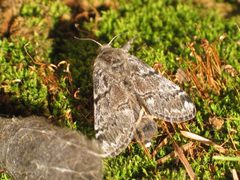
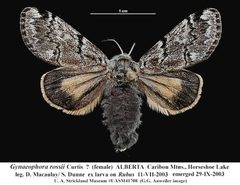
Males possess a thin . Females lack wings and are flightless across all in which they have been observed. Caterpillars are large and densely covered with setae (hairy). Larvae of G. menyuanensis have two distinct color funnel warts (yellow and red) on abdominal segments VI and VII. Male are bipectinate with nine types and 14 subtypes of antennal ; female antennae are club-like with reduced sensilla diversity (three types, three subtypes in G. menyuanensis).
Images
Habitat
Arctic tundra, alpine meadows, and Subarctic regions. High Arctic occur on tundra at locations such as Ellesmere Island (79°N). Asian inhabit alpine meadows on the Qinghai-Tibetan Plateau at elevations of 3,000–3,500 m, particularly in Kobresia meadows with abundant sunshine, loose soil, and scarce precipitation.
Distribution
Holarctic distribution including: Canadian Arctic archipelago (Ellesmere Island, Alexandra Fiord), Greenland, northern Yakutia, Scandinavia (Denmark, Norway, Sweden), and the Qinghai-Tibetan Plateau (Qinghai Province, Tibet). Two North American Arctic (G. groenlandica and G. rossii) have broadly overlapping ranges. Alpine occur in southwestern Yukon, Canada.
Seasonality
Activity constrained by extreme environments. In the High Arctic, the brief summer growing and feeding season lasts approximately one month. Larvae of G. menyuanensis complete one per year with a total of approximately 300 days.
Diet
Larvae feed on vascular plants. G. groenlandica larvae feed primarily on arctic willow (Salix arctica), arctic heather (Cassiope tetragona), and Dryas integrifolia. Alpine of G. groenlandica beringiana exhibit broader diet breadth than High Arctic populations. Asian (G. alpherakii, G. menyuanensis) feed on forage grasses in alpine meadows.
Host Associations
- Salix arctica - primary plantarctic willow
- Cassiope tetragona - plantarctic heather; preferred site for construction
- Dryas integrifolia - plant tundra plant cover
- Kobresia - associationalpine meadow vegetation preferred by Asian
Life Cycle
Extended with unusually slow development. G. groenlandica: seven larval instars, each lasting approximately one year, for a total life cycle of approximately 7 years (previously believed to be 14 years). G. menyuanensis: seven larval instars, one per year, approximately 300-day life cycle. First-instar larvae overwinter. and occur after the final larval instar.
Behavior
Larvae exhibit behavioral through basking, orienting toward the sun to elevate body temperatures up to 30°C (approximately 20°C above ambient). Basking occupies approximately 60% of larval time, with feeding occurring primarily near midday. Larvae spin silk before winter, often concealed between plant stems; communal hibernacula are common at low densities. Males are strong fliers that actively search for flightless females, apparently using for mate location. Cross-attraction between sympatric has been observed.
Ecological Role
Herbivores in extreme environments with extended cycles. Larvae serve as for tachinid (Exorista thula, Chetogena gelida). Significant pest in Asian alpine meadows, causing damage to forage grasses and impacting livestock production. Freeze-tolerant larvae contribute to stability in Arctic despite harsh conditions.
Human Relevance
Major agricultural and ecological pest on the Qinghai-Tibetan Plateau, causing severe losses in livestock production. Risk zoning studies identify high-risk areas for management. Subject of extensive research on cold , behavioral , and climate change impacts. Potential for targeted pest management through manipulation of olfactory cues (odor-binding proteins).
Similar Taxa
- LachanaFormerly included now classified as Lachana (e.g., L. alpherakii, L. selenophora); distinguished by phylogenetic and morphological data
- DicallomeraG. pumila moved to Dicallomera in 2008; formerly placed in subgenus Dasyorgyia
- DasychiraHistorical confusion; G. rossii and G. groenlandica were formerly classified in Dasychira before transfer to Byrdia and then Gynaephora
Sources and further reading
- BugGuide
- Wikipedia
- GBIF taxonomy match
- iNaturalist taxon
- NCBI Taxonomy
- Catalogue of Life
- To Be an Underwing Underfoot | Bug Squad
- Behavioural Thermoregulation in the Freeze-Tolerant Arctic Caterpillar, Gynaephora Groenlandica
- REPRODUCTIVE ISOLATION IN ARCTIC SPECIES OFGYNAEPHORAHÜBNER (LEPIDOPTERA: LYMANTRIIDAE)
- Risk zoning of Gynaephora alpherakii (Lepidoptera: Lymantriidae) on the Qinghai–Tibetan Plateau
- Prokaryotic Expression and Binding Characteristics of Odor-Binding Protein GqinOBP10 in Gynaephora qinghaiensis
- New data on the distribution of the Gynaephora (rossii) species group in Northern Yakutia
- Larvae of grassland caterpillar endemic to Qinghai–Tibet Plateau (Lepidoptera: Lymantriinae: Gynaephora): identification, distribution, and ultramorphology
- Mitochondrial phylogeography of grassland caterpillars (Lepidoptera: Lymantriinae: Gynaephora ) endemic to the Qinghai-Tibetan Plateau
- Instar determination, development, and sexual dimorphism for Gynaephora menyuanensis (Lepidoptera: Lymantriinae) and ultrastructure of adult antennae
- Diet breadth ofGynaephora groenlandica(Lepidoptera: Erebidae): is polyphagy greater in alpine versus Arctic populations?
- Host utilization by Exorista thula Wood (sp. nov.) and Chetogena gelida (Coquillett) (Diptera: Tachinidae), parasitoids of arctic Gynaephora species (Lepidoptera: Lymantriidae)
- Winter mortality and the function of larval hibernacula during the 14-year life cycle of an arctic moth,Gynaephora groenlandica
- Body Temperatures and Behavioral Thermoregulation of High Arcitc Woolly-Bear Caterpillars and Pupae (Gynaephora rossii, Lymantriidae:Lepidoptera) and the Importance of Sunshine
- Immature stages of high arctic Gynaephora species (Lymantriidae) and notes on their biology at Alexandra Fiord, Ellesmere Island, Canada
- Revision of the life history of the High Arctic moth Gynaephora groenlandica (Wocke) (Lepidoptera: Lymantriidae)
- Metabolic opportunists: feeding and temperature influence the rate and pattern of respiration in the high arcticwoollybear caterpillar Gynaephora groenlandica (Lymantriidae)
- Stability Evaluation of Reference Genes in Gynaephora qinghaiensis (Lepidoptera: Lymantriidae) for qRT-PCR Normalization.
- Identification and Functional Speculation of Genes Related to Sex Pheromone Synthesis Expressed in the Gonads of Female Gynaephora qinghaiensis (Lepidoptera: Lymantriidae).
- Comparative Analysis of Transcriptome Data of Wings from Different Developmental Stages of the Gynaephora qinghaiensis.